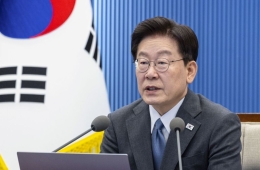
Kim Jongcheol, Police Chief: "Facing a Serious Test"... Unveils 12 Key Priorities
"Trust shattered by the mistakes of a few; uphold the fundamentals"
Unveils 12 key priorities, including tackling interpersonal crimes
Police must prove their capabilities through the "AI cheating probe" and more
Kim Jong-cheol was sworn in as the 25th Commissioner General of the Korean National Police Agency, ending a two-year leadership vacancy. He set out to change the way the agency works, starting with its day-to-day operations, to tackle a long list of challenges, including ensuring the new criminal justice system takes root at an early stage.
At his inauguration ceremony at Chamsuri Hall at the Korean National Police Agency on the morning of November 23, Commissioner General Kim said, "The police are facing a serious test," adding, "By carefully considering what serves the public interest, we will build 'a safer society when we work together' and 'a more confident police force built on trust.'" Kim's term began at midnight on November 21, following President Lee Jae-myung's approval of his appointment. Before the ceremony that day, he paid his respects first at the Seoul National Cemetery and then at the Police Memorial Park.
He also urged his colleagues to reflect on their conduct. "The trust we worked so hard to build has been shattered by the grave mistakes of a few," he said. "When the way ahead is unclear, the path we must take is clear: uphold the fundamentals and principles."
Immediately after the inauguration ceremony, Commissioner General Kim chaired a video conference with police nationwide and called for sweeping reforms to restore public trust. He outlined three principles and approaches for the police force to realize its new vision: fundamentals and principles, pride and responsibility, and empathy and consideration. He also ordered changes to the way police work and make decisions.
He also unveiled 12 key priorities, including ▲ mobilizing all available resources to prevent violent crimes arising from interpersonal relationships ▲ overhauling the response to random violent crimes and missing-person cases ▲ ensuring the new criminal justice system takes root at an early stage ▲ establishing the protection of victims and redress of their rights as core investigative principles ▲ cracking down on crimes that devastate people's livelihoods, including phishing and drug crimes. The agency plans to swiftly implement key policies, including proactively addressing everyday risks and establishing a fair and trusted investigative system.
A key challenge for Commissioner General Kim is demonstrating the police's investigative capabilities. The police are continuing their investigation into Lee Jin-woo, who received a perfect score on the Law School Admission Test (LEET) and later died after allegations of misconduct emerged. Investigations are generally closed with no prosecution possible when a suspect dies, but the police determined that uncovering the facts in this case would serve the public interest. As allegations continue to arise in various exams, they plan to establish whether misconduct occurred, how it was carried out, and whether there were accomplices.
Speaking to reporters before the inauguration ceremony, Commissioner General Kim said, "The fairness of the exam itself is important, but undermining the trust that is equally important to our society is a serious crime." He added, "We will respond firmly to cases referred to us through complaints, accusations, or requests for investigation. We also promise to ensure there is no misconduct in other national and qualification exams—and, if there is, to pursue it to the end, establish the facts, and take legal action."
Asked about expectations surrounding the appointment of a new head of the police force after two years under an acting leadership, he said, "Nothing will change in a fundamental way. I worked closely with the senior officers during the acting leadership period and have put forward various visions. I will ensure that the commitments we have made are implemented one by one in the field and deliver tangible results."
Hot Picks Today
 "Two Spend 500,000 Won in a Flash, Yet Wait Two Hours?" ... 'Dreamland' Shunned by Kids and Foreign Tourists
- The Era of Getting 200 Million Won After 30 Years Is Over... A Japanese Bank's "Perpetual Department Head" Who Just Clocked In Cries Out
- Spain Hit by Its Worst Tragedy... Lee Kangin, Moreno and Real Madrid Join Soccer World in Mourning
- They Said, “Make It Your Home for Life” - Then Suddenly Kicked 200 Passengers Off... What Happened to the Around-the-World Cruise?
- "130 Rice Bowls Sold Out in a Day"... 'Unfiltered Face' Adds 8 Million Won to Night Market Sales: China's Bungeunwoo
He also emphasized improving working conditions for frontline police officers. "We will address frontline officers' excessive workloads in a more structural way," he said, adding, "We will also make a special effort to improve their morale and working conditions."
© The Asia Business Daily. All rights reserved. Unauthorized AI training and use prohibited.