Fossil Fuel Reduction Agreement Falls Through... COP31 Ends in Deadlock for First Time in 17 Years [Reading Science]
Fossil Fuel Phaseout Language Dropped Amid Opposition from Oil-Producing Countries... EU, Island States and Others Reject Final Draft
Disagreement Over Climate Adaptation Finance... Scientists: "Exceeding 1.5 Degrees Could Cause Irreversible Change"
The 31st Conference of the Parties to the UN Framework Convention on Climate Change (COP31) failed to adopt a key agreement after the international community was unable to resolve its differences over reducing fossil fuel use and expanding climate finance. It ended without a comprehensive political agreement for the first time in 17 years, since COP15 was held in Copenhagen, Denmark, in 2009. Climate scientists warned that delays in reducing greenhouse gas emissions could cause irreversible climate change as the likelihood of global average temperatures rising more than 1.5 degrees above preindustrial levels grows.

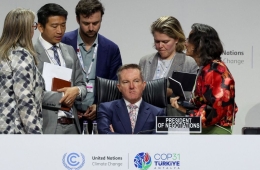
A plenary session of the 31st United Nations Climate Change Conference (COP31) in Antalya, Türkiye. COP31 President Murat Kurum is seen speaking on a large screen. The conference failed to adopt a key agreement amid disagreements over reducing fossil fuel use and expanding climate finance. Provided by the United Nations Framework Convention on Climate Change (UNFCCC).
View original imageAccording to foreign media outlets, including Reuters and the Associated Press, COP31 opened in Antalya, Türkiye, on November 9 and continued negotiations until November 22 local time, two days past its originally scheduled closing date of November 20. However, it failed to adopt the "Antalya Pact," its key agreement. The failure came after more than 190 countries participating in the negotiations could not bridge their differences over the transition away from fossil fuels and climate finance for developing countries.
Fossil Fuel Language Dropped... Oil-Producing Countries and EU Clash
The central issue at this year's conference was reducing fossil fuel use. At COP28, held in Dubai, the United Arab Emirates (UAE), in 2023, countries reached an agreement calling for a transition away from fossil fuels. But at COP31, major oil-producing countries, including Saudi Arabia and Russia, opposed language on fossil fuels, and the relevant wording was removed from the final draft agreement.
The European Union (EU), the United Kingdom, and some small island states and developing countries objected. Darragh O'Brien, Ireland's Minister for Climate, Energy and the Environment, speaking on behalf of the EU, said, "We will not support a comprehensive decision or the Antalya Pact that does not even mention fossil fuels, the main cause of climate change." Foreign media reported that about 40 countries opposed the final draft or indicated they would not accept it.
COP31 President and Turkish Minister of Environment, Urbanization and Climate Change Murat Kurum said at the closing plenary, "It is clear that there are parties in this room that oppose the agreement." He added, "We acknowledge that there is no consensus on this document. Therefore, these decisions have not been adopted."
Expanding climate finance was another major source of tension. A target to increase adaptation finance to $120 billion a year (approximately 180 trillion won) to help developing countries respond to climate disasters, including heat waves, floods, and droughts, was dropped during negotiations. Developed and developing countries remained divided over specific criteria for increasing funding and how to share the burden.
UN Secretary-General António Guterres said, "I am deeply disappointed that COP31 has ended without agreement on a comprehensive outcome." He added, "I share the profound frustration of everyone who expected governments to act in a way that matched the moment demanded by the climate crisis."

UN Secretary-General António Guterres (right) speaks at an event during the 31st United Nations Climate Change Conference (COP31) in Antalya, Türkiye. On the left is Simon Stiell, Executive Secretary of the United Nations Framework Convention on Climate Change (UNFCCC). Provided by the UNFCCC.
View original imageSome Progress on Electrification... 1.5-Degree Goal Further Out of Reach
Not all discussions ended without progress. Some headway was made in discussions on a "just transition" to support workers in carbon-intensive industries and their communities as they move to a low-carbon economy. More than 90 countries also expressed support for a separate target of increasing electricity's share of global final energy consumption to 35% by 2035. However, this was distinct from an agreement adopted by all parties. Key issues will be carried over to COP32, scheduled to take place in Ethiopia in 2027.
Jo Cheonho, former head of the National Institute of Meteorological Sciences, said, "The world has made some progress in responding to climate change, but we still have a long way to go to overcome the climate crisis."
Jo said, "Before the 2015 Paris Agreement, some projections suggested that global average temperatures could rise by more than 4 degrees above preindustrial levels. But if countries meet all the greenhouse gas reduction targets they have pledged, the increase could be limited to about 2.6 degrees." He added, "That represents progress, but there is still a significant gap from the 1.5-degree target of the Paris Agreement."
Kook Jongseong, a professor in Seoul National University's Department of Earth and Environmental Sciences, warned, "In the context of climate change, exceeding 1.5 degrees is not simply a matter of temperatures rising temporarily." He added, "The climate system has considerable inertia, and if temperatures exceed a certain level, changes in the cryosphere, ocean circulation, and ecosystems could persist for a long time or become difficult to reverse."
Kook stressed, "We should not take a temporary overshoot lightly based only on the hope that temperatures can be lowered again in the future." He added, "What matters in responding to climate change is not repeatedly reaffirming targets, but taking action sooner to minimize both the peak level of warming and how long it lasts."

Even Scientific Evidence Becomes a Subject of Negotiations... Debate Over Delayed IPCC Report
International climate scientists raised concerns that scientific findings could be excluded from negotiations based on competing national interests.
Tim Naish, chair of the World Climate Research Programme (WCRP) and a professor at Victoria University of Wellington in New Zealand, who attended COP31 in person, said, "What I did not expect was how strongly the scientific evidence would be resisted."
Naish said, "Saudi Arabia, India, and Russia opposed citing research that had not gone through the procedures of the Intergovernmental Panel on Climate Change (IPCC)." He added that they also took issue with the World Meteorological Organization's (WMO) State of the Global Climate report and research reports from the United Nations Environment Programme (UNEP).
In particular, he said, "The biggest point of contention at this conference was the publication schedule for the IPCC's Seventh Assessment Report." He added, "There were concerns that some countries were trying to delay the report's publication until 2029." A delay would make it difficult to incorporate the latest scientific assessments into the second Global Stocktake (GST), scheduled for 2028.
Naish lamented, "If a system designed to ensure action based on science cannot even agree to hear science's voice in a timely manner, we need to find a new approach."
Approaches to carbon capture and removal technologies also fueled controversy. Some countries emphasized developing technologies to remove carbon dioxide from the atmosphere, while others worried that reliance on technologies that have not yet been sufficiently proven could be exploited to justify continued fossil fuel use.
Karan Titus, a postdoctoral researcher at the University of Canterbury in New Zealand, warned, "Every additional increment of warming beyond the 1.5-degree target could have severe and potentially irreversible consequences for ecosystems and vulnerable populations."
Titus said, "Renewable energy and electrification continue to face opposition from oil-producing countries." He added, "This is happening despite the many examples already showing that renewable energy can provide affordable, abundant electricity and bring greater prosperity to communities."
He stressed, "Once the 1.5-degree target is exceeded, we will need not only to halt the increase in emissions by expanding renewable energy, but also to actively remove carbon dioxide from the atmosphere."

A participant speaks at the COP31 conference in Antalya, Türkiye. Countries remained divided over reducing fossil fuel use and providing climate finance to developing nations. Courtesy of UNFCCC.
View original imageGlaciers and Ice Sheets Also Sidelined... Concerns Over Sea-Level Rise in Korea
Critics also said that glaciers and ice sheets in the polar regions were not adequately addressed in the negotiations.
Lee Wonsang, a principal researcher at the Division of Glaciology and Geocryology at the Korea Polar Research Institute, said, "The cryosphere was effectively and completely overlooked in these negotiations." He added, "According to a tally by the international cryosphere research community, the word 'ocean' appeared 18 times in the second draft, while the cryosphere was mentioned only once."
Lee said, "The main causes of sea-level rise, glaciers and ice sheets, were left out of the discussion." He added, "At COP31, even the agreement on transitioning away from fossil fuels was rolled back."
He explained, "Every millimeter of sea-level rise matters to our country." According to analysis by researchers at the Korea Polar Research Institute, he said, sea levels off Incheon and Busan are projected to rise about 10% more than the global average by 2050 due to mass loss from the Greenland and Antarctic ice sheets.
He urged, "As a country directly affected by changes in polar ice sheets, we must remain alert." He added, "The scientific community must also clearly emphasize, based on facts established through observation and research, that now is the time to act."
Oh Jaeho, CEO of Nanoweather and an emeritus professor at Pukyong National University, emphasized the need for practical action at the local level that goes beyond the limits of international negotiations.
Oh explained, "Climate change is a global phenomenon, but its impacts are felt in specific places at the local level." He added, "Even within the same city, the risks of heat waves and flooding can vary significantly depending on topography, building density, land cover, drainage systems, and residents' vulnerability."
Hot Picks Today
 "Two Spend 500,000 Won in a Flash, Yet Wait Two Hours?" ... 'Dreamland' Shunned by Kids and Foreign Tourists
- The Era of Getting 200 Million Won After 30 Years Is Over... A Japanese Bank's "Perpetual Department Head" Who Just Clocked In Cries Out
- Spain Hit by Its Worst Tragedy... Lee Kangin, Moreno and Real Madrid Join Soccer World in Mourning
- They Said, “Make It Your Home for Life” - Then Suddenly Kicked 200 Passengers Off... What Happened to the Around-the-World Cruise?
- "130 Rice Bowls Sold Out in a Day"... 'Unfiltered Face' Adds 8 Million Won to Night Market Sales: China's Bungeunwoo
He said, "To overcome these limitations, we need highly detailed weather and climate information that can precisely identify local climate risks." He added, "The success of climate policy should be measured not by the scale of its declarations, but by how much risk it reduces in local communities."
© The Asia Business Daily. All rights reserved. Unauthorized AI training and use prohibited.