President Lee Effectively Ousts Choi Kyojin... Three Reasons [Why&Next]
Accepted about an hour after resignation offer...Dismissal approved in swift succession
Belated measures just before the CSAT despite warnings of AI-assisted cheating
Minister's remarks and policy confusion...Calls for his replacement grow w
Attention is focused on why President Lee Jae Myung accepted Education Minister Choi Kyojin's resignation about an hour after it was submitted. Although concerns were repeatedly raised about the possibility of cheating on exams through the misuse of artificial intelligence (AI), the education authorities failed to prepare adequately in advance. Analysts say the decisive factors also included the minister responsible for the issue making remarks during the crisis response and policy confusion.
In particular, President Lee has defined exam fairness as an issue directly tied to public trust in the government and has been calling for an increasingly forceful response day after day. This appears to have led to the judgment that Choi could no longer remain in office. It is reported that opinions that a ministerial replacement was inevitable had also been raised persistently within the Blue House.
Kang Yoo-jung, chief presidential spokesperson, said on November 22, "President Lee was briefed on Minister Choi's offer to resign and accepted it," adding, "He instructed Prime Minister Han Seongsook to take responsibility and make every effort in the response, including post-exam measures for the CSAT." President Lee also approved the dismissal motion for Choi. He accepted the resignation within an hour of its submission and completed the administrative procedures that same day.

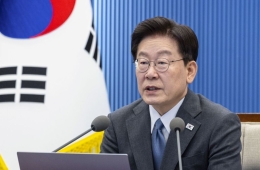
President Lee Jae Myung speaks about AI-assisted exam cheating, which has recently become a social issue, during a meeting with senior secretaries and aides at the Blue House on Nov. 20, 2026. Yonhap News
View original imageBelated Response to a Foreseeable Risk... Measures Announced Just Before the CSAT
The failure of the education authorities to prepare in advance lies behind the Education Minister's replacement as a form of accountability. Concerns about cheating using advanced devices such as AI and smart glasses had been raised even before the CSAT. The Ministry of Education had also drawn up measures to address smart glasses late last month, but the government only scrambled to respond after a cheating scandal on the certified tax accountant exam broke just four days before the CSAT. The Blue House held an emergency countermeasures meeting chaired by policy chief Ha Joon-kyung on November 15, and Prime Minister Han convened a meeting of relevant ministries on November 16. On November 17, President Lee, who was on an official visit to the Philippines, also chaired an emergency CSAT review meeting by video conference.
On November 17, two days before the CSAT, the Ministry of Education decided to deploy an additional approximately 1,800 staff members dedicated to smart devices and approximately 6,600 hallway proctors, for a total of approximately 8,400 people. The day before the exam, it revised its guidelines, including restricting the use of some writing instruments that test-takers had previously been allowed to bring themselves. The additional recruitment of proctors and urgent training also caused greater confusion at schools. In offering her resignation, Choi herself acknowledged, "During preparations for the CSAT, various changes were made just before the exam, causing inconvenience to the public, including test-takers."
Minister's Remarks and Policy Confusion... Accumulating Questions About Leadership
Doubts about Choi's ability to handle a crisis also appear to have played a role. At the National Assembly's Education Committee on November 16, Choi was asked whether she was confident that all AI-related cheating could be detected. She replied, "I don't think I can," adding, "Because of my age." Her intention was to explain the practical limitations of detecting every instance of cheating, but criticism arose that, just three days before the CSAT, the official responsible for exam administration had made remarks that called the effectiveness of the measures into question.
Policy confusion followed as well. Choi said the government would consider blocking signals at exam venues, but the Ministry of Education clarified that same day that it was not considering doing so for this CSAT because of legal and technical limitations. The minister's remarks and the working-level ministry's assessment diverged, undermining confidence in the government's response.
Controversies surrounding education administration had already been mounting before this incident. In September, a malfunction in the early admissions application system delayed submissions for some applicants, and controversy over fairness arose when the application deadline was extended. Since Choi took office, remarks on major education policies and questions about political neutrality had also continued.
Reports that opinions favoring Choi's replacement as inevitable had been persistently raised within the Blue House also appear to be connected to this situation. Analysts say the greater concern was not individual remarks or missteps, but the failure of the ministry responsible for the issue to fully demonstrate its ability to coordinate policy and manage a crisis involving a national exam that had drawn widespread public attention.

Education Minister Choi Kyojin listens to remarks and appears deep in thought during a ruling and opposition parties' consultation at the National Assembly on measures to prevent AI-assisted cheating on the 2027 College Scholastic Ability Test (CSAT), Nov. 18, 2026. Yonhap News
View original imageLee's Warning Escalates to "No Compromise"
The president's firm stance on exam fairness is also cited as a factor behind the decision. After the cheating controversy spread, President Lee raised the intensity of his remarks day after day and called for a strong government response. At an emergency CSAT review meeting on November 17, he described cheating as "a serious crime that undermines the foundations of fair competition and destroys the trust our society has built." On November 20, the day the CSAT ended, he instructed the government to "comprehensively reform the national examination system from A to Z, and do so swiftly." He also called for a response to cheating that the public could accept, insisting that offenders "must be punished severely, without exception."
On November 21, he stressed in a post on X (formerly Twitter) that "cheating on the CSAT is as serious a crime as corruption by public officials." He also personally corrected the government's announced tip reward of "up to 100 million won" to "at least 100 million won for each case of cheating." On November 22, he declared, "Fairness in exams is a principle that can never be compromised." He also ordered officials to consider establishing a legal basis for preventing test papers from being photographed and transmitted outside during exams, as well as ways to trace leaks using unique identifying marks on each test paper.
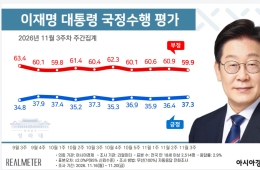
President Lee's hard-line stance on exam fairness is also closely linked to the younger generation's trust in the government. In a poll conducted by Gallup Korea from November 17 to 19 and released on November 20, President Lee's job approval rating was 40%, but stood at just 21% among people aged 18 to 29 and 23% among those in their 30s.
Analysts inside and outside the Blue House say that, because distrust in exam fairness could spread into distrust in the government, the government's ability to respond may serve as a measure of public confidence in its administration. In particular, it is said that the Blue House views exam fairness as one of the issues on which the administration's fate depends. Following this personnel change, Vice Minister Choi Eun-ok will serve as acting education minister. Chief Spokesperson Kang said, "The appointment of a new education minister will proceed according to procedure."
Hot Picks Today
 "Two Spend 500,000 Won in a Flash, Yet Wait Two Hours?" ... 'Dreamland' Shunned by Kids and Foreign Tourists
- The Era of Getting 200 Million Won After 30 Years Is Over... A Japanese Bank's "Perpetual Department Head" Who Just Clocked In Cries Out
- Spain Hit by Its Worst Tragedy... Lee Kangin, Moreno and Real Madrid Join Soccer World in Mourning
- They Said, “Make It Your Home for Life” - Then Suddenly Kicked 200 Passengers Off... What Happened to the Around-the-World Cruise?
- "130 Rice Bowls Sold Out in a Day"... 'Unfiltered Face' Adds 8 Million Won to Night Market Sales: China's Bungeunwoo

© The Asia Business Daily. All rights reserved. Unauthorized AI training and use prohibited.