President Lee's Approval Rating Rises 0.9 Points to 37.3% for Second Straight Week [Asia Business Daily-Realmeter Poll]
Diplomatic tours and exports surpassing $1 trillion in focus
KOSPI and CSAT setbacks limit gains
People Power Party 42.5%, Democratic Party 35.6%
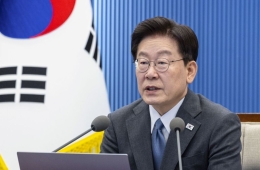
President Lee Jae-myung's job approval rating edged up for the second consecutive week to 37.3%. The increase was attributed to the prominence of achievements such as diplomatic visits and exports surpassing $1 trillion. However, the rise was limited as domestic setbacks, including the KOSPI falling below the 5,000 mark and a scandal over AI-assisted cheating on the College Scholastic Ability Test (CSAT), coincided. The People Power Party continued to lead the Democratic Party of Korea outside the margin of error in party support, although the gap narrowed.
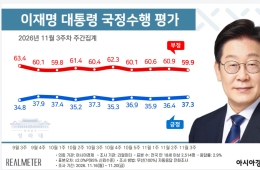
According to a regular poll conducted by Realmeter, a polling firm, on behalf of The Asia Business Daily and released on the 23rd, President Lee's job approval rating stood at 37.3%, up 0.9 percentage points from the weekly tally last week (the second week of November). Of respondents, 25.6% said he was doing a very good job and 11.7% said he was doing a fairly good job. The survey was conducted from the 16th to the 20th of this month, over five days, among 2,514 voters aged 18 or older nationwide, using an automated response system and randomly generated mobile phone numbers. The margin of error was ±2.0 percentage points at a 95% confidence level, and the response rate was 2.9%.

Negative assessments stood at 59.9% (50.3% saying he was doing a very poor job and 9.6% saying he was doing a somewhat poor job), down 1.0 percentage point from the previous week's poll. Negative assessments exceeded positive ones by 22.6 percentage points, outside the margin of error. "Don't know" responses accounted for 2.8%. In the daily figures, calculated over two-day periods, the approval rating closed at 35.2% on the 13th, rose to 38.4% on the 19th, and then fell to 37.7% on the 20th.
By region, the approval rating rose sharply by 7.5 percentage points in Daegu and North Gyeongsang (from 26.5% to 34.0%) and by 5.2 percentage points in Busan, Ulsan, and South Gyeongsang (from 33.1% to 38.3%). By contrast, it fell by 4.7 percentage points in Daejeon, Sejong, and South Chungcheong (from 36.8% to 32.1%), and by 3.1 percentage points in Seoul (from 33.9% to 30.8%). By age group, the rating rose by 4.2 percentage points among those aged 70 or older (from 34.1% to 38.3%) and by 3.6 percentage points among those aged 18 to 29 (from 29.5% to 33.1%). By gender, it rose by 2.8 percentage points among women (from 37.6% to 40.4%). By political leaning, it increased by 2.4 percentage points among moderates (from 38.7% to 41.1%), and by occupation, it rose by 11.4 percentage points among workers in agriculture, forestry, and fishing (from 31.9% to 43.3%).

A Realmeter official said, "Positive assessments rose as diplomatic and economic achievements, including visits to ASEAN (the Association of Southeast Asian Nations) and APEC (the Asia-Pacific Economic Cooperation), the South Korea-China summit, and exports surpassing $1 trillion, came into focus. However, the increase appears to have been limited by a combination of domestic uncertainties, including the KOSPI falling below the 5,000 mark and the scandal over AI-assisted cheating on the CSAT."
According to a party support poll conducted from the 19th to the 20th of this month, over two days, among 1,010 voters aged 18 or older nationwide, the People Power Party's support stood at 42.5%, down 0.5 percentage points from the previous week's poll. The Democratic Party of Korea's support was 35.6%, up 1.0 percentage point. The survey used an automated response system and randomly generated mobile phone numbers. The margin of error was ±3.1 percentage points at a 95% confidence level, and the response rate was 2.8%.

As a result, the People Power Party led the Democratic Party of Korea by 6.9 percentage points, maintaining its lead outside the margin of error for the second consecutive week. The gap narrowed, however, from 8.4 percentage points last week. The Rebuilding Korea Party was at 7.8%, down 0.9 percentage points; the New Reform Party was at 2.9%, up 1.0 percentage point; the Progressive Party was at 0.9%; and other parties were at 2.1%. The share of unaffiliated voters was 8.2%, down 0.6 percentage points.
By region, support for the People Power Party rose by 10.9 percentage points in South Jeolla and Gwangju and North Jeolla (from 15.3% to 26.2%), but fell by 4.6 percentage points in Daegu and North Gyeongsang (from 53.1% to 48.5%). Support for the Democratic Party of Korea rose by 7.7 percentage points in Daegu and North Gyeongsang (from 23.5% to 31.2%).
By age group, support for the People Power Party fell by 7.5 percentage points among people in their 40s (from 34.4% to 26.9%) and by 6.0 percentage points among those aged 18 to 29 (from 50.9% to 44.9%). It rose by 6.0 percentage points among people in their 60s (from 41.1% to 47.1%) and by 5.4 percentage points among people in their 30s (from 49.0% to 54.4%). Support for the Democratic Party of Korea rose by 4.1 percentage points among people aged 70 or older (from 28.0% to 32.1%). By gender, among women, support for the People Power Party fell by 3.2 percentage points (from 41.4% to 38.2%), while support for the Democratic Party of Korea rose by 4.4 percentage points (from 36.2% to 40.6%). Among men, support for the People Power Party rose by 2.2 percentage points (from 44.7% to 46.9%), while support for the Democratic Party of Korea fell by 2.4 percentage points (from 33.0% to 30.6%).
A Realmeter official said the People Power Party's rating "appears to have edged down despite favorable legal developments, including the first-instance acquittal of Daegu Mayor Choo Kyung-ho and the Supreme Court's decision to overturn and remand the case involving former Prime Minister Han Duck-soo, as well as gains from infighting within the Democratic Party. Its confrontational strategy centered on street protests and internal party divisions appear to have weighed on its support." Regarding the Democratic Party of Korea, the official said, "Its support appears to have risen as the President's diplomatic and economic achievements came into focus and the party pursued a special law to penalize AI-assisted cheating, despite concerns over a backlash from factional conflict within the party, including controversy over disciplinary action against Supreme Council member Choi Min-hee, and its push to impeach Chief Justice of the Supreme Court Cho Hee-dae."
Hot Picks Today
 "Two Spend 500,000 Won in a Flash, Yet Wait Two Hours?" ... 'Dreamland' Shunned by Kids and Foreign Tourists
- The Era of Getting 200 Million Won After 30 Years Is Over... A Japanese Bank's "Perpetual Department Head" Who Just Clocked In Cries Out
- Spain Hit by Its Worst Tragedy... Lee Kangin, Moreno and Real Madrid Join Soccer World in Mourning
- They Said, “Make It Your Home for Life” - Then Suddenly Kicked 200 Passengers Off... What Happened to the Around-the-World Cruise?
- "130 Rice Bowls Sold Out in a Day"... 'Unfiltered Face' Adds 8 Million Won to Night Market Sales: China's Bungeunwoo
For more information about the poll, please refer to the website of the National Election Survey Deliberation Commission.
© The Asia Business Daily. All rights reserved. Unauthorized AI training and use prohibited.