President Lee Speaks with Putin for First Time; Discusses N.K. Nuclear Issue Ahead of U.S.-China-Russia Trilateral Summit
Naturally crossed paths at the welcome dinner
Talked for about 10 minutes while leaving
Blue House: "We had an opportunity to appropriately present our position"
Agreed on the need to ease tensions on the Korean Peninsula
South Korean President Lee Jaemyung, who is attending the Asia-Pacific Economic Cooperation (APEC) summit, met and spoke separately with the leaders of the United States, China and Russia ahead of the first-ever trilateral meeting among the three countries. In particular, he met with Russian President Vladimir Putin for the first time since taking office and discussed North Korea’s nuclear program. With the way issues concerning the Korean Peninsula will be addressed at talks among the major powers still uncertain, the Blue House said, “He had an opportunity to appropriately present our position.”

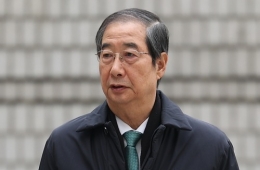
South Korean President Lee Jaemyung holds an informal meeting with Russian President Vladimir Putin after a welcome dinner for the Asia-Pacific Economic Cooperation (APEC) summit at the Shenzhen International Exchange Center in China on the 18th (local time). Nov. 19, 2026. Yonhap News
View original imageA senior Blue House official accompanying President Lee on his overseas trip said in Shenzhen, China, where the APEC summit was held, on November 18 (local time), “President Lee attended the summit’s welcome dinner with President Putin, and they naturally met as they were leaving toward the end of the event.” Their conversation lasted about 10 minutes. The official said they agreed that, although conditions for South Korea-Russia relations were difficult, the two countries should cooperate in areas where there were no problems.
The official said they also discussed North Korea’s nuclear program. “We were able to hear Russia’s views in broad terms on North Korea, inter-Korean relations and U.S.-North Korea relations,” he explained. He added, “They agreed on the need to prevent the situation on the Korean Peninsula from worsening and to ease tensions.” However, he qualified this by saying, “This was not a systematic discussion of issues that had been coordinated with Russia in advance,” and played down the specifics, saying, “The discussion of North Korea was not extensive.”
With his meeting with President Putin, President Lee had preliminary exchanges with all three leaders ahead of the U.S.-China-Russia trilateral meeting. On the morning of November 17, President Lee held a summit with Chinese President Xi Jinping and urged China to play a constructive role in easing tensions on the Korean Peninsula, saying, “The Korean Peninsula issue is a vital interest for South Korea.” He also spoke with U.S. President Donald Trump at a dinner during the ASEAN summit in Manila, Philippines, and reportedly had additional conversations with President Trump on several occasions that have not been disclosed. A Blue House official said, “In each conversation, President Lee presented our position on issues concerning the Korean Peninsula.”
President Lee is expected to complete the rest of his APEC schedule while closely monitoring the possibility of a U.S.-China-Russia trilateral meeting and of U.S.-North Korea talks. At the APEC summit on November 18, President Lee presented a vision built around ▲innovation that enables shared progress, ▲strengthening resilience for all, and ▲cooperation for an inclusive future. “South Korea is developing cutting-edge AI models through collaboration between the public and private sectors and expanding large-scale AI infrastructure. At the same time, it is applying AI across a range of industries by leveraging its strong manufacturing capabilities and accelerating innovation across the country,” he said, adding, “We will actively share this experience with APEC members.” On supply chains, he proposed that “to stabilize vulnerable energy supply chains in the Asia-Pacific region, we should institutionalize information sharing, joint energy stockpiling, joint response systems, and cooperation to stabilize supply and demand during emergencies, while accelerating the expansion of renewable energy and electrification over the long term.”
Hot Picks Today
 "Two Spend 500,000 Won in a Flash, Yet Wait Two Hours?" ... 'Dreamland' Shunned by Kids and Foreign Tourists
- The Era of Getting 200 Million Won After 30 Years Is Over... A Japanese Bank's "Perpetual Department Head" Who Just Clocked In Cries Out
- Spain Hit by Its Worst Tragedy... Lee Kangin, Moreno and Real Madrid Join Soccer World in Mourning
- They Said, “Make It Your Home for Life” - Then Suddenly Kicked 200 Passengers Off... What Happened to the Around-the-World Cruise?
- "130 Rice Bowls Sold Out in a Day"... 'Unfiltered Face' Adds 8 Million Won to Night Market Sales: China's Bungeunwoo
Meanwhile, while on his overseas trip, President Lee approved the “Special Counsel Act on Fabricated Indictments” locally on the night of November 17. The government promulgated the act by publishing it in the official gazette on November 19. Follow-up procedures, including the appointment of a special counsel, are expected to begin. President Lee will depart for South Korea after completing his schedule on November 18.
© The Asia Business Daily. All rights reserved. Unauthorized AI training and use prohibited.