[2027 CSAT] CSAT Committee Chair: "Exam Designed to Distinguish Students Using Public Education Content Alone"
Chair Oh: "Faithfully reflected the curriculum's content and level"
Thoroughly excluded private-education test-taking techniques
EBS linkage rate... "About 50% by question count"
Oh Giyeong, a professor at Hankyong National University and chair of the committee that set the 2027 College Scholastic Ability Test (CSAT), said on the 19th that the exam was designed to sufficiently distinguish students based solely on material covered in high school public education. EBS-linked questions accounted for about 50% of the exam by question count.
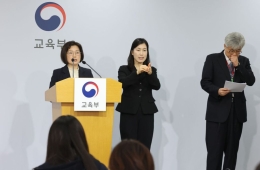
At a briefing on the exam’s direction held that day at the Government Complex Sejong, Oh said, “We did our utmost to faithfully reflect the content and level of the curriculum and to validly assess the academic abilities needed for university education.”

Oh Giyeong, chair of the question-setting committee for the 2027 College Scholastic Ability Test, briefs reporters on the exam's design, including the difficulty of each subject, at the Ministry of Education in the Sejong Government Complex on the 19th, the day the test was held. From left: Kim Munhee, president of the Korea Institute for Curriculum and Evaluation; Lee Doyoung, chair of the test review committee; and Oh Giyeong, chair of the question-setting committee. Yonhap News
View original imageHe added, “The questions focused on the core and fundamental content of the curriculum. Even when core curriculum content had been covered in previous exams, we changed the question formats and problem-solving approaches when necessary.”
In particular, he said, “We thoroughly excluded questions that would favor students who had learned problem-solving techniques and practiced them repeatedly at private academies. The exam was designed to sufficiently distinguish students based solely on material covered in public education.”
Regarding the CSAT’s EBS linkage rate, Oh said, “About 50% of the questions were linked to EBS, and we increased the perceived degree of linkage.” Asked about the sharp increase in so-called “N-suhng” test-takers—those taking the university entrance exam for a second time or more—he said, “The number of graduates taking the exam is the highest in 23 years, so we had to keep the questions standard while distinguishing among students.” He added, “We distributed the questions evenly across a fine-grained range of correct-response rates.”
On the difficulty of the English section, he said, “The English questions assessed students’ ability to listen, speak and communicate using vocabulary at the level prescribed by the curriculum. We made continuous efforts to maintain an appropriate level of difficulty, in line with the purpose of introducing criterion-referenced grading.” He predicted that the proportion of students receiving the top grade would be “stable.”
Hot Picks Today
 "Two Spend 500,000 Won in a Flash, Yet Wait Two Hours?" ... 'Dreamland' Shunned by Kids and Foreign Tourists
- The Era of Getting 200 Million Won After 30 Years Is Over... A Japanese Bank's "Perpetual Department Head" Who Just Clocked In Cries Out
- Spain Hit by Its Worst Tragedy... Lee Kangin, Moreno and Real Madrid Join Soccer World in Mourning
- They Said, “Make It Your Home for Life” - Then Suddenly Kicked 200 Passengers Off... What Happened to the Around-the-World Cruise?
- "130 Rice Bowls Sold Out in a Day"... 'Unfiltered Face' Adds 8 Million Won to Night Market Sales: China's Bungeunwoo
The English section’s difficulty varied considerably between the two mock exams held earlier this year. The proportion of students receiving the top grade in English was just 4.13% in the June mock exam, but rose to 15.5% in the September mock exam. The difference between the two exams reached 11.37 percentage points.
© The Asia Business Daily. All rights reserved. Unauthorized AI training and use prohibited.