[2027 CSAT] With "Record-High Repeat Test-Takers," Correct-Answer Rates Calibrated in Fine Increments... "English Grade 1 Rate Likely Stable" (Comprehensive)
The 2027 CSAT began at 1,312 test sites nationwide on Nov. 19
Korea Institute for Curriculum and Evaluation: "Students who completed the high school curriculum can answer the questions"
Questions similar to private education materials and "killer questions" excluded
AI-assisted cheating to be investigated even after the exam ends
The 2027 College Scholastic Ability Test (CSAT) began simultaneously at 8:40 a.m. on November 19 at 1,312 test sites across 85 test districts nationwide. The exam-setting authorities said they had maintained their basic principle of writing questions at a level that students who had faithfully completed the high school curriculum could handle, while focusing on fine-tuning the difficulty in light of the increase in repeat test-takers, including graduates and people who passed the qualification exam, whose numbers reached a 23-year high this year.
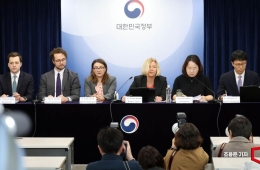
Kim Moonhee, president of the Korea Institute for Curriculum and Evaluation, said at a briefing on the exam’s design direction held at the Government Complex Sejong that morning, "This year’s CSAT was designed with questions that students who have faithfully completed the high school curriculum can answer."

This year’s CSAT is the last to be held under the current elective-subject system. As the so-called "social studies switch," in which science-track students increasingly choose social studies, has intensified, attention has also focused on the relative advantages and disadvantages across sections and on the difficulty of individual subjects. Of the 527,255 applicants for the social studies and science sections, 367,073 (69.6%) chose two social studies subjects, an increase of 8.6 percentage points from the previous year. By contrast, 75,036 (14.2%) chose two science subjects, a decrease of 8.5 percentage points. The sharp decline in the number of science-section test-takers has heightened concerns about subject difficulty and the relative advantages and disadvantages associated with subject choices.
Oh Giyeong, chair of the CSAT question-setting committee and a professor at Korea National University of Economics, said, "We minimized the possibility of applicants gaining an advantage or disadvantage depending on their subject choices." Oh said, "This year’s exam is characterized by a very large number of graduate test-takers and a deepening shift toward social studies. These two trends will affect all subjects, but they are particularly important because they can greatly influence the characteristics of the groups taking elective subjects."

The question-setting committee compared last year’s CSAT results with those of this year’s June and September mock exams to identify the characteristics of the test-taking groups. It also analyzed this year’s CSAT registration data to track changes in those characteristics. Oh said, "Elective subjects can pose a problem when the difficulty is not balanced across subjects. We made every effort to achieve that balance and minimize the possibility of applicants gaining an advantage or disadvantage depending on their subject choices."
The committee also worked to ensure the exam could distinguish among test-takers in light of the increase in graduates taking the test again. This year, 551,864 people registered for the CSAT, down 2,310 from last year, while the number of repeat test-takers, including graduates and people who passed the qualification exam, reached 196,473, the highest in 23 years. They accounted for 35.6% of all applicants, the highest proportion in 31 years. "We kept the questions at a standard level, but still needed to distinguish between test-takers," Oh said. "If we were targeting a correct-answer rate in the 30% range, it could be 31% or 39%; we tried to distribute the questions evenly across that range." The aim, he said, was to secure the exam’s ability to distinguish among test-takers by finely adjusting the difficulty of each question without going beyond the level of the curriculum.
English is another variable in this year’s CSAT. Last year, the proportion of test-takers who earned a Grade 1 in English, which is graded on an absolute scale, was just 3.11%, prompting criticism that the difficulty had not been properly adjusted. The Grade 1 rate also varied widely in this year’s June and September mock exams, at 4.13% and 15.54%, respectively.
"We made sustained efforts to maintain an appropriate level of difficulty in line with the purpose of introducing absolute grading," Oh said. "After reviewing the results of the June and September mock exams, we made fine adjustments to the difficulty of this CSAT." He added, "We expect the Grade 1 rate will likely be at a stable level."
Questions linked to private education and so-called "killer questions" were also strictly excluded. To that end, the committee purchased question books and mock exams from private education companies during the question-setting process and used them to check for similarities.

A mechanical pencil distributed by education authorities to all test-takers for the 2027 College Scholastic Ability Test. This year's pencil color is "Mugunghwa Bora." Ministry of Education
View original imageThis year’s CSAT was held amid significantly strengthened test-site supervision due to concerns about AI-assisted cheating. To prevent cheating with smart glasses and miniature cameras, the government introduced measures including inspections of glasses, stickers to cover clothing buttons, and restrictions on bringing personal writing instruments. In addition to the existing proctors, more than 8,400 extra personnel, including dedicated staff, were deployed, and an emergency alert was also sent.
"Fairness is one of the highest values in the CSAT," Kim said. "The government has taken various measures to prevent cheating." He added, "We plan to respond thoroughly if there is even the slightest indication of cheating after the exam."
The Ministry of Education plans to compile and announce later today the number of people caught cheating during the exam using smart glasses, miniature cameras, or similar devices.
Hot Picks Today
 "Two Spend 500,000 Won in a Flash, Yet Wait Two Hours?" ... 'Dreamland' Shunned by Kids and Foreign Tourists
- The Era of Getting 200 Million Won After 30 Years Is Over... A Japanese Bank's "Perpetual Department Head" Who Just Clocked In Cries Out
- Spain Hit by Its Worst Tragedy... Lee Kangin, Moreno and Real Madrid Join Soccer World in Mourning
- They Said, “Make It Your Home for Life” - Then Suddenly Kicked 200 Passengers Off... What Happened to the Around-the-World Cruise?
- "130 Rice Bowls Sold Out in a Day"... 'Unfiltered Face' Adds 8 Million Won to Night Market Sales: China's Bungeunwoo
Objections to exam questions can be submitted through the Korea Institute for Curriculum and Evaluation’s website from today until 6 p.m. on November 23. The institute will review the objections from November 24 through December 1 and announce the final answers at 5 p.m. on December 1. CSAT scores will be sent to test-takers on December 11.
© The Asia Business Daily. All rights reserved. Unauthorized AI training and use prohibited.