Xi and Takaichi Meet Amid Strained China-Japan Ties... Awkward Handshake After a Year
Avoided a public diplomatic snub, but views remain divided in Japan
NHK also noted: "Protocol differed from that for South Korea and Thailand"
As China-Japan relations have grown strained over remarks about a contingency in Taiwan, Chinese President Xi Jinping and Japanese Prime Minister Sanae Takaichi met face to face and shook hands for the first time in about a year. Japan avoided the public diplomatic snub its government had feared, but there were also signs of caution against reading too much into what was merely a ceremonial encounter.

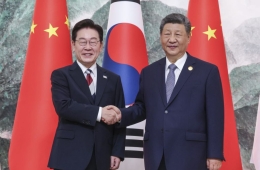
Chinese President Xi Jinping (right) and Japanese Prime Minister Sanae Takaichi shake hands at a welcome dinner for the Asia-Pacific Economic Cooperation (APEC) summit at the Shenzhen International Exchange Center in China on the 18th (local time). Yonhap.
View original imageAccording to NHK, the Yomiuri Shimbun and other outlets on November 19, the two leaders shook hands at a welcome dinner for the Asia-Pacific Economic Cooperation (APEC) summit held the previous day in Shenzhen, Guangdong Province, China. Japanese media reported that after Prime Minister Takaichi shook hands with Xi and smiled as she spoke to him, he responded with a warm expression.
The two leaders met face to face for the first time in a year since their summit in October 2025. Relations between the two countries deteriorated sharply after Takaichi said in November 2025 that a contingency in Taiwan could constitute a "survival-threatening situation" that would allow Japan to exercise its right to collective self-defense.
The Japanese government had been concerned ahead of the APEC summit that Xi might publicly snub Takaichi. On November 9, Bloomberg reported that the Japanese government was making behind-the-scenes efforts to coordinate with China, asking it to treat Takaichi on an equal footing with other national leaders.
Japanese media, however, have offered differing views on Xi's response. NHK reported that when Takaichi arrived in China, she received a protocol reception that differed from those given to leaders of other countries. According to NHK, when Takaichi arrived at Shenzhen Airport, Zhang Zhiyue, an ambassador responsible for protocol at China's Ministry of Foreign Affairs, greeted her. NHK noted that "when leaders of other countries, including South Korea and Thailand, arrived at the airport, music played and many people welcomed them with cheers," adding that "there was no such welcoming atmosphere when Prime Minister Takaichi arrived." An official at Japan's Ministry of Foreign Affairs told the Mainichi Shimbun that this "amounted to a breach of diplomatic protocol. It was truly discourteous."
There has also been a cautious response to the handshake between Xi and Takaichi. A Japanese government official told the Yomiuri Shimbun, "It was merely a diplomatic courtesy extended by the leader of the host economy. Nothing more, nothing less," adding, "It has nothing to do with improving China-Japan relations."
The chances of a China-Japan summit being held on the sidelines of this APEC summit are also slim. Japan had held face-to-face summits with China on the sidelines of the APEC summit for four consecutive years, starting in 2022. Even when China-Japan relations deteriorated in 2014, a summit between then-Japanese Prime Minister Shinzo Abe and Xi was arranged after prior coordination. This time, however, it appears that even such coordination has not taken place.
China is demanding that Takaichi retract her remarks about a contingency in Taiwan and change her policy toward China, but Japan is refusing to comply. With neither country finding a way to break the deadlock, forecasts suggest the conflict will be prolonged.
Hot Picks Today
 "Two Spend 500,000 Won in a Flash, Yet Wait Two Hours?" ... 'Dreamland' Shunned by Kids and Foreign Tourists
- The Era of Getting 200 Million Won After 30 Years Is Over... A Japanese Bank's "Perpetual Department Head" Who Just Clocked In Cries Out
- Spain Hit by Its Worst Tragedy... Lee Kangin, Moreno and Real Madrid Join Soccer World in Mourning
- They Said, “Make It Your Home for Life” - Then Suddenly Kicked 200 Passengers Off... What Happened to the Around-the-World Cruise?
- "130 Rice Bowls Sold Out in a Day"... 'Unfiltered Face' Adds 8 Million Won to Night Market Sales: China's Bungeunwoo
Meanwhile, immediately after the welcome dinner that day, Takaichi spoke with Russian President Vladimir Putin for about 30 minutes. The two countries' leaders had not met face to face and exchanged views since then-Prime Minister Shinzo Abe met with Putin in 2019, seven years ago, and this was their first such meeting since Russia invaded Ukraine in 2022. According to the Yomiuri Shimbun, Takaichi conveyed Japan's position on issues including the detention of a Hokkaido Shimbun reporter by Russian authorities and the placement of Japan Tobacco Inc.'s local subsidiary under the management of a Russian company.
© The Asia Business Daily. All rights reserved. Unauthorized AI training and use prohibited.