CSAT Begins Amid Heightened Alert Over AI Cheating; Government: "We Will Catch Them"
Begins at 8:40 a.m. at 1,312 test centers nationwide
All glasses inspected, stickers placed over buttons... only black pencils allowed as personal supplies
Unannounced alerts to follow the first “Emergency Disaster Alert”
Pan-government task force to launch after the test... reward of up to KRW 100 million for reports also planned
The 2027 College Scholastic Ability Test (CSAT) will be held simultaneously at 1,312 test centers across 85 test districts nationwide, starting at 8:40 a.m. on November 19. This year, as concerns grow over cheating using artificial intelligence (AI)-powered devices such as smart glasses and miniature cameras, supervision at test centers will be significantly tightened. The government will launch a “Pan-Government Task Force on Responding to Cheating on the CSAT,” saying it will track down and catch cheaters even after the exam has ended.

According to the Ministry of Education and other relevant agencies on November 19, all examinees must place their glasses on their desks before the start of the first session so they can be checked for smart-glass capabilities. Proctors will continue to check whether examinees are wearing glasses during each session, and conduct another full inspection of personal belongings before the start of the third session.
Collars, sleeves, buttons and other areas where miniature cameras could be concealed will also be inspected. Examinees wearing clothes with buttons will be given stickers to place over them. If cheating is suspected, additional checks will be conducted using metal detectors. On November 18, the Ministry of Education urged examinees to wear clothes without buttons if possible to facilitate inspections, and to refrain from wearing unnecessary accessories such as necklaces, rings and hats.
The only writing instrument examinees may carry during the test will be a “black pencil.” To prevent cheating with miniature cameras, examinees may not bring personal items that were previously permitted, including black computer-scoring pens, white correction tape, erasers, mechanical pencils and pencil lead. Examinees who bring these items must put them in their bags before the test begins and leave the bags outside the classroom. If they are caught simply possessing these items during the test, the items will be confiscated and an investigation will determine whether they were used to cheat.
Instead, education authorities will provide every examinee, all 550,000 of them, with one computer-scoring pen, mechanical pencil, eraser and correction tape each, in addition to the black pencil. To prepare, they have stocked 700,000 erasers, 77,040 packs of mechanical pencil lead (30 pieces per pack) and 663,540 rolls of correction tape. Five packs of mechanical pencil lead, each containing 30 pieces, will be placed in every classroom.
Electronic devices, including mobile phones, smart glasses and smartwatches, are prohibited at test centers. Examinees who bring them for unavoidable reasons must turn them off and hand them to a proctor before the first session begins. Anyone caught keeping a device or storing it in a bag without turning it in will be treated as having cheated, regardless of whether the device was actually used.
To find mobile phones that were not turned in, the government plans to send an “Emergency Disaster Alert” for the first time at 8:30 a.m. on November 19, and to send additional alerts without prior notice afterward.

An Emergency Disaster Alert is the highest-level disaster alert and cannot be opted out of. It will be sent to mobile phones nationwide, including those belonging to examinees, members of the public and foreign nationals staying in South Korea. To minimize confusion, advance notices will be provided to hospitals, nursing facilities, transportation facilities—including railways, airports, buses and subways—and high-risk facilities such as power plants. Notices will be disseminated through TV subtitles, electronic message boards, safety alerts and broadcasts, and banners on major domestic portal sites.
Examinees’ bags will be stored in the corridors outside classrooms. Corridor proctors will check for smart devices that respond to disaster alerts and continuously scan for Wi-Fi signals. To support these efforts, more than 1,800 personnel dedicated to smart devices and more than 6,600 corridor proctors—a total of more than 8,400 additional staff—will be deployed this year.

The government is also pursuing a reward program offering up to KRW 100 million for reports that lead to the detection of cheating. It plans to swiftly establish the relevant rules and apply them starting with this year’s CSAT.
Penalties for cheaters will also be strengthened. Anyone found to have cheated on this year’s CSAT will be barred from taking the test for the next 10 years. The government will also seek criminal liability through referrals for investigation and formal complaints, with penalties of up to five years in prison. Examinees who are university students will be expelled from their universities if found to have cheated.
In particular, the government plans to thoroughly investigate businesses and buyers who sell or purchase smart devices that could be used to cheat, despite knowing that their use would be illegal, and take stern action in accordance with relevant laws and regulations.

Efforts to track down cheaters will continue after the test ends.
Starting November 20, the “Pan-Government Task Force on Responding to Cheating on the CSAT” will begin full operations, with the prime minister as its head and the Ministry of Education, the Ministry of Science and ICT, the Ministry of Justice, the Ministry of the Interior and Safety, the Korean National Police Agency and other organizations participating.
The task force will work with relevant government agencies, global AI companies and telecommunications companies to thoroughly investigate and detect suspected cases of cheating. If cheating is confirmed, it will strictly impose criminal and administrative sanctions in accordance with the principle of zero tolerance.

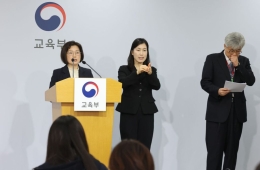
Prime Minister Han Seongsook delivers a public address on measures to address cheating in the College Scholastic Ability Test at the joint briefing room of the Government Complex Seoul in Jongno-gu, Seoul, on the afternoon of Nov. 17, 2026. Photo by Cho Yongjun.
View original imageThe government also said it would assume responsibility to ease the burden of complaints and lawsuits on teachers resulting from strengthened supervision. It plans to support proctors in actively checking suspicious situations and respond to complaints and disputes that arise after cheating is detected.
Hot Picks Today
 "Two Spend 500,000 Won in a Flash, Yet Wait Two Hours?" ... 'Dreamland' Shunned by Kids and Foreign Tourists
- The Era of Getting 200 Million Won After 30 Years Is Over... A Japanese Bank's "Perpetual Department Head" Who Just Clocked In Cries Out
- Spain Hit by Its Worst Tragedy... Lee Kangin, Moreno and Real Madrid Join Soccer World in Mourning
- They Said, “Make It Your Home for Life” - Then Suddenly Kicked 200 Passengers Off... What Happened to the Around-the-World Cruise?
- "130 Rice Bowls Sold Out in a Day"... 'Unfiltered Face' Adds 8 Million Won to Night Market Sales: China's Bungeunwoo
The government said, “In keeping with our firm principle that cheaters will be caught and held accountable without exception, both administratively and criminally, we will bring together all available government resources to address cheating not only during the CSAT but also after the test has ended.”
© The Asia Business Daily. All rights reserved. Unauthorized AI training and use prohibited.