President Lee: "Overseas Missions Like Community Centers"... Actively Pursuing Overseas Voting System Improvements (Comprehensive)
"Complaints are a treasure trove of policy ideas"... Reflecting views from the field in policymaking
Pledges institutional reforms to expand the rights and interests of Korean citizens abroad
"Further strengthen the strategic cooperative partnership"
Expand cooperation in emerging industries ahead of the 35th anniversary of South Korea-China diplomatic relations
President Lee Jae-myung said on the 18th that he would transform overseas diplomatic missions into friendly, accessible organizations, like local community centers in Korea. He also said the government would actively gather overseas Koreans’ complaints and suggestions and reflect them in policy, while improving the overseas voting system to ensure that citizens can effectively exercise their right to vote.

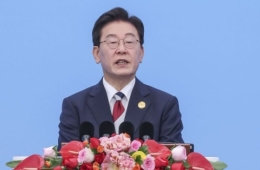
South Korean President Lee Jae-myung delivers opening remarks at a meeting with Korean residents in southern China at a hotel in Shenzhen on Nov. 18, 2026. Yonhap News Agency
View original imageAt a luncheon meeting with Korean residents in South China, held in Shenzhen, China, that day, President Lee said, “Now we will change that completely,” signaling his intention to change the role and operations of overseas diplomatic missions. He particularly stressed that “overseas diplomatic missions should not be organizations detached from the daily lives of overseas Koreans, but places they can visit at any time to ask for help.”
President Lee also underscored that the government and public officials are entrusted with authority by the people and work for them. He urged overseas Koreans to “make active use of overseas diplomatic missions and raise any everyday inconveniences or issues that require policy improvements at any time.”
He also said the government would use overseas Koreans’ complaints as important material for policymaking. Calling complaints “a treasure trove of policy ideas,” President Lee stressed that effective policies can only be developed by properly understanding problems on the ground.
He also pledged to improve institutions to expand the rights and interests of Korean citizens living abroad. President Lee said the government was actively pursuing improvements to the overseas voting system so that Korean citizens could properly exercise their rights as citizens of the Republic of Korea wherever they are in the world. He also said the government would consider further measures to reduce barriers to voting.
“The government of the Republic of Korea will stand firmly behind you so that you do not have to worry about it,” President Lee said, reaffirming the government’s commitment to supporting overseas Koreans.
President Lee also stressed that, ahead of the 35th anniversary of diplomatic relations between South Korea and China next year, the two countries should further strengthen their strategic cooperative partnership on the foundation of the trust and friendship they have built over the years. He outlined plans to establish mutually beneficial cooperation in emerging industries, particularly artificial intelligence (AI), renewable energy and biotechnology.

President Lee Jaemyung toasts with attendees, including Jin Ikhwa, president of the Shenzhen Korean Association, at a meeting with Korean residents of South China held at a hotel in Shenzhen, China, on the 18th (local time). Nov. 18, 2026. Yonhap News.
View original imageNoting that Shenzhen and the wider South China region are hubs for innovative technologies, finance and talent, President Lee urged overseas Koreans in the region to “serve as a bridge connecting South Korea-China cooperation in future industries.” He added, “Each and every one of you is a leading force in the development of South Korea-China relations,” and said, “The path you have walked is itself the history of South Korea-China relations.”
At the meeting, Kim Ryeongpil, head of furniture company Jinpeiteo and great-grandson of independence activist Kim Gyusik; Bae Yunkyung, a professor in the Department of Korean at Guangdong University of Foreign Studies; and Kim Seonbi, a graduate student at Sun Yat-sen University, shared their experiences and reflections on life in China, presidential spokesperson Kim Seongwan said.
Kim Ryeongpil, head of Jinpeiteo, said, “My great-grandfather, General Kim Gyusik, raised a righteous army and took part in the Battle of Cheongsanri, dedicating his life to armed resistance. I am deeply moved to stand here as his descendant.” He then asked President Lee to “pay special attention to and support the preservation of overseas historic sites of the independence movement and the passing on of their historical significance.” Bae Yunkyung, a professor in the Department of Korean at Guangdong University of Foreign Studies, said, “Future-oriented South Korea-China relations stem from mutual interest and deep understanding. I hope that many opportunities for exchange and engagement will be created so that young people in both countries can understand each other correctly.”
Finally, Kim Seonbi, a graduate student at Sun Yat-sen University, said, “I hope that international students can also learn from the experiences and wisdom of senior members of the Korean community and contribute to the joint growth of South Korea and China by applying what they have learned in their respective fields.”
After listening to the participants, President Lee said, “You must be happy to see the Republic of Korea’s elevated standing in the international community,” and spoke about the achievements of the People’s Sovereignty Government to date. He added, “We will work to ensure that you do not have to worry about the Republic of Korea and to achieve even more in the future.”
Hot Picks Today
 "Two Spend 500,000 Won in a Flash, Yet Wait Two Hours?" ... 'Dreamland' Shunned by Kids and Foreign Tourists
- The Era of Getting 200 Million Won After 30 Years Is Over... A Japanese Bank's "Perpetual Department Head" Who Just Clocked In Cries Out
- Spain Hit by Its Worst Tragedy... Lee Kangin, Moreno and Real Madrid Join Soccer World in Mourning
- They Said, “Make It Your Home for Life” - Then Suddenly Kicked 200 Passengers Off... What Happened to the Around-the-World Cruise?
- "130 Rice Bowls Sold Out in a Day"... 'Unfiltered Face' Adds 8 Million Won to Night Market Sales: China's Bungeunwoo
Meanwhile, pianist Du Ningwu, grandson of Kim Seongsuk, an anti-Japanese independence activist who served as a member of the Korean Provisional Government’s State Council, performed “Arirang” at the meeting’s cultural performance. Fourteen second-grade students from the Shenzhen Korean School choir also sang “Five Pretty Words,” accompanied by pianist Du Ningwu, adding to the significance of the gathering, spokesperson Kim said.
© The Asia Business Daily. All rights reserved. Unauthorized AI training and use prohibited.