More Than Half of Investigative Workforce Are 'Assistants'... Kim Jongcheol: 'We Will Pursue Rank Adjustments'
Rep. Park Sang-woong Criticizes Restrictions on Assistant Judicial Police Officers Preparing Interrogation Records
"Formal Measures Will Only Add to the Burden on Frontline Officers"
Police Chief Nominee to Adjust Ranks of 10,000 Officers Over Three Years
At the National Assembly confirmation hearing for the nominee to lead the Korean National Police Agency, lawmakers raised concerns that although the police had substantially increased their investigative workforce, more than half of its members were assistant judicial police officers, who cannot personally prepare suspect interrogation records. Nominee Kim Jongcheol said he would address the issue through measures such as rank adjustments to ensure that suspect interrogation records are admissible as evidence.
At the hearing on November 18, Park Sang-woong of the People Power Party said, "The police have increased their investigative workforce to more than 30,000, but there are still reports from the front lines that they lack enough officers at the rank of inspector or above to oversee suspect interrogations."

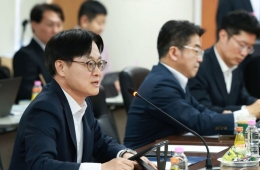
Kim Jongcheol, nominee for National Police Agency commissioner, delivers opening remarks at a confirmation hearing at the National Assembly on the 18th. Photo by Yoon Dongju.
View original imageAccording to The Asia Business Daily, as of last month, the total investigative workforce stood at 30,263, of whom 15,886 (52.5%) were assistant judicial police officers. The current Criminal Procedure Act classifies officers at the rank of inspector or above as judicial police officers, who lead investigations, and lower-ranking officers—including senior police officers, police officers and junior police officers—as assistant judicial police officers, who assist with investigations. This means that more than half are assistants.
Investigative Workforce Expanded, but Half Are Tied Up... Staffing Assignments Become a Headache
For years, citing factors such as a shortage of personnel, assistant judicial police officers have in practice independently questioned suspects and prepared interrogation records. However, following recommendations for improvement from the National Human Rights Commission of Korea and a request for corrective action from the Public Prosecution Office, guidelines were introduced requiring them to work under the specific direction and supervision of judicial police officers. In particular, assistant judicial police officers cannot be listed as the authors of suspect interrogation records; the records must instead be prepared in the name of the judicial police officer who directed the questioning.
Rep. Park criticized the arrangement, saying, "In the past, questioning took place in investigative team offices, so the team leader could hear the investigation unfolding right beside them. Now that questioning takes place in separate rooms, an officer at the rank of inspector or above who wants to attend has to stop working on their own case and go to that room. If they briefly come in at the start of questioning and then leave, while their name appears on the record, how can anyone verify what they actually observed or whether they truly directed the questioning? There are also concerns that this will simply add to the burden on officers in the field as a formality."

Some have also argued that staffing across the organization needs to be addressed at a fundamental level. Unlike the prosecution service, the police have a mix of investigative and non-investigative units, and the difficulty of recruiting officers for demanding units, including investigative departments, is seen as a problem. In fact, 46,550 (71.4%) of the 65,176 officers at the ranks of superintendent and inspector, who are supposed to lead investigations under the Criminal Procedure Act, were assigned to non-investigative units. The largest share, 38.9% of the total, worked at police substations and precinct stations handling public safety duties rather than investigations.
Referring to this staffing structure, Rep. Park urged officials to "take a closer look at the current staffing of investigative teams handling a large caseload, including how many officers at the rank of inspector or above are assigned to each team and how many more are needed," and to "review which investigative teams need how many additional officers and how to secure the personnel for next year's first-half personnel appointments."
Kim said, "I fully understand the concern," and added, "Judicial police officers currently make up about 32% of the investigative workforce. To ensure that suspect interrogation records are admissible as evidence, we plan to pursue rank adjustments for about 10,000 officers over the next three years."
Hot Picks Today
 "Two Spend 500,000 Won in a Flash, Yet Wait Two Hours?" ... 'Dreamland' Shunned by Kids and Foreign Tourists
- The Era of Getting 200 Million Won After 30 Years Is Over... A Japanese Bank's "Perpetual Department Head" Who Just Clocked In Cries Out
- Spain Hit by Its Worst Tragedy... Lee Kangin, Moreno and Real Madrid Join Soccer World in Mourning
- They Said, “Make It Your Home for Life” - Then Suddenly Kicked 200 Passengers Off... What Happened to the Around-the-World Cruise?
- "130 Rice Bowls Sold Out in a Day"... 'Unfiltered Face' Adds 8 Million Won to Night Market Sales: China's Bungeunwoo
The Korean National Police Agency has issued guidelines requiring judicial police officers to direct assistant judicial police officers' questioning of suspects, and has also recommended adjusting staffing to ensure judicial police officers are distributed evenly among investigative teams on the front lines. It is also discussing an increase in the authorized headcount with the Ministry of the Interior and Safety to address the fact that the current number of judicial police officers already exceeds the staffing allocation by 10,000.
© The Asia Business Daily. All rights reserved. Unauthorized AI training and use prohibited.