Korea Gas Corp. President Hong Eui-rak: "A 1-won increase in wholesale gas prices would recover KRW 500 billion in unpaid receivables"
First press conference since taking office, held in Sejong on November 18
Unpaid receivables total KRW 14 trillion... "Could approach KRW 17 trillion next year if high oil prices persist"
"The most important thing is raising rates... Gas rates must go up"
Hong Eui-rak, president of Korea Gas Corporation, emphasized the need to raise gas rates on November 18, saying, "If the wholesale price of gas is raised by 1 won per megajoule (MJ), Korea Gas Corporation can recover approximately KRW 500 billion in unpaid receivables."
Hong made the remarks at his first press conference since taking office, held in Sejong on November 18. "The most important thing in recovering unpaid receivables is raising rates," he said. Unpaid receivables are a kind of "bill on credit" for gas supplied at prices below cost but not paid for by customers. As they accumulate, the burden of borrowing and interest grows.

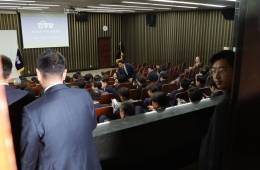
Korea Gas Corporation President Hong Euirak is emphasizing the need to raise gas rates at a press briefing on the 18th. Korea Gas Corporation
View original imageAccording to Korea Gas Corporation, unpaid receivables for city gas supplied to residential customers totaled KRW 13.8277 trillion as of the third quarter of this year, up KRW 288.6 billion from KRW 13.539 trillion at the end of the first half. This was because residential gas rates had been frozen since August 2024. "With international oil prices rising due to the war in the Middle East, Korea Gas Corporation's unpaid receivables are expected to approach KRW 17 trillion next year," Hong said. "They are growing by KRW 4 trillion every year."
He stressed that raising gas rates was essential. "I want to tell the government that excessively suppressing gas rates can have harmful consequences," Hong said. "There are other ways to recover unpaid receivables, but they would have limited effect. Raising prices first is what is needed now."
Hong also stressed that the success of advanced industries such as artificial intelligence (AI), semiconductors and data centers depends on securing sufficient electricity on time. He said Korea Gas Corporation would support stable supplies of gas for power generation so that gas-fired power plants can provide electricity when needed for the three major mega-projects.
He said that securing and sharing information were of utmost importance to strengthening Korea Gas Corporation's competitiveness. "We need to combine our purchasing power for liquefied natural gas (LNG) with global information and analytical capabilities, and analyze market prices, supply chains, electricity demand and LNG inventories together so we can anticipate and respond to market changes," Hong said. "We will combine the corporation's capabilities in importing, producing and supplying gas with technology, information and market experience, and connect gas and electricity, as well as industry and technology, to create new businesses and services, including energy platforms."

Hong Euirak, president of Korea Gas Corporation, speaks at a press conference on the 18th. Korea Gas Corporation.
View original imageKorea Gas Corporation plans to strengthen its average-price system to ensure stable gas and electricity supply. Under the system, the corporation calculates the average cost of the gas it purchases under multiple import contracts, weighted by volume, and supplies it to all customers at the same price. The system cushions the impact of individual contracts or short-term market conditions, while also entailing obligations to supply and maintain reserves and responsibility for national supply and demand.
"As the volume supplied under the average-price system for power generation, which underpins the corporation's ability to fulfill its responsibility for national supply and demand, declines, we expect difficulties in managing a stable supply of electricity and gas," Hong said. "We will therefore develop ways to strengthen the competitiveness of the current average-price system for power generation in response to market changes, ensuring consumer choice and stable gas and electricity supply."
To strengthen the average-price system, Korea Gas Corporation plans to enhance the competitiveness of its import portfolio, build its trading capabilities, cooperate with private direct-import companies and promote the joint use of pipeline facilities. To strengthen the competitiveness of its imports, the corporation will respond to surges in international spot prices by reducing spot purchases and expanding term contracts, under which set volumes are purchased each year according to a set price formula (long-term contracts of 10 years or more). It will also diversify its sources of supply and prioritize imports of volumes in which it holds equity interests to improve supply stability and cost efficiency. The corporation also plans to strengthen its trading capabilities to build a supply-and-demand management system that can respond flexibly to fluctuations, and to work with private direct-import companies on joint LNG purchases and investments.
Hot Picks Today
 "Two Spend 500,000 Won in a Flash, Yet Wait Two Hours?" ... 'Dreamland' Shunned by Kids and Foreign Tourists
- The Era of Getting 200 Million Won After 30 Years Is Over... A Japanese Bank's "Perpetual Department Head" Who Just Clocked In Cries Out
- Spain Hit by Its Worst Tragedy... Lee Kangin, Moreno and Real Madrid Join Soccer World in Mourning
- They Said, “Make It Your Home for Life” - Then Suddenly Kicked 200 Passengers Off... What Happened to the Around-the-World Cruise?
- "130 Rice Bowls Sold Out in a Day"... 'Unfiltered Face' Adds 8 Million Won to Night Market Sales: China's Bungeunwoo
"The corporation, which oversees national supply and demand management, should be responsible for LNG imports, while power generators should focus on stable electricity production and the transition to renewable energy. We need to establish this division of roles," Hong said. "We will promote information sharing between the corporation and private direct importers, review the need for joint purchases in response to fluctuations in domestic demand, and strengthen price competitiveness by increasing our bargaining power through bulk purchases."
© The Asia Business Daily. All rights reserved. Unauthorized AI training and use prohibited.