"Token Securities Infrastructure Is in Place, but... Legislation on Non-Monetary Trusts Must Be Expedited"
Expansion of issuance to include non-monetary trust beneficiary certificates is key
"Four hurdles" between the effective date and first issuance
Indirect routes have limits; the bill must pass without delay
Calls have emerged for an urgent revision to the Capital Markets Act to allow the issuance of beneficiary certificates backed by non-monetary trusts ahead of the system for token securities taking effect next year.

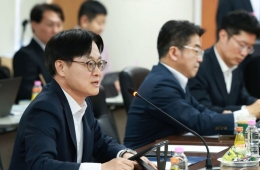
Lee Kangil, a lawmaker from the Democratic Party of Korea, speaks at the policy seminar “Opening the Era of Token Securities and New Possibilities for Capital Markets” in Yeouido, Seoul, on the 18th. Photo by Lim Chunhan.
View original imageAssemblyman Lee Kangil of the Democratic Party of Korea said at the policy seminar “The Opening of the Token Securities Era and New Possibilities for Capital Markets,” held in Yeouido, Seoul, on November 18: “To keep pace with global markets and further strengthen the competitiveness of our capital market, we must continuously review and improve the practical conditions that allow a wide range of assets to be smoothly issued and traded as financial products.” He emphasized, “The key is to expand the scope of issuance to include ‘beneficiary certificates backed by non-monetary trusts.’”
Lee sponsored a bill that would expand issuance rules, currently centered on monetary trusts, while establishing requirements for issuance, advance registration, valuation and sales. The total amount issued would be capped at the value of the trust property. The settlor and other parties would be required to hold beneficiary certificates worth up to 10% of the issuance amount, in accordance with standards set by an enforcement decree. If beneficiaries holding at least 5% of the voting rights request a meeting, one must be held within one month.
Assemblyman Min Byeongdeok of the Democratic Party said, “For the market to grow, not only issuance but also settlement, collateral, custody, clearing and investor protection must work together.” He added, “In addition to the Capital Markets Act and the Electronic Securities Act, various systems related to digital assets, trusts and custody, and anti-money laundering must be aligned. We need to build a robust institutional foundation so that tokens lead to actual trading and use, rather than stopping at issuance.”
Assemblyman Park Sanghyuk of the Democratic Party said, “For financial innovation to lead to sustained growth, technological development of this kind must go hand in hand with market confidence.” He added, “The token securities market will be able to grow steadily when objective valuation, transparent disclosure of information and effective investor protection measures are put in place together.”
Kim Jonghyeon, chairman of the Korea Fintech Industry Association, said, “What matters is not simply introducing a new means of issuance, but making the system effective enough for token securities to be used in practice for corporate financing and investors’ asset management.” He added, “To achieve this, we must ease regulations, including restrictions on issuing beneficiary certificates backed by non-monetary trusts, while faithfully upholding the investor protection principle of separating underlying assets from the bankruptcy risk of their original owners, thereby building trustworthy market infrastructure.”

Participants pose for a group photo at the policy seminar “The Dawn of the Token Securities Era and New Possibilities for Capital Markets,” held in Yeouido, Seoul, on the 18th. Photo by Im Chunhan
View original imageChoi Insoo, head of the Digital Assets Department at Shinhan Securities, delivered a presentation titled “Changes in the Token Securities Market and the Future of Capital Markets.” He said, “After the system takes effect on February 4, 2027, the first issuance of each product will come only after clearing four hurdles: final approval for an over-the-counter exchange, a review of the suitability of the distributed ledger, an account management framework, and disclosure and issuance procedures.”
He identified beneficiary certificates backed by non-monetary trusts as a key issue for product supply. Under the current Capital Markets Act, only monetary trusts may issue beneficiary certificates. Products such as real estate have so far been issued through regulatory sandboxes or under the Asset-Backed Securitization Act. Choi noted, “To invigorate the market, we need a system and ecosystem that many ordinary companies can also use.”
He outlined five institutional tasks for revitalizing the market. For underlying assets, he said the revision of the Capital Markets Act should minimize the time gap with the implementation of the Token Securities Act. He proposed setting different annual net purchase limits for retail investors at each over-the-counter exchange, currently KRW 100 million, based on product risk, and gradually raising the limits, starting with products that have been vetted. For distributed ledger requirements, he proposed retaining a permissioned participation structure and beginning with pilot projects before using public blockchains. Current regulations require at least two account management institutions to participate and prohibit charging fees for use of the ledger. He suggested replacing the KRW 4 billion minimum equity capital requirement for issuer account management institutions with tiered requirements linked to issuance volume and scope of business. On on-chain settlement, he called for establishing a legal basis in the framework act for linking securities settlement, recognizing the reserve assets of tokenized money market funds (MMFs), piloting tokenized collateral, and drawing up a roadmap for overseas connections.
Attorney Hwang Hyunil of Sejong Law Firm delivered a presentation titled “The Current Status of the Token Securities System and Its Tasks Ahead.” He said, “Under the current framework of the Capital Markets Act, beneficiary certificates backed by non-monetary trusts cannot be formally issued.” At present, they must be issued indirectly through the Asset-Backed Securitization Act. The bar is high because eligibility to serve as an asset holder is limited to financial institutions and companies subject to external audits with assets of at least KRW 50 billion. Hwang pointed out, “Small and venture companies seeking to raise funds by tokenizing innovative intangible assets or physical assets face the problem of being unable to issue beneficiary certificates under the Asset-Backed Securitization Act.”
Hwang said, “To resolve this bottleneck, what is absolutely necessary is not merely an indirect route through the Asset-Backed Securitization Act, but a revision to the Capital Markets Act that directly permits the issuance of beneficiary certificates backed by non-monetary trusts.” He added, “This is not an issue that should be viewed differently depending on the position of a particular political party. The law must be passed without too much delay if the token securities system is to take root.”
Hot Picks Today
 "Two Spend 500,000 Won in a Flash, Yet Wait Two Hours?" ... 'Dreamland' Shunned by Kids and Foreign Tourists
- The Era of Getting 200 Million Won After 30 Years Is Over... A Japanese Bank's "Perpetual Department Head" Who Just Clocked In Cries Out
- Spain Hit by Its Worst Tragedy... Lee Kangin, Moreno and Real Madrid Join Soccer World in Mourning
- They Said, “Make It Your Home for Life” - Then Suddenly Kicked 200 Passengers Off... What Happened to the Around-the-World Cruise?
- "130 Rice Bowls Sold Out in a Day"... 'Unfiltered Face' Adds 8 Million Won to Night Market Sales: China's Bungeunwoo
Han Sanghyeong, head of the legal affairs office at BuySellStandard, said, “There are now only 78 days left until the system takes effect, and concerns are also being raised in the market about a shortage of products.” He added, “Passage of this revision to the Capital Markets Act and its swift implementation are key to the early establishment and growth of the token securities market.”
© The Asia Business Daily. All rights reserved. Unauthorized AI training and use prohibited.