Boryeong Declares Bid to Host Integrated Headquarters of State-Owned Power Companies... Claims It Is the “Heartland of 40 Years of Sacrifice”
Boryeong City... To make its pledge more than an optimistic blueprint, it must demonstrate a concrete implementation plan and a clear administrative and political breakthrough to persuade the government.

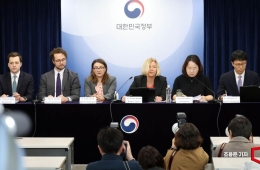
Boryeong Mayor Eom Seungyong and Boryeong City Council Chairman Seong Taeyong hold a press briefing on the 18th, announcing their bid to bring the integrated headquarters of state-run power companies to Boryeong.
View original imageAs Boryeong, South Chungcheong Province, has entered the race in earnest to host the integrated headquarters of state-owned power companies, it has moved beyond the vague cause of bringing it to South Chungcheong Province and chosen to make a direct case that Boryeong is the ideal location.
After the government announced its integration plan last September and a policy debate was held at the National Assembly in November, the focus shifted from a metropolitan-level designation to one at the basic local government level. Boryeong has now broken its silence and is emphasizing that it is the ideal location.
The city had focused on the broader cause of bringing the headquarters to South Chungcheong Province. But after the government changed course and said it would decide on a location at the basic local government level, Boryeong made a bold move on the 18th, holding an urgent press briefing to make the case that it is the ideal location.
At the briefing, Mayor Eom Seungyong and Boryeong City Council Chairman Seong Taeyong emphasized that “the integrated headquarters must be in Boryeong.”
Boryeong’s case is rooted not in slogans but in a painful history. The city has borne the brunt of decline, including the closure of Units 1 and 2 of its coal-fired power plants and an outflow of around 1,800 residents, after hosting many of South Chungcheong Province’s 28 coal-fired power plants and helping sustain South Korea’s industrialization.
“Boryeong once accounted for 10% of the nation’s coal production and quietly made sacrifices as South Korea’s energy hub,” Mayor Eom said. “After two shocks—the coal industry rationalization program and the closure of coal-fired power plants—if the departure of the integrated headquarters also becomes a reality, the government will once again be forcing Boryeong residents to make sacrifices.”
He added, “We will put together a package to support people settling here, including modernizing the Jukjeong staff housing, establishing an emergency medical cooperation system, connecting the Seohae Line with the Seohae KTX, and helping spouses find jobs.”
However, even as Boryeong has declared a friendly competition with Taean and Dangjin, the practical limitations it faces are clear.
It is a painful reality that living conditions—including access to large hospitals, education and culture—are still not fully developed enough to accommodate a large corporation’s headquarters.
For the mayor’s pledge to have these facilities in place by the time the headquarters begins operations to be more than an optimistic blueprint, Boryeong will need to demonstrate a concrete implementation plan and a clear administrative and political path to persuade the government.
Mayor Eom said, “South Chungcheong Province bears more than 6 trillion won in environmental damage from the power generation sector each year, but compensation and support amount to only 89.8 billion won. This imbalance must be corrected this time.”

Boryeong Mayor Um Seung-yong briefs reporters at the press briefing room of Boryeong City Hall on the 18th, joined by members of a private committee working to attract the integrated headquarters of state-owned power companies to Boryeong.
View original imageIn response, Boryeong has put forward three arguments for why it is the ideal location.
First, Korea Midland Power’s headquarters, a key hub for the power generation industry, and the New Boryeong Power Plant are already located in the city. Boryeong therefore has the assets and personnel to immediately carry out core work related to carbon-free nuclear power and the energy transition.
Second, as a symbol of a just transition, Boryeong is both a population-decline area and a place that has borne the full impact of the coal industry. It is where links to the future energy industry ecosystem—including offshore wind, solar power and hydrogen—can be realized, rather than providing mere compensation.
Third, Boryeong has a ready foundation for people to settle in. Plans to build large-scale residential complexes, including Gold City, are being developed on top of the existing infrastructure used by Korea Midland Power employees, which the city says can adequately accommodate around 1,800 people.
The city has declared a “friendly competition” with other municipalities in the province, including Taean and Dangjin, and proposed ways to share the benefits regardless of which area is selected. Rather than disparaging other regions, Boryeong says it will abide by the government’s objective criteria.
Mayor Eom said, “We are working to improve administrative services and living conditions to match the needs of attracting a large corporation, and we will be fully qualified by the time the headquarters begins full-scale operations.” The city is also prepared to activate a Plan B—attracting a headquarters for renewable energy—in case its bid for the integrated headquarters falls through.
Hot Picks Today
 "Two Spend 500,000 Won in a Flash, Yet Wait Two Hours?" ... 'Dreamland' Shunned by Kids and Foreign Tourists
- The Era of Getting 200 Million Won After 30 Years Is Over... A Japanese Bank's "Perpetual Department Head" Who Just Clocked In Cries Out
- Spain Hit by Its Worst Tragedy... Lee Kangin, Moreno and Real Madrid Join Soccer World in Mourning
- They Said, “Make It Your Home for Life” - Then Suddenly Kicked 200 Passengers Off... What Happened to the Around-the-World Cruise?
- "130 Rice Bowls Sold Out in a Day"... 'Unfiltered Face' Adds 8 Million Won to Night Market Sales: China's Bungeunwoo
He continued, “Boryeong has supported South Korea’s power supply for more than 40 years. The integrated headquarters should be in South Chungcheong Province, and Boryeong is the ideal location in the province.”
© The Asia Business Daily. All rights reserved. Unauthorized AI training and use prohibited.