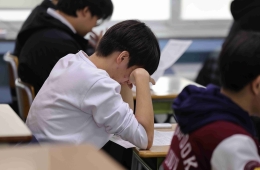
"Let's Trick CSAT Proctors and Extract a Settlement"... Outrageous Scheme Spreads Day Before Exam
Proctors as anxious as test-takers
A post urges "provoking suspicion to file a lawsuit" over AI glasses
Teachers: "We're under pressure whether we catch it or miss it"
Teachers' groups call for a national response
It is not only test-takers who will sit the exam who are feeling anxious and tense with the College Scholastic Ability Test (CSAT) just one day away. Teachers proctoring the CSAT are worried about missing cheating involving AI glasses and miniature cameras, while also fearing that they might wrongly suspect a test-taker wearing ordinary glasses, disrupt the exam, or become entangled in complaints or lawsuits. Amid these circumstances, an online post has even appeared proposing to deliberately arouse a proctor's suspicion and obtain a settlement, fueling controversy.

With the 2027 College Scholastic Ability Test approaching, training was held at the Seoul Metropolitan Office of Education in Yongsan-gu for all 239 staff members who will be assigned to CSAT test sites across Seoul to monitor smart glasses. They learned about the key features of smart glasses and how to identify them, and practiced distinguishing the devices by examining actual smart glasses. Photo by Kang Jinhyung
View original imageYonhap News reported on November 18 that teachers assigned to proctor the CSAT are facing a double burden: pressure to detect new AI devices and concerns that they might harm an innocent test-taker or become entangled in complaints or lawsuits. Since friction, conflict, and lawsuits have in fact occurred between test-takers and proctors, measures to protect proctors are also essential, alongside protections for test-takers against cheating.
"Get Suspected of Wearing AI Glasses and Claim a Settlement": Outrageous Post Adds to CSAT Proctors' Burden
A recent post on social media illustrates the burden on proctors. The author of a post titled "Found a Way to Make Money Off the CSAT" wrote that they would deliberately arouse suspicion at the exam by fiddling with their thick-rimmed glasses and glancing at the proctor. The author claimed that if a proctor asked to check the glasses, they would act anxious and burst into tears, then file a criminal complaint or seek damages against the proctor after the exam to obtain a settlement or other payment. "Ssalmuk" originally referred to converting in-game items or currency into cash, and is also used online to mean making money easily.

The author of a social media post titled “Found a Way to Make Money Off the CSAT” wrote that they would deliberately arouse suspicion at the exam by fiddling with their thick-rimmed glasses and glancing at the proctor.
View original imageAfter the post spread to YouTube, Instagram, and other platforms, users criticized it. One YouTube user said the author was trying to exploit the proctor's duties to extort money. Another called it an attempt to disrupt a national exam for the sake of a settlement, saying it was "even more malicious than actual cheating." Some Instagram users also condemned it as "a social evil." There are concerns that making proctors hesitant to conduct legitimate checks could undermine the rights and interests of test-takers who are taking the exam honestly.
Proctors Have Also Become Entangled in Real Disputes and Lawsuits
Although the post brought the controversy to light, proctors had already been under pressure during the CSAT. With the burden growing this year due to efforts to crack down on cheating, teachers at test sites are under more pressure than ever both to avoid missing suspicious devices and to avoid wrongly identifying innocent test-takers. A middle school teacher surnamed Lee in Busan, who is proctoring this year's CSAT, told Yonhap News that it would be difficult to intervene hastily even if a student appeared to be wearing AI glasses, unless there was clear evidence. The teacher also expressed concern that a student who had not cheated might be unfairly suspected and unable to take the exam properly.

On the afternoon of the 17th, two days before the 2027 College Scholastic Ability Test, employees of the Jeju Provincial Office of Education move exam papers that arrived in Jeju by air to a warehouse. Yonhap News.
View original imageA middle school teacher surnamed Ha in Hapcheon, South Gyeongsang Province, also pointed out that ordinary glasses and smart glasses look alike, making it difficult to leave it to proctors alone to tell them apart with the naked eye. Since complaints are already filed over minor proctoring actions, responding actively to suspicious situations can feel burdensome.
Conflicts over proctoring duties have also arisen. During the 2024 CSAT, a parent visited the school of a proctor who caught a test-taker trying to mark their answer sheet after the exam had ended and held a one-person protest. The Ministry of Education and the Seoul Metropolitan Office of Education viewed this as a threat against the proctor and began a joint response. In a damages lawsuit, whether the proctor's actions had legitimate grounds was a key issue. A test-taker in the 2019 CSAT sought 7 million won in damages from the state and the staff member involved, claiming that an instruction to correct their personal information on the test paper with a computer-scored answer sheet marker had ruined the exam. However, the first- and second-instance courts dismissed the claim, finding no evidence that the instruction lacked objective justification.

Conflicts over proctoring duties also arose. During the 2024 College Scholastic Ability Test (CSAT), a parent visited the school of a proctor who caught a test-taker trying to mark their answer sheet after the exam had ended and held a one-person protest. Photo is unrelated to the specific content of this article. The Asia Business Daily
View original imageBy contrast, in a case involving the 2016 CSAT, a proctor wrongly instructed a test-taker to hand over a "CSAT watch" that they were permitted to bring, leaving them to take the exam without a watch. The first-instance court at the Jeonju District Court ruled that the state and the proctor were jointly liable to pay 5 million won in compensation for emotional distress. An appeal was filed against the ruling. The right to file a lawsuit and the ability to obtain compensation are separate matters; the court considered the actual proctoring conduct and the resulting harm in reaching its decision.
Government Pledges to "Protect Proctors"; Teachers' Groups Call for Specific Measures to Handle Lawsuits

Prime Minister Han Seongsuk delivers a public address on measures to respond to cheating on the College Scholastic Ability Test (CSAT) at the joint briefing room of Government Complex Seoul in Jongno-gu, Seoul, on the afternoon of the 17th. Photo by Jo Yongjun
View original imageAmid a sharp rise in concerns about cheating, the government announced on November 17 that it would deploy more than 8,400 additional personnel at testing sites nationwide, including staff dedicated to monitoring smart devices and hallway proctors, to prevent cheating with AI devices. It will inspect test-takers' glasses before the first exam period and check them again before each subsequent period, and put stickers on buttons on their clothing. If there are suspicious circumstances, it plans to use metal detectors and specialized staff at test headquarters. The government pledged that proctors who carry out their duties conscientiously would not be left to shoulder the burden of unjustified complaints and lawsuits alone.
Despite the government's pledge, teachers' groups say that simply increasing staffing will not be enough to identify advanced devices or resolve disputes. The Korea Federation of Teachers' Associations said that expertise cannot be developed through last-minute additional assignments and training, and called for clear rules on the scope of inspections and procedures for handling cases in which test-takers refuse to be inspected.

Amid a sharp rise in concerns about cheating, the government announced on the 17th that it would deploy more than 8,400 additional personnel, including staff dedicated to monitoring smart devices and hallway proctors, at testing sites nationwide to prevent cheating with AI devices. The photo shows last year's College Scholastic Ability Test. The Asia Business Daily
View original imageThe Korean Teachers and Education Workers Union called for a system in which the state responds to lawsuits, saying teachers could be held responsible both for failing to detect a device and for wrongly suspecting ordinary glasses. The Federation of Korean Teachers' Trade Unions welcomed the government's pledge to protect proctors, while calling for specific measures covering direct responses by education authorities, legal support, and payment of litigation costs.
Hot Picks Today
 "Two Spend 500,000 Won in a Flash, Yet Wait Two Hours?" ... 'Dreamland' Shunned by Kids and Foreign Tourists
- The Era of Getting 200 Million Won After 30 Years Is Over... A Japanese Bank's "Perpetual Department Head" Who Just Clocked In Cries Out
- Spain Hit by Its Worst Tragedy... Lee Kangin, Moreno and Real Madrid Join Soccer World in Mourning
- They Said, “Make It Your Home for Life” - Then Suddenly Kicked 200 Passengers Off... What Happened to the Around-the-World Cruise?
- "130 Rice Bowls Sold Out in a Day"... 'Unfiltered Face' Adds 8 Million Won to Night Market Sales: China's Bungeunwoo
Park Juhyeong, a professor in the Department of Education at Gyeongin National University of Education, stressed that authorities should do more than simply distribute the increasingly complex proctoring manual: they should provide advance training to ensure proctors have fully understood it and to address questions from those working at test sites. The point is that clear standards for on-site procedures and accountability are needed so that test-takers are not disrupted by unnecessary suspicion, while proctors can respond without hesitation. Kang Seongtae, head of Gongshin.com, also pointed to the difficulty of identifying miniature electronic devices in a video posted on November 16 to his YouTube channel, "Study God Kang Seongtae," adding, "It pains me that the Ministry of Education seems to be shifting all the responsibility onto proctors on the ground."
© The Asia Business Daily. All rights reserved. Unauthorized AI training and use prohibited.