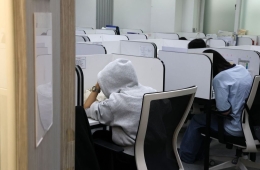
"Catch Cheaters for 100 Million Won? Are Our Kids Proctors?"... Test-Takers and Parents Fume Ahead of CSAT
Government Offers 100 Million Won Reward for Reporting Cheating on the CSAT
Plans to Use Emergency Alerts on Exam Day to Detect Undeclared Phones
Students Fear Disruptions, While Teachers Worry About Lawsuits
Students and parents are protesting a 100 million won reward for reporting cheating and plans to send emergency alerts, both announced two days before the College Scholastic Ability Test (CSAT).
Students: "Emergency alerts will disrupt the test"… Parents: "Are our kids proctors?"

With the 2027 College Scholastic Ability Test (CSAT) just two days away, a high school senior moves reference books from a classroom at Seongji Girls' High School in Masanhappo-gu, Changwon, South Gyeongsang Province, on Nov. 17, ahead of a Chaekgeori ceremony to discard the books she has studied. Yonhap News
View original imageOn the 17th, a post appeared on the online community for CSAT candidates "Sumanhui": "The sound of an emergency alert will lower our scores more than AI cheating ever could." Another user wrote, "If an emergency alert goes off during the test, the whole class is doomed," and asked, "Could we sue the government if an alert sounds during the English listening test?" Another post asked, "If an emergency alert goes off, won't the first person in that class to report it get the 100 million won reward?"
The government's proposed 100 million won reward has drawn criticism over the potential for abuse. A user on the CSAT community Orbi wrote, "With a 100 million won reward on offer, I'm more afraid of being targeted in a witch hunt than of monitoring cheating." Other posts pointed out loopholes, asking, "Couldn't two students who don't plan to go to college work together, with one using a miniature camera and the other reporting them, then split the reward?" and saying, "Looking for someone to split 100 million won with." Another user wrote, "The president seems to think this is just one or two people fooling around, judging by the 100 million won reward."
On the parent community "Romulcon," users complained that the burden of monitoring had been shifted to students. They asked, "Are our kids going to the test as candidates or as proctors?" and "Why should students, who need to focus on the exam questions, have to catch cheaters?" Another post called the plan "an alternative with no practical effect, meant to quell public opinion and pull the wool over our eyes."

Used test-preparation books are piled up at Gangbuk Jongno Academy in Seongbuk-gu, Seoul, on Nov. 17, two days before the College Scholastic Ability Test (CSAT). Yonhap News.
View original imageSome also questioned the policy review process. One post on a community forum asked, "Proctors will have their phones turned on too, so did they really think this through before deciding to send emergency alerts during the test?" Another user commented, "I saw the emergency alert idea on a community forum yesterday. Did the government come up with this policy after reading online forums? It's a farce."
Teachers voice concerns: "It's a problem whether we catch them or not"
Teachers' organizations opposed the plan to bring in more than 8,400 additional exam proctors. The Korean Federation of Teachers' Associations (KFTA) criticized the plan, saying, "The CSAT is just two days away. If proctors are hurriedly selected today, trained tomorrow and deployed the day after, will they really develop the expertise to detect sophisticated AI-assisted cheating?" The Korean Teachers and Education Workers Union also said, "Increasing the number of proctors does not automatically give them the expertise to identify advanced devices."

Teachers preparing to proctor the exam said they were worried about complaints and lawsuits. The Korean Teachers and Education Workers Union (KTU) said, "If normal behavior is suspected of being cheating, complaints may follow. If a cheating device goes undetected, teachers could be held responsible for failing to supervise properly. That's why teachers say, 'It's a problem whether we catch them or not.'" A middle school teacher in Busan who will serve as a proctor this year told Yonhap News, "Even if a student appears to be wearing AI glasses, it may be difficult to stop them without clear evidence. I had already been thinking that I could be sued if I suspected someone wrongly."
"Emergency alerts have loopholes… AI companies should be asked to restrict responses"

Notices related to the government’s plan to crack down on cheating using AI (artificial intelligence) during the College Scholastic Ability Test (CSAT) are displayed at a store in Seoul on the 17th, the day Prime Minister Han Seongsuk announced the plan at a Cabinet meeting. Yonhap News
View original imageMeanwhile, Kang Seongtae, known as the "God of Studying," pointed out a loophole in the emergency alert plan in an interview with KBS. "There are so many devices that don't receive emergency alerts," he said. "If you put a SIM card that provides data only into a tablet, no emergency alert will sound at all."
Kang proposed asking generative AI companies to restrict responses, or put guardrails in place, as an alternative. "Just as they don't answer questions about self-harm or suicide, they could be set not to respond when a CSAT-style image is uploaded, making it effectively difficult to get an answer," he said. "CSAT questions have fixed fonts, formatting and line spacing, so AI can identify them well enough." Responding to the deputy prime minister's comment that it would be difficult to create a separate model or filter, he said, "There's no need to tune the model in the first place," adding, "OpenAI's published guardrail rules also state that they are applied differently in each country."
On the 17th, Prime Minister Han Seongsuk said in a public address that an emergency alert would be sent on the morning of the CSAT to identify students who had not turned in their mobile phones. President Lee Jae-myung held a video conference and instructed officials to pay rewards of more than 100 million won to people who report cheating and to send at least one additional emergency alert without prior notice. After the meeting, he wrote on X (formerly Twitter) that cheating was like stealing other students' grades.
Hot Picks Today
 "Two Spend 500,000 Won in a Flash, Yet Wait Two Hours?" ... 'Dreamland' Shunned by Kids and Foreign Tourists
- The Era of Getting 200 Million Won After 30 Years Is Over... A Japanese Bank's "Perpetual Department Head" Who Just Clocked In Cries Out
- Spain Hit by Its Worst Tragedy... Lee Kangin, Moreno and Real Madrid Join Soccer World in Mourning
- They Said, “Make It Your Home for Life” - Then Suddenly Kicked 200 Passengers Off... What Happened to the Around-the-World Cruise?
- "130 Rice Bowls Sold Out in a Day"... 'Unfiltered Face' Adds 8 Million Won to Night Market Sales: China's Bungeunwoo
Earlier, the top scorer on the 63rd Certified Tax Accountant Examination confessed to cheating with AI and a miniature camera, and appeared at a police station on the 17th for more than 13 hours of questioning. The test taker who became the first to achieve a perfect score on the multiple-choice section of the Law School Admission Test (LEET) last July is also suspected of using AI to cheat.
© The Asia Business Daily. All rights reserved. Unauthorized AI training and use prohibited.