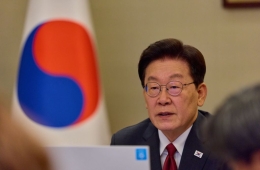
Kwon Soongi, Gyeongsangnam-do Superintendent of Education, Stages One-Person Protest Outside National Assembly ... "Enact the Local Education Finance Win-Win Plan"
"Please enact the Local Education Finance Win-Win Plan so our children can continue learning in a stable educational environment."
Kwon Soongi, superintendent of education for Gyeongsangnam-do, staged a one-person protest at the main gate of the National Assembly in Yeouido, Seoul, on November 17, calling for the enactment of the "Local Education Finance Win-Win Plan."
Kwon and other superintendents of education from across the country expressed strong concern over the government's proposal to abolish the current system, which allocates 20.79% of total domestic tax revenue to local education finance grants, and to introduce a bill partially amending the Local Education Finance Grant Act to reflect changes in the school-age population and the nominal growth rate. In response, they proposed the Local Education Finance Win-Win Plan as a buffer to ensure stable funding for education.

Kwon Sunki, superintendent of education for Gyeongsangnam-do, stages a solo protest in front of the main gate of the National Assembly in Yeouido, Seoul, on the 17th, calling for the passage of the “Local Education Finance Win-Win Plan.” [Photo provided by the Gyeongsangnam-do Office of Education]
View original imageThe plan would maintain the link between local education finance grants and 20.79% of domestic tax revenue. If tax revenue rises by at least 5% from the previous year, two-thirds of the amount exceeding that threshold would be contributed to the National Future Response Fund. If tax revenue falls by at least 5%, the government would make up one-third of the amount beyond that threshold.
The plan also calls for legally specifying a settlement amount of 11.7 trillion won through 2026 under the previous rules, designating support for education and talent development in the National Future Response Fund, and including members recommended by a council of superintendents of education.
Superintendents of education from across the country have decided to hold a relay of one-person protests to raise awareness of the plan's necessity and call for its swift enactment as deliberations on next year's budget proposal and related bills get underway.
Kwon is the first to take part in the nationwide relay of one-person protests by superintendents of education.
"Cutting the budget simply because the number of students is declining weakens the foundations of future education," Kwon said. "Please join forces to ensure the plan is enacted swiftly, cushioning the impact of fluctuations in tax revenue and making education funding more predictable."
Kwon and other superintendents of education from across the country plan to work closely with the National Assembly through the end of November, when budget-related bills are automatically referred to a plenary session, to ensure the plan's principles are reflected in legislation.
Hot Picks Today
 "Two Spend 500,000 Won in a Flash, Yet Wait Two Hours?" ... 'Dreamland' Shunned by Kids and Foreign Tourists
- The Era of Getting 200 Million Won After 30 Years Is Over... A Japanese Bank's "Perpetual Department Head" Who Just Clocked In Cries Out
- Spain Hit by Its Worst Tragedy... Lee Kangin, Moreno and Real Madrid Join Soccer World in Mourning
- They Said, “Make It Your Home for Life” - Then Suddenly Kicked 200 Passengers Off... What Happened to the Around-the-World Cruise?
- "130 Rice Bowls Sold Out in a Day"... 'Unfiltered Face' Adds 8 Million Won to Night Market Sales: China's Bungeunwoo
The superintendents' relay of one-person protests will continue for a week, through November 26, excluding the College Scholastic Ability Test (CSAT) day and weekends.
© The Asia Business Daily. All rights reserved. Unauthorized AI training and use prohibited.