Government: "AI-related cheating on CSAT to be tracked with Big Tech and telecom firms... Test-center Wi-Fi to be blocked"
Ministry of Science and ICT to Trace AI and Communications Usage Records with Global Big Tech
Wi-Fi Access Inside and Near Schools to Be Blocked
The government will work with global Big Tech and telecommunications companies to trace cheating involving generative artificial intelligence (AI) after the fact during the 2027 College Scholastic Ability Test (CSAT). Wi-Fi access inside schools being used as test centers and on nearby public Wi-Fi networks will be blocked.
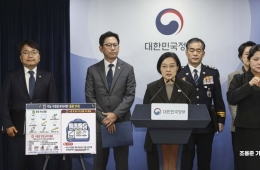
Deputy Prime Minister and Minister of Science and ICT Bae Kyunghoon said on the afternoon of Nov. 17, at a public address on measures to address cheating on the CSAT held at the Government Complex Seoul in Jongno-gu, Seoul, "For this CSAT only, we have decided to seek active cooperation from global Big Tech companies."

Deputy Prime Minister and Minister of Science and ICT Bae Kyunghoon answers reporters' questions while delivering a public address on measures to respond to cheating on the College Scholastic Ability Test at the Joint Briefing Room of the Government Complex Seoul in Jongno-gu, Seoul, on the afternoon of Nov. 17, 2026. Photo by Cho Yongjun
View original imageDeputy Prime Minister Bae explained, "To use AI, an image must first be taken, then sent to the cloud for analysis. We have decided to work actively with global Big Tech companies to check communication records and whether AI was used during this process."
He added that it would be difficult to block the use of AI to solve test questions outright. "It is not easy to separately tune models or create separate filters just for South Korea," Deputy Prime Minister Bae said, explaining that the government would respond by analyzing records after the fact. China, which has effectively allowed only domestic companies' AI services through regulations, previously blocked generative AI services from solving questions during the Gaokao, its university entrance exam.
"If we can identify those who cheated, we can analyze and review the relevant records and take action," Deputy Prime Minister Bae said. "We have not reached full agreement on every matter, but the Big Tech companies have agreed to cooperate actively when requested by the government."
He dismissed as technically impossible measures to block communications networks, which had been proposed by some. Instead, Deputy Prime Minister Bae said, "We are preparing to block Wi-Fi in areas around test centers, Wi-Fi inside schools, and public Wi-Fi. Since personal Wi-Fi cannot be completely blocked, we will check Wi-Fi connection records."
He also proposed working with telecommunications companies to trace communication records after the fact. Deputy Prime Minister Bae explained, "Communication records are left not only through Wi-Fi but also through telecommunications companies," adding, "We plan to analyze records of communications use and take action even after the fact, and we will use the relevant logs to identify those involved."
Hot Picks Today
 "Two Spend 500,000 Won in a Flash, Yet Wait Two Hours?" ... 'Dreamland' Shunned by Kids and Foreign Tourists
- The Era of Getting 200 Million Won After 30 Years Is Over... A Japanese Bank's "Perpetual Department Head" Who Just Clocked In Cries Out
- Spain Hit by Its Worst Tragedy... Lee Kangin, Moreno and Real Madrid Join Soccer World in Mourning
- They Said, “Make It Your Home for Life” - Then Suddenly Kicked 200 Passengers Off... What Happened to the Around-the-World Cruise?
- "130 Rice Bowls Sold Out in a Day"... 'Unfiltered Face' Adds 8 Million Won to Night Market Sales: China's Bungeunwoo
Regarding suggestions from some to use radio signal detectors, Deputy Prime Minister Bae said, "We are not currently using them separately." However, he said, "If Wi-Fi, LTE, 5G, 6G, or other communication functions are actually turned on, we can detect them. We will establish a system that allows designated proctors to respond in real time."
© The Asia Business Daily. All rights reserved. Unauthorized AI training and use prohibited.