U.S. Turton Capital CEO: "Corporate Governance Is Key to the Korea Discount"
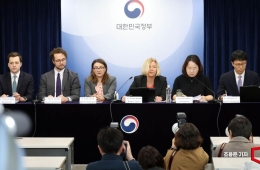
CEO Albert Ryan's press conference
"Japan took 10 years; Korea's Value-Up delivered results in 2.5
Unique corporate governance... Further reforms needed"
Ryan Albert, CEO of U.S.-based investment firm Turton Capital, identified corporate governance as the core of the “Korea discount” and said reforms related to corporate control are needed.
Speaking at a press conference at FKI Tower in Yeouido, Seoul, on the morning of Nov. 17, Albert said, “It is true that recent stock price volatility has been caused by the fact that two semiconductor companies account for more than 50% of the KOSPI. However, the return on equity (ROE) of the Korean stock market has been around 7% over the past 20 years. Corporate governance is not the only reason, but I believe it is the biggest factor.”

Ryan Albert, CEO of Turton Capital, speaks at a press conference held at FKI Tower in Yeouido, Seoul, on the morning of the 17th. Courtesy of Turton Capital.
View original imageHe continued, “Among many listed companies in Korea, when a founder’s family holds a controlling stake, its ownership is usually around 20% to 40%, yet the company is run as if the family owned all the shares. In the end, rather than trying to raise share values and maximize shareholder value, companies often keep their stock prices low because of the burden of inheritance or gift taxes.”
He said the Korean government’s Value-Up policy was producing results quickly but remained at an early stage. “Through its Value-Up policy, Korea has achieved in two and a half years what took Japan more than 10 years,” he said. “However, the key difference between Korea and Japan is that shareholders with controlling stakes hold a very large 20% to 40% stake in Korea, while their stakes are much smaller in Japan. Given this distinctive difference, other types of regulations and reforms will be needed to achieve the full benefits.”
He also likened the Value-Up policy to baseball, describing it as being in the “second or third inning.” Albert said, “If the introduction of reform measures was the first inning, we are now in the second or third inning, putting them into practice. In the fourth to sixth innings, various additional reforms will be introduced, and the resulting growth will continue into the seventh and eighth innings.”
In response to opposition from the business community, he emphasized the importance of protecting minority shareholders. Albert said, “I understand why controlling shareholders may be hesitant about the Value-Up policy. But thanks to these policies, minority shareholders now have a way to make their voices heard. I believe various measures, including the 3% rule, have been implemented effectively to protect minority shareholders.”
He did not take a side in the debate over whether the scope of mandatory tender offers should be set at “50% plus one share” or “100%.” He said, “I don’t think 100% is better or worse than 50% plus one share. Some countries have adopted 100%, while others have adopted 50% plus one share, and both approaches have been effective. However, if the threshold is 50% plus one share, allocating shares on a pro rata basis according to each shareholder’s existing stake would be fair to all shareholders.”
Turton Capital also conveyed its requests regarding three domestic companies in which it has engaged publicly as a shareholder. Regarding Golfzon Holdings, the firm said, “We are interested not so much in who ultimately acquires Golfzon County as in realizing the value of Golfzon County itself. We have not yet received a response on this matter, and we hope the company will find a way to maximize shareholder value.” It added that it did not particularly favor either an IPO of Golfzon County or its acquisition by Golfzon Holdings.
Regarding Dong-A Pharmaceutical, it said, “We are considering proposing experts in consumer health and consumer goods, as well as experts in asset allocation. We believe that appointing an expert as an outside director would benefit Dong-A Pharmaceutical, even if that person is not someone we propose.”
Hot Picks Today
 "Two Spend 500,000 Won in a Flash, Yet Wait Two Hours?" ... 'Dreamland' Shunned by Kids and Foreign Tourists
- The Era of Getting 200 Million Won After 30 Years Is Over... A Japanese Bank's "Perpetual Department Head" Who Just Clocked In Cries Out
- Spain Hit by Its Worst Tragedy... Lee Kangin, Moreno and Real Madrid Join Soccer World in Mourning
- They Said, “Make It Your Home for Life” - Then Suddenly Kicked 200 Passengers Off... What Happened to the Around-the-World Cruise?
- "130 Rice Bowls Sold Out in a Day"... 'Unfiltered Face' Adds 8 Million Won to Night Market Sales: China's Bungeunwoo
It also said Orion needs a comprehensive review of its capital allocation. Albert said, “We should consider the investment in LIGACHEM BIOSCIENCES, as well as the bid to acquire JoongAng Ilbo, from the perspective of capital allocation. I believe the company needs to establish a framework for capital allocation, its dividend payout ratio and reinvestment.”
© The Asia Business Daily. All rights reserved. Unauthorized AI training and use prohibited.