President Lee to China and Japan at ASEAN+3 Summit: “We Should Learn from Kim Dae-jung, Obuchi and Zhu Rongji’s Decisions” (Roundup)
Mention first Korea-China-Japan meeting in Manila in 1999
Urge regional cooperation ahead of ASEAN Plus Three's 30th anniversary
Call for support for peaceful coexistence on the Korean Peninsula
Adopt statements on maritime trade and external sho
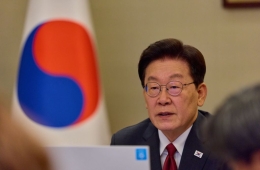
At the 29th ASEAN+3 Summit in Manila, Philippines, on Nov. 17 (local time), President Lee Jaemyung invoked the trilateral meeting between South Korea, China and Japan initiated by former President Kim Dae-jung, addressing China and Japan. “I believe the visionary decision by the three leaders to open up new avenues for cooperation centered on shared economic interests is a model we should learn from in this era of multiple crises,” he said. President Lee is also holding a summit with Japanese Prime Minister Sanae Takaichi today and will travel to Shenzhen, China, where the Asia-Pacific Economic Cooperation (APEC) summit will be held on Nov. 18.

South Korean President Lee Jaemyung speaks at the Korea-ASEAN Summit held at the Philippine International Convention Center (PICC) in Manila, Philippines, on Nov. 16 (local time). 2026.11.16 Yonhap News Agency
View original imageAt the meeting, President Lee said, “The history of trilateral cooperation among South Korea, China and Japan began here in Manila,” looking back at the origins of the cooperation and emphasizing the importance of regional coordination. He added, “ASEAN+3, launched amid the 1997 East Asian financial crisis, began to take shape as an institutional framework at the 1999 Manila Summit.” He also said that ASEAN+3 had contributed to the region’s crisis response through its joint experience of the global food price crisis and the COVID-19 pandemic.
The trilateral summit meeting President Lee referred to came about after former President Kim proposed a breakfast meeting with then-Japanese Prime Minister Keizo Obuchi and then-Chinese Premier Zhu Rongji at the ASEAN+3 meeting in Manila in November 1999. That meeting became the starting point for the trilateral summit and helped ease strained relations between China and Japan. Amid a year-long chill between China and Japan over Prime Minister Takaichi’s remarks about Taiwan, President Lee appears to be seeking to lower tensions by taking the initiative to emphasize the importance of trilateral cooperation.
With the 30th anniversary of ASEAN+3’s establishment coming next year, President Lee also stressed that the countries “must work together to strengthen our ability to respond to and recover from multiple crises, and lay the foundations for sustainable future growth.” He said South Korea had led the East Asia Vision Group (EAVG) twice to explore ASEAN+3’s medium- and long-term development direction, adding, “The Republic of Korea will fulfill its due responsibilities and role as ASEAN+3 plans its future for the next 30 years.”
At the subsequent closed-door meeting, President Lee proposed improving the efficiency and use of existing cooperation mechanisms in food and energy security, and strengthening crisis response capabilities by making comprehensive use of the strengths of individual partnerships, including ASEAN-South Korea, ASEAN-China and ASEAN-Japan cooperation, Cheong Wa Dae spokesperson Kim Seongwan said. President Lee also stressed the need to expand the achievements made under ASEAN+1 in areas such as transnational crime, the ASEAN power grid and the digital economy into ASEAN+3 cooperation to multiply its impact. He also called for expanding talent development and people-to-people exchanges to keep pace with new conditions, including artificial intelligence (AI) and the digital transition.
President Lee also called for ASEAN+3’s continued attention and support to ensure that the South Korean government’s efforts to promote stability and development on the Korean Peninsula, including peaceful coexistence and shared growth, lead to regional peace and shared prosperity. “The leaders shared the view that ASEAN+3, which has demonstrated its value during regional crises, needs to find a breakthrough for cooperation amid today’s multiple crises,” spokesperson Kim said. “They agreed that concrete results in cooperation should be achieved next year, when ASEAN+3 marks its 30th anniversary.” At the meeting, the leaders adopted the “Leaders’ Statement on Maritime Trade and Logistics Connectivity” and the “Leaders’ Statement on External Shocks” to reflect this commitment.
After completing his ASEAN+3 summit schedule today, President Lee will hold a separate summit with Prime Minister Takaichi. It will be their fourth meeting and the first in about six months, following their talks in Andong last May. With a U.S.-China-Russia summit expected in Shenzhen and possible contact between North Korea and the United States being discussed in connection with U.S. President Donald Trump’s trip to Asia, attention is focused on what position the two leaders will take on issues concerning the Korean Peninsula. President Lee will also attend the East Asia Summit (EAS) for the first time since taking office, where he plans to call for regional cooperation in responding to online scams and advancing his vision for peaceful coexistence on the Korean Peninsula.
The previous day, at the Korea-ASEAN Summit, President Lee called for the launch of negotiations to improve the free trade agreement (FTA), saying, “We must move forward together toward an era of $300 billion in annual trade.” At the Korea-Mekong Summit, held for the first time in six years, he proposed expanding cooperation on critical mineral supply chains by combining mineral resources from the Mekong region with South Korean technology. South Korea and Thailand agreed to accelerate negotiations on a Comprehensive Economic Partnership Agreement (CEPA), while South Korea and the Philippines agreed to expand cooperation into shipbuilding, artificial intelligence (AI) and nuclear power. On the night of Nov. 16, President Lee and his wife attended a dinner hosted by Philippine President Marcos and his wife during the ASEAN Summit.
Hot Picks Today
 "Two Spend 500,000 Won in a Flash, Yet Wait Two Hours?" ... 'Dreamland' Shunned by Kids and Foreign Tourists
- The Era of Getting 200 Million Won After 30 Years Is Over... A Japanese Bank's "Perpetual Department Head" Who Just Clocked In Cries Out
- Spain Hit by Its Worst Tragedy... Lee Kangin, Moreno and Real Madrid Join Soccer World in Mourning
- They Said, “Make It Your Home for Life” - Then Suddenly Kicked 200 Passengers Off... What Happened to the Around-the-World Cruise?
- "130 Rice Bowls Sold Out in a Day"... 'Unfiltered Face' Adds 8 Million Won to Night Market Sales: China's Bungeunwoo
On Nov. 18 in Shenzhen, President Lee will hold a luncheon meeting with South Korean residents in southern China and attend the APEC CEO Summit and a welcome dinner hosted by Chinese President Xi Jinping and his wife. At the APEC plenary session on Nov. 19, he is expected to call on member economies to work together to respond to energy supply chain shocks originating in the Middle East and restore the multilateral trading system.
© The Asia Business Daily. All rights reserved. Unauthorized AI training and use prohibited.