KOSPI Could Plunge to 3,900... Mandatory Tender Offer System Needs 'Reconsideration from the Outset'
Governance Forum: "Directly conflicts with the principle of equal treatment of shareholders and the amended Commercial Act"
"KOSPI could fall to 3,900 if investor sentiment worsens"
Calls argument for boosting M&A activity &q
The Korea Corporate Governance Forum warned that the KOSPI could plunge to around 4,200 if the mandatory tender offer system, which limits the offer to "50%+1 share" rather than requiring a tender offer for 100% of shares, passes the National Assembly without revisions. It cautioned that, if investor sentiment deteriorates, the index could fall as low as 3,900.
In a statement on the 17th, the forum said, "If the bill to amend the Capital Markets Act to introduce a mandatory tender offer system, currently pending in the National Assembly, passes the plenary session in its original form without revisions, a sharp drop in share prices is expected due to large-scale foreign selling."
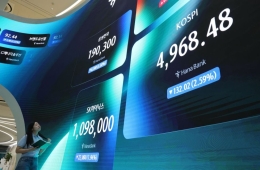
The forum said, "The decline could take the KOSPI to 4,200, where the price-to-book ratio (PBR) is around 1, or even to 3,900 if supply-demand imbalances worsen." It added, "Expectations for the semiconductor cycle have weakened, and if confidence in the government's governance reforms is fundamentally shaken, past experience suggests that the PBR is likely to fall below 1. A KOSPI PBR below 1 is not an exception but has been the norm over the past 30 years."

A mandatory tender offer system requires an acquirer to make a tender offer for at least a specified percentage of a company's shares when control of the company changes hands. It gives ordinary shareholders an opportunity to share in the control premium. There are widespread concerns in the market that, if the bill approved by the National Assembly's Political Affairs Committee passes unchanged, it will widen the disparity between controlling shareholders and ordinary shareholders, running counter to the very purpose of the Commercial Act amendments, which is to ensure equal treatment of shareholders. This is because the bill limits the shares to be acquired to "50%+1 share" on the grounds that a broader requirement would constrain mergers and acquisitions (M&A), while also allowing the acquirer to purchase the controlling shareholder's stake in advance.
"We ask the National Assembly: Do you oppose the amended Commercial Act's requirement to 'treat the interests of all shareholders fairly'?" the forum said. It also stressed, "A mandatory tender offer system that conflicts with the duty of loyalty to shareholders needs to be reconsidered from the ground up. A 100% mandatory tender offer is a system that protects the property rights of 14.4 million individual investors and, in effect, the entire population, as beneficiaries of the National Pension Service, and is in line with global standards."
By contrast, the forum criticized the current bill as "a system that favors a small number of interested parties, including some controlling shareholders of more than 2,000 listed companies and private equity (PE) firms," adding that it "allows wealth to be transferred to a minority accounting for less than 0.01% of the population at the expense of the property rights of 99.99%." The forum asked, "Who is this legislation really for?" and said, "The National Assembly should protect the property rights of the public, not the privileges of a small number of controlling shareholders and private equity stakeholders."

The International Corporate Governance Network (ICGN), whose members have more than $100 trillion in assets under management, also recently sent an official letter to the National Assembly urging improvements to the bill, warning that it may not fully uphold the fundamental principle of equal treatment of shareholders or achieve its original purpose.
The forum noted that the Asian Corporate Governance Association (ACGA), the ICGN and others had publicly voiced concerns, saying that "'50%+1 share' and 'advance purchases' are in direct conflict with the principle of equal treatment of shareholders and the amended Commercial Act." It also said, "Every foreign long-term investor we have met recently has expressed serious concern that the Lee Jae-myung government's capital market policies may be making a 180-degree U-turn." It added, "Investors find it difficult to trust a country that does not protect ordinary shareholders, and are seriously considering whether to make long-term investments in Korea."
The forum also pointed out that foreign investors have continued to sell on a large scale recently, even though the KOSPI has fallen more than 40% from its June peak, calling this "a warning signal to the National Assembly and the government for acting against directors' duty of loyalty."
The forum said, "If the pending Capital Markets Act amendment passes the National Assembly unchanged, most cases will follow a downward trajectory, with share prices structurally declining after controlling shareholders exit, as happened with Aekyung Industrial." It noted that Aekyung Industrial's share price hit a one-year high of 19,100 won in February but has since fallen to around 10,000 won. It also cited Taekwang's adjusted acquisition price of 26,642 won for Aekyung Industrial, a 77% premium over the share price of 15,000 won at the time. The forum said ordinary shareholders who were excluded from the opportunity to participate in the sale had no choice but to watch the share price fall.
The forum also shared comments sent this week by an official at a leading sovereign wealth fund. The official said, "The Korean market is facing significant challenges. In an extreme case, many listed companies could be reduced to shells with only minority stakes remaining under controlling shareholders, further weakening shareholder oversight and corporate governance. Ultimately, overseas investors will come to prefer investment destinations other than Korea."
The forum therefore argued, "If the current government aims for gradual, sustained growth in the capital market, it should focus not only on protecting shareholder rights and upholding the principle of equal treatment of shareholders, but also on raising market equity valuation multiples." It added, "The introduction of bear-hug rules should be completed by the end of the year, and the pending mandatory tender offer bill should be put on hold. If the government insists on moving forward, requiring a 100% acquisition to prevent exploitative transactions is the right answer."
Related Articles
 President Lee: "Promote M&A Despite Criticism... Mandatory Tender Offers Come Down to Resolve"
- [Reporter's Notebook] Companies Ignoring "PBR Improvement Plans" Should Face Mandatory Tender Offers
- Concerns Mount Overseas... ICGN: "Ban Prior Acquisitions in Mandatory Tender Offers"
- "‘Loopholes’ abound, undermining equal treatment of shareholders"... The paradox of the mandatory tender offer bill’s ‘50% plus one share’ rule
The forum criticized as "unconvincing" the argument that the current "50%+1 share" approach is needed to promote M&A. It said, "In developed countries such as the United States, M&A activity is robust while ordinary shareholders are guaranteed a fair opportunity to sell. This is clear empirical evidence that protecting shareholder rights and promoting M&A can coexist." It added, "Ultimately, the argument that a 100% tender offer would stifle M&A is merely a self-serving claim by interested parties who oppose full tender offers and seek to let controlling shareholders and PE funds alone monopolize control premiums."
© The Asia Business Daily. All rights reserved. Unauthorized AI training and use prohibited.