IMF Raises South Korea's Growth Forecast to Nearly 4% This Year, Up 0.6 Percentage Points in a Month
Forecast raised again in a month on semiconductor boom
Highest among major institutions
Calls for structural reforms
The International Monetary Fund (IMF) raised its forecast for South Korea’s economic growth this year to 3.9%. Reflecting record-high semiconductor exports driven by increased global investment in artificial intelligence (AI), it forecast that growth in the 3% range would continue next year.
According to the Ministry of Finance and Economy on Nov. 17, the IMF’s Korea mission team raised its forecast for the country’s growth this year by 0.6 percentage points, from 3.3% to 3.9%, following its annual consultation conducted over two weeks starting on Nov. 3. This came just one month after it raised its forecast from 2.6% to 3.3%, an increase of 0.7 percentage points.
The latest forecast is higher than those of domestic and international institutions, including the Organization for Economic Cooperation and Development (OECD, 3.7%), the ASEAN+3 Macroeconomic Research Office (AMRO, 3.3%), the National Assembly Budget Office (3.5%), and the Korea Development Institute (KDI, 3.2%).

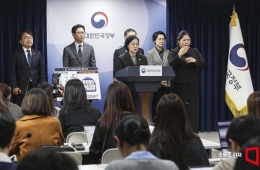
Deputy Prime Minister and Minister of Finance and Economy Lee Hyung-il shakes hands with Corinne Delechat, head of the IMF Asia and Pacific Department’s Korea mission for its annual consultation, before their meeting at the Government Complex Seoul in Jongno-gu, Seoul, on the 17th. Ministry of Finance and Economy
View original imageIn its statement, the mission team said, "The global AI boom is providing the Korean economy with an exceptional growth engine through record-high semiconductor exports," adding that "this is translating into robust corporate earnings and higher fiscal revenues."
It forecast that robust growth of 3.3% would continue next year, as higher incomes in high-tech industries spread to consumption and investment in the AI transition accelerates.
Mission Chief Corinne Delechat said in a statement, "These investments will contribute to raising potential growth over the medium term."
The inflation outlook was unchanged from the previous forecast. While government measures, including the introduction of a price ceiling, have eased some of the price pressures stemming from rising energy prices, the IMF forecast that inflation would reach 2.7% this year and 2.3% next year as the domestic recovery gains strength.
However, it said the benefits of growth were not spreading across the economy as a whole. The mission team said, "The gains from growth are concentrated mainly in high-tech industries, and their spillover across the broader economy will be gradual," and recommended that "the near-term macroeconomic policy stance should be carefully calibrated to mitigate risks arising from concentration in specific sectors."
It said further monetary tightening would be appropriate to prevent inflationary pressures from becoming entrenched. It advised that maintaining a somewhat contractionary fiscal stance while providing targeted support to vulnerable households and businesses would help contain aggregate demand pressures.

The IMF also called for structural reforms, citing rapid population aging, deepening regional imbalances, and uneven productivity gains between companies and workers as longstanding structural constraints.
It pointed to stimulating household consumption, expanding investment opportunities, and reducing exposure to external shocks, and advised that policies to raise labor force participation, narrow wage gaps across types of employment, and strengthen the social safety net would help boost household incomes and consumption.
Hot Picks Today
 "Two Spend 500,000 Won in a Flash, Yet Wait Two Hours?" ... 'Dreamland' Shunned by Kids and Foreign Tourists
- The Era of Getting 200 Million Won After 30 Years Is Over... A Japanese Bank's "Perpetual Department Head" Who Just Clocked In Cries Out
- Spain Hit by Its Worst Tragedy... Lee Kangin, Moreno and Real Madrid Join Soccer World in Mourning
- They Said, “Make It Your Home for Life” - Then Suddenly Kicked 200 Passengers Off... What Happened to the Around-the-World Cruise?
- "130 Rice Bowls Sold Out in a Day"... 'Unfiltered Face' Adds 8 Million Won to Night Market Sales: China's Bungeunwoo
Mission Chief Delechat said, "Targeted efforts to support the widespread adoption and diffusion of AI, including by developing regional growth hubs and making public investments to boost productivity outside the capital region, will underpin more balanced development and unlock new productive investment opportunities." She added, "We welcome the authorities' focus on addressing longstanding structural challenges through their economic growth strategy, including by promoting balanced regional development."
© The Asia Business Daily. All rights reserved. Unauthorized AI training and use prohibited.