"Selling Only Individual Titles Just Lines the Pockets of Overseas Platforms"... Business Community Urges Support for Homegrown OTTs
Service Industry Committee Meets with Culture Minister
Proposes Expanding IP-Securing Production Support to 100 Billion Won
Urges Prompt Enactment of Framework Act on Service Industry Development
It was suggested that homegrown distribution platforms should be actively supported in their global expansion to create a virtuous cycle in which the worldwide success of K-content leads to growth and reinvestment in domestic industries.
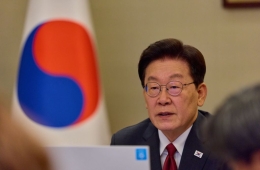
On November 18, the Korea Enterprises Federation (KEF) held the fourth meeting of its Service Industry Competitiveness Enhancement Committee at the conference center in FKI Tower in Yeouido, Seoul, with Choi Hwiyeong, Minister of Culture, Sports and Tourism, as a guest. Around 20 business leaders representing the culture and service industries attended, including committee chair Hur Minhoe, CEO of CJ.

In his opening remarks, Minister Choi said, "As K-culture is the country's third-largest export industry after semiconductors and automobiles, we will strengthen policy financing and tax support to create a virtuous cycle in which global interest leads to corporate growth and investment in creative work."
In his welcoming remarks, Chair Hur emphasized, "Investment in the cultural industry is an investment in growing the entire K-lifestyle ecosystem. Institutional support from the government is needed to ensure that the interest in Korea generated by content translates into economic gains for the country."
Cho Youngshin, a professor at Dongguk University and CEO of the Media Entertainment Research Institute C&X, delivered a presentation diagnosing a crisis in the revenue structure of Korea's video content ecosystem. Revenue has risen substantially for games, music and webtoons, in which domestic businesses own the distribution rights or intellectual property (IP). By contrast, film, television and video content, for which global online video services (OTT) control both distribution and IP, are experiencing negative growth.
A prominent example is Season 1 of Squid Game. The estimated economic value of about 1.0546 trillion won, according to Netflix's own estimate, and all revenue from IP expansion went to overseas platforms. The domestic production company's earnings, meanwhile, amounted to only around 2 billion to 4 billion won.
Professor Cho proposed "the global expansion of K-OTTs" as a solution, arguing that homegrown distribution platforms themselves should be built up rather than relying on individual sales of content rights. "Only by growing K-OTTs into a 'second gateway overseas' for Korean content and directly acquiring overseas subscribers can we complete a virtuous cycle in which that revenue flows back into increased domestic production and the production ecosystem," he explained.
The KEF's Service Industry Committee submitted 20 policy proposals to the government to boost investment in the cultural industry. First, it called for increased policy financing for content, including tax benefits such as tax exemptions on capital gains for private investors. It also proposed extending first-loss coverage, under which government contributions absorb losses first, to strategic investors (SIs), including large corporations, to encourage private capital inflows.
It also called for the introduction of tax credits for production costs for games and music content, and for support to strengthen the competitiveness of K-content IP. This year, the government's "Production Support for OTT-Specific Content" program is limited to 21 productions, with a total budget of 13.5 billion won. The committee urged the government to significantly expand the program over the medium to long term, to more than 100 billion won in total and at least 4 billion won per production. It also proposed creating a fund in which private capital would be matched one-to-one with subordinated government investments.
Hot Picks Today
 "Two Spend 500,000 Won in a Flash, Yet Wait Two Hours?" ... 'Dreamland' Shunned by Kids and Foreign Tourists
- The Era of Getting 200 Million Won After 30 Years Is Over... A Japanese Bank's "Perpetual Department Head" Who Just Clocked In Cries Out
- Spain Hit by Its Worst Tragedy... Lee Kangin, Moreno and Real Madrid Join Soccer World in Mourning
- They Said, “Make It Your Home for Life” - Then Suddenly Kicked 200 Passengers Off... What Happened to the Around-the-World Cruise?
- "130 Rice Bowls Sold Out in a Day"... 'Unfiltered Face' Adds 8 Million Won to Night Market Sales: China's Bungeunwoo
The committee also called for the prompt enactment of the Framework Act on the Development of the Service Industry. It said an institutional foundation for consistent policy support must be established so that the service industry can become a pillar of national growth alongside manufacturing.
© The Asia Business Daily. All rights reserved. Unauthorized AI training and use prohibited.