"AI Exports to Support Korean Growth... Economy Could Take a Hit if AI Investment Adjustments and Fiscal Instability Coincide"
KIEP Forecasts 3.2% Global Growth Next Year
The Korea Institute for International Economic Policy (KIEP), a state-run research institute, forecast global economic growth of 3.2% next year. It said investment in artificial intelligence (AI) would support growth, but uncertainty over corporate profitability and investment execution, falling share prices of AI companies, and high energy and financing costs could constrain it. KIEP also warned that the Korean economy could contract sharply if external shocks overlap, such as an adjustment in AI investment or fiscal instability in major economies.
On Nov. 17, KIEP forecast in its "2027 World Economic Outlook" report that global growth next year would be 3.2%, up 0.1 percentage point from this year. That is 0.1 percentage point higher than the 3.1% forecast it issued in May.
KIEP identified "growth drivers put to the test, cost burdens that persist" as the key theme of its global economic outlook for next year. Although expanding AI investment is supporting South Korean exports, KIEP said the country's external economic conditions should be viewed in terms of the sustainability of AI-related demand and the effects of high cost burdens, rather than the slight increase in global growth. KIEP projected that if investment adjustments or fiscal instability in major economies materialize, weaker export demand, risk aversion, and increased exchange-rate and capital-flow volatility could occur simultaneously.
Yoon Sang-ha, director of KIEP's International Macroeconomics and Finance Department, noted, "AI-related exports will support growth in the Korean economy, but energy and financing costs could constrain the recovery of other industries and domestic demand."

"AI investment and asset-price adjustments pose downside risks to growth"
KIEP cited sharp adjustments in AI investment and asset prices, financial instability stemming from rising fiscal burdens in major economies, a renewed escalation of trade tensions, and disruptions to key supply chains as major downside risks to the global economy.
KIEP said investment in AI infrastructure is boosting private investment in the United States and exports in Asia, but could also heighten risks. AI-related megacap stocks account for a large share of stock indexes, so investors in multiple countries who invest in funds or ETFs tracking those indexes are effectively exposed to the performance and share prices of the same AI companies. If investment in leveraged products and margin trading (borrowing to invest) also increases, share prices could fall sharply all at once if AI companies' profit outlooks fall short of expectations.
In particular, investors who have bought shares on margin may find that the collateral they have deposited with securities firms is insufficient when share prices fall. They may then have to sell large amounts of stock to limit their losses, potentially triggering a vicious cycle in which falling share prices and selling reinforce each other. In other words, while the AI boom is having the positive effect of increasing actual investment and exports, investment is concentrated in a small number of large AI companies and the amount of borrowed money used to invest is also growing. KIEP said that as a result, any sudden reversal in expectations could send a major shock through the entire market.

New York's three major stock indexes closed mixed amid rising international oil prices fueled by escalating tensions in the Middle East and news of technological advances by a Chinese memory chipmaker.
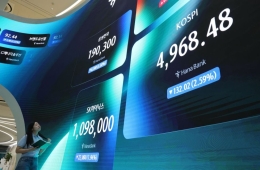
A display board shows the KOSPI and share prices for Samsung Electronics and SK hynix at the dealing room of Hana Bank's headquarters in Jung-gu, Seoul, on Oct. 15, as South Korean stocks opened lower following a sharp drop in semiconductor shares, including those of Samsung Electronics and SK hynix. The KOSPI opened at 5,673.01, down 335.8 points (5.59%) from the previous day's close of 6,008.81. Oct. 15, 2026. Photo by Cho Yong-jun
KIEP also raised the possibility that vulnerabilities could intensify as fiscal deficits persist in major economies, increasing refinancing costs and interest payments, while financial institutions incur losses from falling government bond prices and capital flows out of emerging economies. The United States and China have extended until January 10, 2027, the suspension of some export control measures, but supply chains could be disrupted again depending on the outcome of follow-up talks.
KIEP said, "If an adjustment in AI investment coincides with a deterioration in financial conditions, new investment could contract further. If disruptions to supplies of key materials and components are added to this, the slowdown in manufacturing output and trade could deepen."
KIEP noted that if profit realization is delayed or financing conditions worsen, adjustments to new data center projects and equipment orders could slow the growth of investment in the United States and the growth of exports related to semiconductors and servers from South Korea, Taiwan, and other economies.
Long-term interest rates to remain high...exchange rate to strengthen gradually
KIEP forecast that U.S. 10-year Treasury yields would remain high through the first half of the year, then gradually decline in the second half as energy-driven inflationary pressure eases and expectations take hold that the monetary tightening cycle is ending.
The dollar is expected to be supported by U.S. growth and the possibility of rising interest rates next year, as well as risk aversion. However, its gains are expected to gradually narrow as expectations for higher interest rates weaken amid slowing inflation.
The won-dollar exchange rate is expected to strengthen gradually or remain stable next year, supported by a continued current account surplus on strong semiconductor exports and capital inflows following South Korea's inclusion in the World Government Bond Index (WGBI).
Factors that could push the exchange rate higher include increased investment in overseas assets, net sales of South Korean stocks by foreign investors, and dollar demand stemming from the execution of investments in the United States. Factors that could push it lower include a narrowing of the interest rate gap between South Korea and the United States, strong semiconductor exports, a continued current account surplus, and increased dollar selling by export companies.
KIEP did not provide a specific exchange-rate forecast. Major international investment banks expect the won to appreciate moderately in the first half of the year, with the won-dollar exchange rate at 1,350 won in the first quarter and around 1,350 won in the second quarter.

International oil prices to fall...price pressures to persist
KIEP forecast that international oil prices would fall from this year as the effects of the war in the Middle East ease. However, it expects the decline to be limited by threats to maritime transport from Houthi rebels, shortages of refined petroleum products, and the replenishment of strategic petroleum reserves, even if military tensions between the United States and Iran ease.
KIEP said, "If attacks by Houthi rebels on major maritime shipping routes in the Middle East continue, disruptions to transport in the region and a geopolitical risk premium could persist."
Hot Picks Today
 "Two Spend 500,000 Won in a Flash, Yet Wait Two Hours?" ... 'Dreamland' Shunned by Kids and Foreign Tourists
- The Era of Getting 200 Million Won After 30 Years Is Over... A Japanese Bank's "Perpetual Department Head" Who Just Clocked In Cries Out
- Spain Hit by Its Worst Tragedy... Lee Kangin, Moreno and Real Madrid Join Soccer World in Mourning
- They Said, “Make It Your Home for Life” - Then Suddenly Kicked 200 Passengers Off... What Happened to the Around-the-World Cruise?
- "130 Rice Bowls Sold Out in a Day"... 'Unfiltered Face' Adds 8 Million Won to Night Market Sales: China's Bungeunwoo
KIEP put this year's average international oil price at $83.60 per barrel of West Texas Intermediate (WTI). That is higher than the U.S. Energy Information Administration's (EIA) forecast of $80.54 per barrel.
© The Asia Business Daily. All rights reserved. Unauthorized AI training and use prohibited.