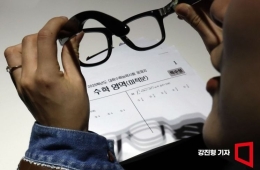
"Signal Jamming, AI Surveillance, and a 1.6 Billion Won Fine for Cheating"... A Look at Anti-Cheating Measures Around the World
Countries Strengthen Exam Proctoring as AI Cheating Spreads
China Uses AI CCTV to Monitor Cheating... Blocks AI Answer-Solving During Exams
India, UK and U.S. Also Strengthen Security... South Korea Faces Challenge of Building a Comprehensive Securi
Concerns are growing over the management of advanced devices and oversight systems at exam sites following the confession of a top scorer on the certified tax accountant exam, who admitted to cheating with artificial intelligence (AI). With the government launching an emergency response ahead of the College Scholastic Ability Test (CSAT) on Nov. 19, other countries are tackling exam cheating through various methods, including AI surveillance systems, signal-jamming technology, and restrictions on AI service features, in addition to controls on bringing electronic devices into exam sites.

China Uses AI CCTV to Monitor Cheating... Blocks AI Services From Solving Problems During Exams
In China, which administers the Gaokao, the world's largest university entrance exam, AI is used to monitor exam sites. More than 10 million students take the exam each year, and security measures are strict. AI analyzes closed-circuit television (CCTV) footage from exam rooms in real time and alerts a central control room if test takers show unusual behavior, such as frequently turning their heads or hiding their hands under their desks. The AI flags suspicious scenes, while on-site proctors make the final determination.
China has also introduced a system in which AI service providers restrict some features during exam periods. During the Gaokao period in June 2025, DeepSeek, Tencent, Alibaba and other companies temporarily suspended image-recognition features that could be used to photograph exam questions and request solutions. Yuanbao, Tencent's AI service, displayed a notice to users attempting to use the feature: "To ensure fairness in the university entrance exam, this feature is unavailable." Rather than blocking AI services entirely, the companies restricted only features that could be exploited for cheating.

China also operates signal jammers to block wireless communications around exam sites, as well as gates that detect metal and radio signals. There have been cases in which actual cheating equipment was uncovered. According to China's Ministry of Industry and Information Technology, in 2024, a wireless spectrum management agency in Shenzhen tracked suspicious signals during an information technology certification exam and uncovered six sets of cheating equipment disguised as portable chargers. The devices used wireless signals to send answers received from outside to test takers. In 2023, authorities in Sichuan Province also found a transmitting device about 1 km from an exam site during a graduate school entrance exam.
However, China has an environment that makes it relatively easier to secure cooperation from private companies: the government leads nationally important exams, and major AI platforms are also operated primarily by domestic companies. By contrast, introducing signal-jamming technology at domestic CSAT sites would face legal and technical constraints. The current Radio Waves Act generally restricts acts that interfere with others' use of radio waves, and jamming signals could also affect communications networks around exam sites.

China uses AI to analyze exam room CCTV footage in real time and monitor test takers for unusual behavior. Screenshot from an SBS news report.
View original imageIndia Mobilizes Signal Detection and Answer Analysis... Organized Cheating Carries a Minimum Fine of 1.6 Billion Won
In India, authorities analyze test takers' answers and exam data after exams to determine whether cheating was organized. In May 2026, India installed mobile communications signal-detection equipment at all 5,432 exam sites for the National Eligibility cum Entrance Test for Undergraduates (NEET-UG), the medical school entrance exam. Authorities check response patterns for each question based on test takers' answers, observation records, and statistical analysis. If irregularities are detected, they review CCTV footage as well.
Penalties for cheating have also been strengthened. In July 2026, the Indian government amended the Public Examinations (Prevention of Unfair Means) Act, enacted in 2024 after a major exam paper leak. Under the amended law, individuals who cheat face five to 10 years in prison and a fine of up to 5 million rupees (about 80 million won). Organized crimes carry a prison term of seven to 10 years and a fine of at least 100 million rupees (about 1.6 billion won).

UK and US Also Move to Strengthen Exam Security
The United States has piloted a remote exam proctoring system using AI. In August 2026, the National Conference of Bar Examiners (NCBE), which supports the administration of the U.S. bar exam, conducted a pilot test in which 56 people took next-generation bar exam questions remotely. Webcams, microphones, and secondary cameras were used to monitor the test takers' exam environments. If suspicious situations were detected, such as a test taker leaving the screen or using an unauthorized device or material, proctors were notified. AI detects irregularities, but people make the final determination.
The UK uses detection technology to identify AI-generated answers, along with post-exam verification procedures. The Office of Qualifications and Examinations Regulation (Ofqual) advises assessment organizations to check for unauthorized use of AI and verify the authenticity of submitted work. It focuses in particular on non-exam assessments, such as assignments and projects that students complete outside exam sites.
Hot Picks Today
 "Two Spend 500,000 Won in a Flash, Yet Wait Two Hours?" ... 'Dreamland' Shunned by Kids and Foreign Tourists
- The Era of Getting 200 Million Won After 30 Years Is Over... A Japanese Bank's "Perpetual Department Head" Who Just Clocked In Cries Out
- Spain Hit by Its Worst Tragedy... Lee Kangin, Moreno and Real Madrid Join Soccer World in Mourning
- They Said, “Make It Your Home for Life” - Then Suddenly Kicked 200 Passengers Off... What Happened to the Around-the-World Cruise?
- "130 Rice Bowls Sold Out in a Day"... 'Unfiltered Face' Adds 8 Million Won to Night Market Sales: China's Bungeunwoo
Meanwhile, the South Korean government is pursuing measures to revoke the certification of the top scorer on the certified tax accountant exam who was caught cheating and bar the person from taking exams for five years. Police have also launched an investigation. The Presidential Office has decided to conduct a comprehensive review of suspected AI-related cheating across national certification exams held this year. However, the Ministry of Education plans not to introduce separate signal-detection equipment for this year's CSAT, which is three days away, and will instead focus on strengthening proctors' training in identifying devices and responding on site. Improving the accuracy of advanced detection equipment, as well as addressing signal interference, installation costs, and legal grounds, are also cited as challenges.
© The Asia Business Daily. All rights reserved. Unauthorized AI training and use prohibited.