U.S.-China-Russia Summit Puts North Korea's Nuclear Issue in Focus... Trump Mentions Possible Meeting with Kim Jong Un (Comprehensive)
First-ever U.S.-China-Russia summit on Nov. 19
Trump: "Kim Jong Un may come to China"
Nuclear arms reduction talks raise concerns South Korea could be sidelined on North Korea's nuclear issue
U.S. President Donald Trump said on the 16th (local time) that he could meet with North Korean leader Kim Jong Un during his visit to China, drawing attention to whether North Korea's nuclear issue will be discussed at the first-ever U.S.-China-Russia summit, scheduled for this week. The United States, China and Russia are expected to discuss nuclear arms reductions as a key agenda item, while the possibility of resuming U.S.-North Korea dialogue has also been raised. This has prompted concerns that South Korea could be sidelined on security issues concerning the Korean Peninsula.
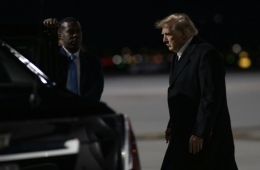
Before departing the White House that day for a trip to Asia, including the Philippines and China, Trump told reporters, "I will be meeting with Chinese President Xi Jinping, and I will also meet with Russian President Vladimir Putin," adding, "I could meet with Chairman Kim, too."
Asked where he might meet with Kim, Trump replied, "In China," then said, "He may come [to China]. That would be up to President Xi."

Trump's remarks came three days after the White House said on the 13th that there were no plans for a meeting with Kim during the trip. However, it has not been confirmed whether there have been any preliminary contacts between the United States and North Korea or whether a specific meeting has been scheduled.
Trump's remarks have drawn attention to the U.S.-China-Russia summit, which will be held in Shenzhen, China, on November 19. Trump is scheduled to hold the first-ever trilateral summit with Xi and Putin on the sidelines of the Asia-Pacific Economic Cooperation (APEC) summit.
The White House has said that nuclear arms reductions and the war in Iran will be discussed at the summit. North Korea's nuclear issue has not been announced as an official agenda item, but it could be raised along with other issues concerning the Korean Peninsula, given Trump's expressed willingness to resume dialogue with Kim.
In particular, Trump linked the possibility of Kim visiting China to Xi's decision, putting a spotlight on the role China might play in resuming U.S.-North Korea dialogue. China and Russia are countries with influence over North Korea, and the possibility has been raised that Trump may ask the two leaders to cooperate in resuming dialogue between the United States and North Korea.
One concern is that the principle of North Korea's denuclearization could be weakened. North Korea has long rejected denuclearization negotiations and demanded recognition of its status as a nuclear-armed state. China and Russia, meanwhile, called for the lifting of sanctions on North Korea, among other things, without mentioning North Korea's denuclearization in a joint statement following their summit in May.
There are also concerns that if the U.S., Chinese and Russian leaders reach a consensus on resuming dialogue without making their positions on North Korea's denuclearization clear, future U.S.-North Korea negotiations could shift to arms control talks that effectively take North Korea's possession of nuclear weapons as a given.
The South Korean government is wary of issues directly related to security on the Korean Peninsula being discussed without South Korea's participation. In particular, it maintains that a "second Yalta Conference" must not be repeated, in which the United States, China and Russia reach an agreement on issues concerning the Korean Peninsula without adequately reflecting South Korea's position.
The Yalta Conference was a meeting in 1945 at which the leaders of the United States, the United Kingdom and the Soviet Union discussed the international order after World War II. In South Korea, it is often cited to express concerns that major powers could decide matters concerning the Korean Peninsula without the participation of the parties directly involved.
Hot Picks Today
 "Two Spend 500,000 Won in a Flash, Yet Wait Two Hours?" ... 'Dreamland' Shunned by Kids and Foreign Tourists
- The Era of Getting 200 Million Won After 30 Years Is Over... A Japanese Bank's "Perpetual Department Head" Who Just Clocked In Cries Out
- Spain Hit by Its Worst Tragedy... Lee Kangin, Moreno and Real Madrid Join Soccer World in Mourning
- They Said, “Make It Your Home for Life” - Then Suddenly Kicked 200 Passengers Off... What Happened to the Around-the-World Cruise?
- "130 Rice Bowls Sold Out in a Day"... 'Unfiltered Face' Adds 8 Million Won to Night Market Sales: China's Bungeunwoo
Accordingly, the South Korean government also conveyed to China its position that North Korea must not be recognized as a nuclear-armed state and that no decision should be made that runs counter to establishing a peace regime on the Korean Peninsula. China reportedly responded that it understood the South Korean government's position.
© The Asia Business Daily. All rights reserved. Unauthorized AI training and use prohibited.