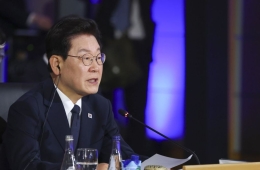
Kim Dae-jung: “Leap Forward as a K-Education Special City” ... First Integrated Budget of 7.7418 Trillion Won Drawn Up
Five educational indicators and three priority tasks unveiled
"Harnessing the synergy of administrative integration to set a new standard for future education"
Kim Dae-jung, superintendent of education for the Jeonnam-Gwangju Integrated Special City, declared 2027 the first year of a leap forward as a “K-Education Special City” and drew up a budget proposal for the coming year totaling 7.7418 trillion won.
His plan is to build a new model for the future of education in Korea by harnessing the synergy of administrative integration, which brings together the region’s educational capabilities, to support students’ learning and growth.

Kim made the announcement on November 16 in an address on education policies for the 2027 budget at a plenary session of the Jeonnam-Gwangju Integrated Special City Council. He also presented five educational indicators and three priority tasks for next year.
The five educational indicators announced that day are: classrooms where everyone’s potential can blossom; open schools that encourage challenge and connection; cultivating talent that embraces the region and changes the world; civic education that fosters empathy and action; and educational autonomy that works alongside schools.
The three key tasks supporting these goals are strengthening the protection of educational activities, nurturing talent in artificial intelligence (AI) and semiconductors, and transforming the evaluation system. The 2027 budget proposal for the Jeonnam-Gwangju Integrated Special City Office of Education submitted to the city council totals 7.7418 trillion won. On the revenue side, transfers from the central government are budgeted at 6.719 trillion won, up 501.5 billion won from this year, while transfers from local governments and other sources total 856.7 billion won, an increase of 90.8 billion won.
Own-source and other revenues are 135.1 billion won, down 700 million won. To ensure the smooth implementation of policy programs, the Office of Education is also making active use of 31 billion won in fund transfers, including from the Integrated Fiscal Stabilization Fund, as a source of revenue.
By area, spending will go toward educational autonomy that works alongside schools (1.6562 trillion won); classrooms where everyone’s potential can blossom (835.4 billion won); cultivating talent that embraces the region and changes the world (373.3 billion won); open schools that encourage challenge and connection (212 billion won); and civic education that fosters empathy and action (53.8 billion won). A total of 4.6111 trillion won has been allocated to inflexible expenses, including personnel costs for school staff and operating expenses for administrative agencies.
In addition, this year’s first supplementary budget proposal has been set at 8.1116 trillion won, an increase of 1.1 billion won from the original budget of 8.1105 trillion won. To proactively respond to declining transfers from local governments, the Office of Education focused on improving fiscal efficiency, including cutting 145.9 billion won by adjusting programs that would be difficult to carry out within the year.
In his address to the council, Kim stressed, “The integration of educational administration in Jeonnam and Gwangju is not a finished result but a starting point for creating a new future. Students must always be at the center of change, and the classroom must be both the starting point and the destination of education policy.”
Hot Picks Today
 "Two Spend 500,000 Won in a Flash, Yet Wait Two Hours?" ... 'Dreamland' Shunned by Kids and Foreign Tourists
- The Era of Getting 200 Million Won After 30 Years Is Over... A Japanese Bank's "Perpetual Department Head" Who Just Clocked In Cries Out
- Spain Hit by Its Worst Tragedy... Lee Kangin, Moreno and Real Madrid Join Soccer World in Mourning
- They Said, “Make It Your Home for Life” - Then Suddenly Kicked 200 Passengers Off... What Happened to the Around-the-World Cruise?
- "130 Rice Bowls Sold Out in a Day"... 'Unfiltered Face' Adds 8 Million Won to Night Market Sales: China's Bungeunwoo
He added, “We will devote every effort to ensuring that the benefits of integration extend beyond administrative efficiency to support students’ learning and growth, drive innovation in schools, and ultimately contribute to regional development. I ask for your continued interest and support so that education in Jeonnam and Gwangju can establish itself as a new standard for education in Korea.”
© The Asia Business Daily. All rights reserved. Unauthorized AI training and use prohibited.