As Agents Acting on People's Behalf Spread... "Regulatory Scope and Accountability Standards Must Be Clarified"
Criteria for high-impact AI remain unclear
Legal framework needs to account for AI agents and physical AI
As artificial intelligence (AI) advances into areas where it makes decisions and takes action on its own, calls have emerged to overhaul the legal framework governing issues such as accountability and the scope of regulation. Participants also proposed clarifying confusion in the field over what constitutes high-impact AI and improving the system to reflect the characteristics of agentic AI and physical AI.

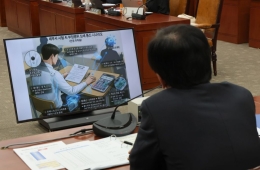
Kang Jiwon, a lawyer at Bae, Kim & Lee, speaks at a seminar titled “Current Issues and Challenges in AI Regulation” at the Glad Yeouido hotel in Yeongdeungpo-gu, Seoul. Photo by Lee Eunseo.
View original imageAt a seminar titled "Current Issues and Challenges in AI Regulation," held at Glad Yeouido on November 16, participants presented legislative tasks for addressing emerging AI technologies, including agentic AI and physical AI. The seminar was co-hosted by Assembly members Lee Ju-hee and Choi Hyung-doo of the National Assembly's Science, ICT, Broadcasting and Communications Committee, the Korea Information and Communications Law Association, the Korea Data and AI Law & Policy Association, the Korea Information Society Development Institute, and Bae, Kim & Lee LLC.
Kang Jiwon, an attorney at Bae, Kim & Lee LLC, said companies were struggling to determine whether their AI services were subject to regulation and what obligations they had to fulfill, with the implementation of the AI Basic Act set to mark its first anniversary. A key issue is the scope of high-impact AI. Under the AI Basic Act, high-impact AI refers to AI systems that have, or could have, a significant impact on people's lives, physical safety, or fundamental rights, or that could pose a risk to them.
Attorney Kang cited robo-advisers that automatically execute trades and AI systems that calculate insurance premium rates as examples of AI that could significantly affect individuals' assets and rights. Even when a person makes the final decision, AI's intermediate judgments can affect the outcome, underscoring the need for more detailed criteria to determine the severity of risks. "The purpose of regulating high-impact AI is to consider the purpose for which it is used in a particular field or context," Kang said. "The criteria for making that determination need to be tailored to the context or purpose of use."
Participants also said the legal framework needed to be overhauled to address "AI that acts" while reducing uncertainty around existing regulations. Jung Junhwa, an analyst at the National Assembly Research Service, proposed incorporating agentic AI and physical AI into the existing legal framework in stages. The proposal is to address related risks within the high-impact AI framework in the short term, while considering adding the concepts of AI agents and physical AI over the medium to long term. Jung said, "The special bill on physical AI introduced by Assembly member Hwang Jeong-ah would establish new governance arrangements and regulatory exemptions, and also includes safety measures such as performance certification and disclosure of defects." He added, "As it is among 11 bills on key contentious issues included in consultations between the ruling party and the government, it could be enacted quickly depending on the direction of discussions."
In the ensuing discussion, participants also said domestic platform companies were facing a dilemma amid legal uncertainty as competition in AI agent services accelerates. They explained that legal uncertainty is particularly high when an agent logs in on a user's behalf and submits authentication information to an external website. Kakao Vice President Seo Young-hoon said, "If we allow only services in areas where the regulations are clear, we face the dilemma of not being chosen by users. We need to interpret current laws and regulations proactively to eliminate uncertainty for businesses."
Hot Picks Today
 "Two Spend 500,000 Won in a Flash, Yet Wait Two Hours?" ... 'Dreamland' Shunned by Kids and Foreign Tourists
- The Era of Getting 200 Million Won After 30 Years Is Over... A Japanese Bank's "Perpetual Department Head" Who Just Clocked In Cries Out
- Spain Hit by Its Worst Tragedy... Lee Kangin, Moreno and Real Madrid Join Soccer World in Mourning
- They Said, “Make It Your Home for Life” - Then Suddenly Kicked 200 Passengers Off... What Happened to the Around-the-World Cruise?
- "130 Rice Bowls Sold Out in a Day"... 'Unfiltered Face' Adds 8 Million Won to Night Market Sales: China's Bungeunwoo
Assembly member Choi Hyung-doo said, "I will do my utmost to ensure that efforts to promote the AI industry and introduce appropriate regulations do not miss the right timing or become unbalanced."
© The Asia Business Daily. All rights reserved. Unauthorized AI training and use prohibited.