Morgan Stanley: "KOSPI Could Top 10,000... Korea's Renaissance Is Coming"
"the best story in equity markets over the next five years"
Morgan Stanley, a global investment bank (IB), has described the Korean stock market as “the best stock market story over the next five years,” projecting that the KOSPI could surpass 10,000 points.
In its “Korea Renaissance” report published on Nov. 11 (local time), Morgan Stanley said that “the investment thesis for Korea is changing.”
The report was co-authored by six people, including Seok Jun, head of Korea strategy at Morgan Stanley, and Catherine Oh, chief Korea and Taiwan economist. They said in the report that “AI-driven growth, a recovery in industrial demand, and reforms could drive a sustained increase in return on equity (ROE) and a long-term revaluation of the Korean stock market.”
The report added that “if Korea achieves results in improving corporate earnings and implementing reforms, a KOSPI level above 10,000 could become sustainable,” and that “the revaluation of Japan’s stock market offers a useful precedent.”

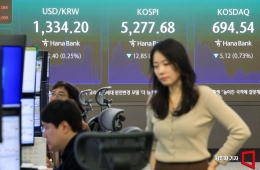
The domestic stock market situation is displayed on an electronic board in the dealing room at Hana Bank's headquarters in Jung-gu, Seoul, on Nov. 16, as the KOSPI briefly recovered to the 5,300 level shortly after the market opened before giving up its gains and falling below 5,200. Nov. 16, 2026. Photo by Kang Jinhyeong.
View original imageMorgan Stanley said that “past attempts to revalue the Korean market lacked the policy and strategic execution needed to sustain momentum,” but added that “we believe three powerful drivers are now coming together.” It identified these three drivers as strategic reinvention, economic revitalization, and capital market reform.
On “strategic reinvention,” Morgan Stanley said that “Korea is at the intersection of four global investment cycles, each worth trillions of dollars,” identifying digital AI, physical AI, defense and shipbuilding, and power and energy. It noted that “few stock markets cover such a broad range of the physical foundations needed for AI, energy, and security.”
“Economic revitalization” was also identified as a key driver. Morgan Stanley said it believes Korea is “entering a period in which national wealth will expand over several years, supported by solid exports, a strong capital expenditure cycle, and benefits from the semiconductor boom.” However, it added that “a new growth model is urgently needed due to low productivity in the services sector, an extremely low birth rate, and rapid population aging.”
Regarding Korea’s “capital market reform,” Morgan Stanley said that “reform is the link that allows improvements in corporate earnings to translate into higher stock valuations,” and projected that “the total shareholder return ratio will rise from the current 35-40% to 50-60% by 2030.” It also forecast that corporate ROE, which was around 8% in the past, would rise to more than 14% by 2030.
"AI and institutional reform... Korea is building a new growth model"

The domestic stock market is displayed on an electronic board in the dealing room at Hana Bank's headquarters in Jung-gu, Seoul, on Nov. 16, as the KOSPI fluctuates around the flatline after opening higher. 2026.11.16. Photo by Kang Jinhyung
View original imageMorgan Stanley said that “a new growth model for Korea is taking shape,” noting that “the adoption of AI, the multipolarization of the global order, and the energy transition are creating new markets where Korea can leverage its technological capabilities and manufacturing competitiveness.”
On AI and advanced manufacturing in particular, it forecast that “the shift from digital AI to physical AI will give Korea an opportunity to build a more robust, cross-sector ecosystem, drawing on its competitive edge in memory and supported by a solid supply chain.”
Morgan Stanley also said that “as Korean companies pursue growth both through their own businesses and through mergers and acquisitions (M&A), the importance of capital and financing will continue to grow.” It added that “although some executives worry that efforts to reform corporate governance could hinder capital investment, we believe that fair treatment of minority shareholders will ultimately benefit the corporate sector.”
Hot Picks Today
 "Two Spend 500,000 Won in a Flash, Yet Wait Two Hours?" ... 'Dreamland' Shunned by Kids and Foreign Tourists
- The Era of Getting 200 Million Won After 30 Years Is Over... A Japanese Bank's "Perpetual Department Head" Who Just Clocked In Cries Out
- Spain Hit by Its Worst Tragedy... Lee Kangin, Moreno and Real Madrid Join Soccer World in Mourning
- They Said, “Make It Your Home for Life” - Then Suddenly Kicked 200 Passengers Off... What Happened to the Around-the-World Cruise?
- "130 Rice Bowls Sold Out in a Day"... 'Unfiltered Face' Adds 8 Million Won to Night Market Sales: China's Bungeunwoo
On improving productivity and ROE, it said that “policies are needed to strike a balance between reform and healthy growth.” It went on to say that “it remains uncertain how long the economic benefits Korea is enjoying now will last.” It therefore stated that “Korea needs to use the current opportunity to invest in areas where private-sector participation may be insufficient and in emerging technologies where the country can secure a leading position.”
© The Asia Business Daily. All rights reserved. Unauthorized AI training and use prohibited.