"There's Something Even Scarier Than AI Glasses"... CSAT Cheating: The 'Thing' Even Proctors Can't Catch
"Hidden Phones Are the Problem; Metal and Radio-Frequency Detection Have Limits"
"For Now, Visual Inspection Is a Practical Alternative"
Concerns are growing about cheating on the 2027 College Scholastic Ability Test (CSAT) using artificial intelligence (AI) smart glasses and other devices. Education authorities designated AI glasses as prohibited items for the first time this year, but critics say it will be difficult to prevent cheating involving miniature cameras and concealed smartphones. One expert said the current exam monitoring system would have limited ability to catch candidates who hide and bring in multiple smartphones.

Miniature cameras on sale at a camera store in Seoul on the 16th. The Ministry of Education said it is preparing additional measures after determining that cheating on the 2027 College Scholastic Ability Test (CSAT) could involve not only smart glasses but also miniature cameras. Yonhap News
View original imageOn November 16, Professor Choi Byungho of Korea University's Human-Inspired AI Research Institute appeared on YTN Radio and discussed the monitoring and supervision of cheating. "The most important thing is smartphones. If you take smartphones out of the equation, you can stop all cheating," he said. "But candidates could have two or three smartphones."
He explained that even if candidates hand in their smartphones, they could conceal and bring in separate devices in their shoe soles or on their bodies. He also said there were limits to using metal detectors or radio-frequency detectors. Metal detectors would have difficulty identifying only the devices used for cheating among the various metal objects, while radio-frequency detectors would have to distinguish suspicious signals from the many signals in the surrounding area.
"Filtering each of these effectively requires another specialized technology," Professor Choi said. "That's why it would be difficult to implement right away."

Miniature cameras on sale at a camera store in Seoul on the 16th. The Education Ministry said it is preparing additional measures amid concerns that students could cheat on the 2027 College Scholastic Ability Test (CSAT) using miniature cameras as well as smart glasses. Yonhap News Agency.
View original image"They likely photographed the questions with a miniature camera and solved them while looking at a smartphone"
Professor Choi also explained the method used by the top-scoring tax accountant exam candidate who recently admitted to cheating. "It depends on the scenario, but first, you connect a miniature camera to a smartphone by wire or short-range communication, then use the miniature camera to photograph the entire set of questions," he said. "After that, I suspect they used a macro app on the smartphone. It seems they created a program that automatically calls AI when a photo comes in and uses it to solve the questions."
"Once the questions are solved that way, the program provides the answers sequentially, starting with question one," he said. "I suspect the candidate then received the answers and looked at them on the smartphone to solve the questions."
He said it would not take long for AI to solve the questions. "When AI solves questions in the cloud, it would take no more than five seconds for a simple question, and no more than 30 seconds even for a complex one," Professor Choi said. "The total time, including sending the initial photo and receiving the answers, would be less than one minute." He said AI could have solved 80 multiple-choice questions in around 10 minutes and essay questions in 10 to 20 minutes.

Miniature cameras on sale at a camera store in Seoul on the 16th. The Ministry of Education said it is preparing additional measures after determining that cheating on the 2027 College Scholastic Ability Test (CSAT) could involve not only smart glasses but also miniature cameras. Yonhap News
View original image"A perfect CSAT score is possible by solving just three or four killer questions"
Professor Choi said it would be entirely possible to get a perfect score on the CSAT using AI smart glasses. "In particular, high-achieving students may face killer questions that take a long time to solve," he said. "Even targeting just three or four of them could be enough to get a perfect score."
"AI is better than people at questions with definite answers," he said. "The more complex the passages and calculations, the faster and better it solves the questions."
"The best option is to turn the glasses over and check them"
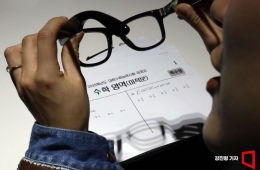
Professor Choi said visual inspection was a practical way to catch AI glasses at test sites. This would involve checking for LEDs on the front of the glasses or thick frames, then turning them over to look for charging ports and microphone or speaker holes.
Hot Picks Today
 "Two Spend 500,000 Won in a Flash, Yet Wait Two Hours?" ... 'Dreamland' Shunned by Kids and Foreign Tourists
- The Era of Getting 200 Million Won After 30 Years Is Over... A Japanese Bank's "Perpetual Department Head" Who Just Clocked In Cries Out
- Spain Hit by Its Worst Tragedy... Lee Kangin, Moreno and Real Madrid Join Soccer World in Mourning
- They Said, “Make It Your Home for Life” - Then Suddenly Kicked 200 Passengers Off... What Happened to the Around-the-World Cruise?
- "130 Rice Bowls Sold Out in a Day"... 'Unfiltered Face' Adds 8 Million Won to Night Market Sales: China's Bungeunwoo
He also proposed other options, including technology to detect concealed smartphones, equipment to identify miniature cameras and smart glasses, and technology to capture abnormal radio signals during the exam. He explained that cheating could still be confirmed by tracking smartphone usage records during the exam, even if the candidate was not caught in the act. "To some extent, this is possible if supported by policies and laws," he said.
© The Asia Business Daily. All rights reserved. Unauthorized AI training and use prohibited.