Chung Dongyoung: "Ease Tensions, Reduce Military Burden to Invest in R&D and Education"
Also criticizes closure of the Kaesong Industrial Complex... "A failure of political leadership"
Unification Minister Chung Dong-young proposed easing military tensions on the Korean Peninsula and investing the resulting savings on military spending in research and development (R&D), education, and advanced industries. He also criticized the suspension of operations at the Kaesong Industrial Complex under the Park Geun-hye administration, calling it a failure of political leadership.

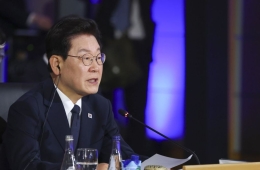
Unification Minister Chung Dong-young delivers congratulatory remarks at an international seminar on the future vision for a peace regime and peace economy on the Korean Peninsula at the Westin Josun Hotel in Jung-gu, Seoul, on the 16th. Yonhap News.
View original imageIn congratulatory remarks at the International Seminar on the Future Vision for a Peace Regime and Peace Economy on the Korean Peninsula, held at the Westin Josun Hotel in Seoul on November 16, Chung said, "We can ease military tensions and turn massive military spending into a peace dividend," adding, "By investing the savings on military spending in R&D, education, and advanced industries, we can lay the groundwork for economic growth."
Chung said that military tensions and geopolitical divisions constrain opportunities for prosperity, and that uncertainty stemming from the armistice system has prevented the South Korean economy from receiving a valuation commensurate with its growth. Citing military conflicts around the world, supply chain restructuring, and competition for leadership in artificial intelligence (AI), he said, "We must respond wisely to the changes of our time, in which security and the economy are closely intertwined, and create new opportunities."
He added, "Peace is the economy, and it is food," and said, "Transforming the unstable armistice system into a permanent peace regime is a solid foundation for a peace economy." His point was that the armistice system should be transformed into a peace regime to lay the groundwork for economic growth.
He also emphasized the need to address the undervaluation of the South Korean economy. "We can turn the Korea Discount into a Korea Premium," Chung said, predicting that "overcoming the undervaluation of our economy will improve the country's credit rating and increase foreign investment."
Chung also said, "Within the broad framework of a peace regime on the Korean Peninsula, we can comprehensively discuss ending the Korean War, institutionalizing peaceful coexistence between the two Koreas, normalizing relations through diplomatic ties between North Korea and the United States and between North Korea and Japan, halting the advancement of North Korea's nuclear capabilities, as well as economic cooperation and shared prosperity." He was reiterating his previously proposed vision of a "broad framework for a peace regime on the Korean Peninsula." North Korea, however, has rejected calls for denuclearization and has characterized inter-Korean relations as those between "two hostile states."
Chung also criticized the suspension of operations at the Kaesong Industrial Complex under the Park Geun-hye administration. "With many troops and weapons withdrawn from the area beyond Kaesong, the border region and the Korean Peninsula could have become safer," he said. "The decision on February 10, 2016, to close the Kaesong Industrial Complex 10 years ago symbolizes the failure of political leadership marked by shortsightedness and a narrow perspective." At the time, the Park Geun-hye administration decided to completely suspend operations at the complex in response to North Korea's fourth nuclear test and launch of a long-range missile.
Hot Picks Today
 "Two Spend 500,000 Won in a Flash, Yet Wait Two Hours?" ... 'Dreamland' Shunned by Kids and Foreign Tourists
- The Era of Getting 200 Million Won After 30 Years Is Over... A Japanese Bank's "Perpetual Department Head" Who Just Clocked In Cries Out
- Spain Hit by Its Worst Tragedy... Lee Kangin, Moreno and Real Madrid Join Soccer World in Mourning
- They Said, “Make It Your Home for Life” - Then Suddenly Kicked 200 Passengers Off... What Happened to the Around-the-World Cruise?
- "130 Rice Bowls Sold Out in a Day"... 'Unfiltered Face' Adds 8 Million Won to Night Market Sales: China's Bungeunwoo
The seminar, co-hosted by the Ministry of Unification and the National Research Council for Economics, Humanities and Social Sciences and organized by the Korea Institute for National Unification, is being held from November 16 to 17.
© The Asia Business Daily. All rights reserved. Unauthorized AI training and use prohibited.