HRD Korea's Exam Fees Frozen for 12 Years... Test Takers Increase, but Proctors Are in Short Supply
Miniature Cameras Have Been Detected for 4-5 Years
On-Site Response and Infrastructure Investment Have Stalled
Building an Advanced Proctoring System Has Yet to Gain Momentum
After cheating using artificial intelligence (AI) was uncovered in this year's tax accountant exam, the Human Resources Development Service of Korea (HRD Korea), which manages national qualification exams, came under fire for its inadequate exam supervision system. HRD Korea had detected cheating involving advanced devices, such as miniature cameras and smart glasses, for years, but it had failed to secure enough on-site proctors and budget to prevent it. Critics say cheating methods have evolved, while the exam management system has failed to keep pace.
According to the Ministry of Employment and Labor and HRD Korea on November 16, the agency had been detecting cases of cheating involving miniature cameras hidden in ties or shirt buttonholes and special lenses for four to five years, reporting them to the police, and had an on-site manual for identifying suspicious behavior. It also uncovered five cases of cheating with smart glasses in national technical qualification exams held between May and June this year. Despite already being aware of the risk, the agency failed to fully deploy its supervisory capacity to prevent cheating at professional qualification exams, which require a high level of fairness.

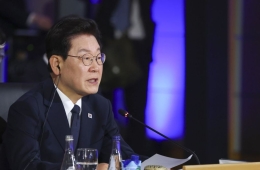
Lee Byunghoon, chairman of the Human Resources Development Service of Korea (center), listens to Prime Minister Han Seongsuk speak at a meeting of relevant government ministries on preventing cheating in exams through the use of smart devices, held at the Government Complex Seoul in Jongno-gu, Seoul, on Nov. 16, 2026. Photo by Cho Yongjun
View original imageStaff and Budget Shortages Amid Fees Frozen for 12 Years
People inside and outside the agency cited chronic staffing and budget shortages as limiting on-site exam supervision. Fees for taking national qualification exams have effectively remained frozen for 12 years, since 2014. They are designated by the government as an "essential item for price management," so any increase requires consultation with fiscal authorities, given the need to consider the impact on the cost of living for ordinary households and young people. HRD Korea's budget for this year was KRW 1,135,323,000,000, an increase of just KRW 12,021,000,000, or 1.1%, from last year. An HRD Korea official said, "The number of applicants increases every year without a corresponding increase in staff. With fees also frozen and prices rising, we are facing considerable difficulties."
Limited funding for exam operations also makes it difficult to invest in infrastructure to prevent cheating. If HRD Korea's direct expenses required to administer exams are assumed to be 100 won, current fee revenue covers only about 20 won, while the remaining roughly 80 won is made up through government contributions and other sources. The agency said that because it manages both more than 490 national technical qualifications and 37 professional qualifications, it has little capacity to invest in advanced anti-cheating equipment or supervision systems after covering direct expenses.

4.5 Million Exam Takers a Year, with 89% of Proctoring Entrusted to External Supervisors
The staffing structure is also inadequate for the vast scale of operations. According to HRD Korea's 2026 work report, 4.5 million people took national qualification exams administered by the agency last year, while the total number of exam proctors reached about 435,000. Of these, 386,000, or 89%, were externally appointed. In effect, the agency relies on external personnel for most on-site supervision. Critics say that exam materials and on-site management also rely heavily on manual processes, which can lead to differences in supervision standards among test centers and make it difficult to respond quickly to new forms of cheating.
Hot Picks Today
 "Two Spend 500,000 Won in a Flash, Yet Wait Two Hours?" ... 'Dreamland' Shunned by Kids and Foreign Tourists
- The Era of Getting 200 Million Won After 30 Years Is Over... A Japanese Bank's "Perpetual Department Head" Who Just Clocked In Cries Out
- Spain Hit by Its Worst Tragedy... Lee Kangin, Moreno and Real Madrid Join Soccer World in Mourning
- They Said, “Make It Your Home for Life” - Then Suddenly Kicked 200 Passengers Off... What Happened to the Around-the-World Cruise?
- "130 Rice Bowls Sold Out in a Day"... 'Unfiltered Face' Adds 8 Million Won to Night Market Sales: China's Bungeunwoo
The government is launching a full investigation into AI-related cheating across all national qualification exams held this year and is pursuing the establishment of online and offline tip-off centers and the introduction of radio wave detectors. It also plans to expand proctor training and increase the number of AI inspectors, dedicated proctors assigned to each test center. However, it remains unclear whether new equipment and staff alone can resolve the structural problems. Because of concerns that radio wave detectors could infringe on human rights and physical freedom, they cannot easily be used to scan examinees directly, limiting their use to the entry process. The Ministry of Employment and Labor and HRD Korea have agreed to form a joint task force (TF) to review the entire examination system and draw up comprehensive measures by the end of the year.
© The Asia Business Daily. All rights reserved. Unauthorized AI training and use prohibited.