[Editorial] Protect Exam Fairness with Systems, Not People, Against "AI Cheating"

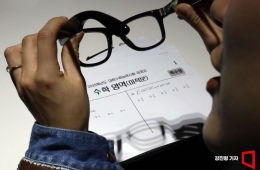
On the 11th, ahead of the 2027 College Scholastic Ability Test, training is underway at the Seoul Metropolitan Office of Education in Yongsan-gu for all 239 staff members assigned to monitor smart glasses at test sites across Seoul. Photo by Kang Jinhyeong
View original imageThe fairness of nationally administered qualification exams is being shaken to its core. The top scorer on the tax accountant exam confessed to cheating in both the first and second stages using a miniature camera and artificial intelligence (AI). After admitting to using the same method on the first-stage certified public accountant exam, the examinee has fueled distrust across the country’s qualification exams. Online, calls are mounting for a full investigation and severe punishment, accompanied by dismay that “some people worked themselves to the bone studying...” and concerns that “there may be cheaters who cleverly did just enough to clear the passing threshold.”
This case shows that surveillance systems reliant on human observation have reached their limits. Until the person involved confessed, the Human Resources Development Service of Korea, which administered the exam, maintained that “a review by two proctors found nothing unusual.” Increasing the number of proctors and stepping up patrols cannot keep pace with rapidly evolving devices. New methods involving AI, including AI glasses, will continue to emerge.
The immediate concern is the College Scholastic Ability Test (CSAT), which will be held on November 19. If even one case of AI-assisted cheating is confirmed in the CSAT, taken by hundreds of thousands of people, the impact would be difficult to gauge. With little time left, this year’s exam will have to rely on proctors. Education authorities have pledged to strengthen proctor training and assign dedicated staff to deal with new devices such as AI glasses, but they must review the manuals and countermeasures once again.
Hot Picks Today
 "Two Spend 500,000 Won in a Flash, Yet Wait Two Hours?" ... 'Dreamland' Shunned by Kids and Foreign Tourists
- The Era of Getting 200 Million Won After 30 Years Is Over... A Japanese Bank's "Perpetual Department Head" Who Just Clocked In Cries Out
- Spain Hit by Its Worst Tragedy... Lee Kangin, Moreno and Real Madrid Join Soccer World in Mourning
- They Said, “Make It Your Home for Life” - Then Suddenly Kicked 200 Passengers Off... What Happened to the Around-the-World Cruise?
- "130 Rice Bowls Sold Out in a Day"... 'Unfiltered Face' Adds 8 Million Won to Night Market Sales: China's Bungeunwoo
Fundamentally, the system must change rather than relying on people. Most smart devices, including AI glasses, need to connect to external networks wirelessly to function. Blocking radio signals at exam sites would render the devices useless even if they were smuggled in. A system must also be established to detect wireless signals using portable radio-frequency detectors. China’s approach is worth considering: using security checkpoints and metal detectors to prevent electronic devices from being brought in, blocking radio signals at exam sites, and using drones to detect illegal transmissions. Signal blocking, however, would require updating relevant laws and minimizing communications disruptions in nearby areas. But fairness in exams is a value that cannot be traded away. If the belief that people will be evaluated fairly according to their efforts collapses, the exam system will lose its very reason for being. The government must urgently introduce comprehensive proctoring measures commensurate with technological advances.
© The Asia Business Daily. All rights reserved. Unauthorized AI training and use prohibited.