"We May Have Let Our Guard Down a Little," Lee Says, Orders Dedicated Capital Market Reform Body (Comprehensive)
President Lee Chairs Capital Market Policy Meeting
Private Sector, Government and National Assembly to Take Part; Lee to Personally Resolve Disagreements
Plans to Make Annual IR Events a KOSDAQ Listing Requirement
Cautious on 100% Tender Offer; Favors Promoting M&A
Orders Comprehensive Review of Rules Obstructing Hostile M&A
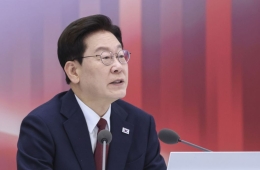
President Lee Jaemyung on the 13th ordered the swift formation of a high-level body dedicated to capital market reform. The plan is for the ruling and opposition parties, the Korea Exchange and the investment industry to discuss reform proposals, with President Lee personally receiving reports and coordinating on issues where opinions differ sharply. He also called for urgent steps to require KOSDAQ-listed companies to hold investor relations (IR) events at least once a year. In a debate over the mandatory tender offer ratio, he leaned toward promoting mergers and acquisitions (M&A), saying, "Even if it means taking criticism, we should choose the path that grows the pie."
At a capital market policy meeting held that day at the Korea Exchange in Yeouido, Seoul, President Lee heard recommendations that South Korea needs a long-term vision for its domestic capital market and called for the formation of a dedicated body. He said that existing financial reform discussions had covered the financial market as a whole, and that a body focused solely on the capital market should have been established earlier. "Things seemed to be going so easily and so well that we may have let our guard down a little," he said. He instructed the new body to appoint a clearly designated head and, after conducting a fact-finding survey and gathering opinions, draw up legislative tasks and proposals for institutional improvements. In his closing remarks, President Lee also said, "I will personally see to it that this is completed as quickly as possible."

President Lee Jaemyung speaks about revitalizing the capital market at a policy meeting in Yeouido, Seoul, on the 13th. 2026.11.13 Yonhap News Agency
View original image"Do They Deserve to Remain on the Market?"... Mandatory IR for KOSDAQ Companies
Lee Geonjae, head of the KOSDAQ Research Center at IBK Investment & Securities, told the meeting that some listed companies refuse securities firms' requests to visit them. He said that last year, about 30% of KOSPI-listed companies and about 26% of KOSDAQ-listed companies disclosed plans to hold IR events. "It makes me wonder whether they deserve to remain on the market," President Lee said. "I learned this for the first time today. I didn't know things were at that level."
When Korea Exchange Chairman Jeong Eunbo said the exchange was considering making at least one IR event a year a requirement for maintaining a KOSDAQ listing, President Lee asked, "When are you going to change it?" and urged the exchange to move quickly to revise its rules. Asked about the shortage of English-language materials for foreign investors, he responded, "Couldn't we just have ChatGPT do it?" Lee Soyoung, Minister of SMEs and Startups, said that securities firms publish research reports on only about 600 of the roughly 1,800 KOSDAQ-listed companies, and called for them to expand their coverage of small- and mid-cap stocks.

President Lee Jae Myung speaks about revitalizing the capital market at a policy meeting in Yeouido, Seoul, on Nov. 13, 2026. Yonhap News
View original imageMandatory Tender Offer: "100% or 50% Plus One Share?"... Lee Proposes an Impromptu Show of Hands
A revision to the Capital Markets Act, which passed the National Assembly's Legislation and Judiciary Committee last September, would require an additional tender offer to bring the buyer's holdings to "50% plus one share," including shares already held, in cases where the buyer acquires at least 25% of a listed company and becomes its largest shareholder. Kim Woochan, a professor at Korea University, argued that buyers should be required to purchase all shares held by shareholders who wish to sell. When President Lee asked, "If M&A itself becomes impossible, wouldn't minority shareholders lose the opportunity altogether?" Professor Kim countered that acquisition costs might not rise significantly if the control premium, which had been concentrated in the hands of major shareholders, were reduced.
President Lee put the two proposals to an impromptu show of hands. More attendees at the meeting raised their hands for the 50%-plus-one-share option, while the moderator reported that the 100% option had slightly more support in the livestream chat. President Lee also asked separately, in cases where only part of the shares must be purchased, whether buyers should first purchase shares held by the largest shareholder or allocate the opportunity to sell proportionally between the largest shareholder and minority shareholders. President Lee's view is that a greater share of the gains would go to all shareholders if M&A transactions increased. He also requested research findings and overseas examples to assess whether a 100% mandatory tender offer would reduce the number of actual transactions.
President Lee called for a comprehensive review of institutions that obstruct hostile M&A. When Lee Seongwon, an executive at Truston Asset Management, said that 570 listed companies have major shareholders and related parties holding more than 50% of their shares and a price-to-book ratio (PBR) below 1, President Lee called for an assessment of whether companies that "enjoy all the benefits of being listed while effectively being run as monopolies" should remain listed. Chairman Jeong noted that there are cases where major shareholders' stakes rise to nearly 80% after a company is listed. Financial Services Commission Chairman Lee Eog-weon said he would examine whether the shareholder distribution requirement for maintaining a listing was working properly.
Lee: "Delist Failing and Underperforming Companies Quickly"... Debate Over Delisting Criteria
President Lee instructed officials to review KOSDAQ's listing, delisting and evaluation systems together, so that failing and underperforming companies can be delisted quickly without harming companies with technological capabilities and growth potential. The market capitalization threshold for KOSDAQ delisting was raised to KRW 20 billion in July and is scheduled to rise to KRW 30 billion in January 2027. After a court on October 2 suspended the effects of the delisting decisions against Jooyeon Tech and KM Pharmaceutical, respectively, the Korea Exchange deferred subsequent delisting procedures for companies designated as administrative issues for falling below the market capitalization threshold.
Professor Kim said that 39 KOSDAQ companies were caught in stalled delisting proceedings and argued that a single market capitalization criterion should be retained. In response, Song Byungjoon, chairman of the Korea Venture Business Association, said, "A financially troubled company and a company with a low share price are not necessarily the same." He noted that investors may be reluctant to buy shares in companies close to the threshold because of the risk of delisting, which could push their share prices down further. Hearings on the Korea Exchange's objections to the injunctions are scheduled to conclude on the 27th.

President Lee Jae-myung casts an impromptu vote on measures to promote the mandatory tender offer system at a capital market policy meeting held at the Korea Exchange's promotional hall in Yeouido, Seoul, on the 13th. 2026.11.13 Yonhap News Agency
View original imageLee: "Let's Review the Appropriate Size of the Stock Market Stabilization Fund"... Orders Review of Worker Participation in Retirement Pensions
Kim Jinwook, chief economist at Citibank Korea, suggested that even the signal that the stock market stabilization fund could be activated might reduce volatility in the stock market. President Lee raised the possibility that market intervention could instead fuel distrust and called for a review of effective operating methods and the fund's appropriate size. Chairman Lee said the fund should be viewed as a tool to be used temporarily and exceptionally in emergencies.
During discussions on fund-based retirement pensions, participants pointed out that defined contribution (DC) plan subscribers can choose only among providers contracted by their employer. President Lee instructed officials to check how workers' opinions are reflected when providers are selected and to find ways to address the issue if workers are excluded from decision-making. The core elements of the retirement pension reform plan announced by the government last October are to gradually make the external funding of retirement benefits mandatory and expand fund-based management.
Hot Picks Today
 "Two Spend 500,000 Won in a Flash, Yet Wait Two Hours?" ... 'Dreamland' Shunned by Kids and Foreign Tourists
- The Era of Getting 200 Million Won After 30 Years Is Over... A Japanese Bank's "Perpetual Department Head" Who Just Clocked In Cries Out
- Spain Hit by Its Worst Tragedy... Lee Kangin, Moreno and Real Madrid Join Soccer World in Mourning
- They Said, “Make It Your Home for Life” - Then Suddenly Kicked 200 Passengers Off... What Happened to the Around-the-World Cruise?
- "130 Rice Bowls Sold Out in a Day"... 'Unfiltered Face' Adds 8 Million Won to Night Market Sales: China's Bungeunwoo
Meanwhile, President Lee arrived at the meeting that day wearing a red tie, a color associated with rising share prices in the South Korean stock market. Seeing the attendees' serious expressions, he asked, "Is it because stock prices have been falling lately?" When he added, "No one is smiling at all," laughter broke out among the attendees. Referring to the colors of their ties, President Lee said, "I went with red, too," before noting that recent market corrections and other factors had put "the government's commitment and policies for capital market reform back to the test."
© The Asia Business Daily. All rights reserved. Unauthorized AI training and use prohibited.