Lee: "Problematic If Workers Are Excluded from Retirement Pension Choices"
President Lee chairs capital market policy meeting
Calls for review and improvements to asset manager selection process
New issue emerges in reform of 500 trillion won retirement pension system
Strengthening subscriber rights goes beyond introduc
President Lee Jae-myung on the 13th instructed officials to check whether workers’ decision-making rights are adequately protected in the process of selecting retirement pension providers and to draw up measures to address any shortcomings. As the government pushes to introduce fund-based retirement pensions to boost returns on more than 500 trillion won in retirement pension assets, the aim is also to expand subscribers’ ability to make meaningful choices about their asset managers and products. Attention is focused on whether the reform will broaden its focus beyond how pension assets are managed to include protections for workers’ rights.

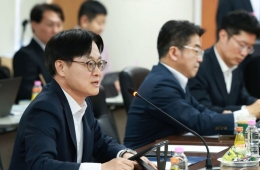
President Lee Jae-myung listens to an expert presentation on revitalizing the capital market before joining a discussion at a policy meeting on capital markets at the Korea Exchange's PR Center in Yeouido, Seoul, on the 13th. 2026.11.13 Yonhap News
View original imageAt a policy meeting on capital markets held that day at the Korea Exchange in Yeouido, Seoul, President Lee heard concerns that companies hold too much authority over the selection of retirement pension providers. He called for officials to “check what is happening and look for ways to address it if workers are being excluded from decision-making, because that would be a problem.”
The discussion began with a proposal from Kim Seong-il, CEO of Uprise Investment Advisory. He noted that institutional reforms to improve retirement pension returns are underway, but workers’ authority to choose asset managers remains limited. Under the current system, the range of choices available to subscribers varies depending on the plan type established by their company and the financial institution it has contracted with. Under a defined benefit (DB) plan, the company is responsible for managing the assets, while under a defined contribution (DC) plan, workers select investment products themselves. However, the workplace’s decision influences the selection of the pension provider.
“If a company opts to offer only a DB plan, workers have no way to manage their pensions themselves. Even with a DC plan, they have to choose from among the retirement pension providers selected by the company,” Kim said, calling for improvements to the system. President Lee also asked whether giving workers the right to choose their asset managers could help channel retirement pension funds into the capital market and improve returns.
He also noted that worker representatives may already be able to provide input when companies select asset managers, and instructed officials to first review the details of the current system and proposed amendments. On October 29, the government announced its “Plan to Strengthen the Role of Retirement Pensions.” Based on a joint declaration by labor, management and the government in February this year, its main measures are to require companies to set aside retirement benefits externally and promote fund-based retirement pensions.
If the relevant legal amendments are made as planned, the requirement to set aside retirement benefits externally will first apply in 2028 to workplaces with 100 or more employees. It will then be extended to workplaces with 10 to 99 employees in 2029 and those with fewer than 10 employees in 2030. The measure is intended to reduce the risk that companies will be unable to pay retirement benefits during financial difficulties after holding the funds internally.
Under a fund-based retirement pension, a specialized trustee corporation pools and manages assets from multiple workplaces. The government is pursuing the introduction of three types: open-ended plans run by financial institutions, consortium-based plans, and open-ended plans run by public institutions. It also plans to allow workplaces to set up both contract-based and fund-based plans. In particular, the government proposal requires the consent of worker representatives when a specific fund-based retirement pension is designated as the default option. The issue raised that day, however, went beyond whether worker representatives consent: it was about how fully individual workers can be guaranteed the right to choose or change their asset managers.
Meanwhile, the retirement pension market is also growing rapidly. According to the Ministry of Employment and Labor, retirement pension assets totaled 501.4 trillion won at the end of last year, an increase of about 70 trillion won from the previous year. The annual return last year was 6.5%, the highest on record, but challenges remain in improving long-term returns and narrowing the gaps in investment performance among subscribers.
Hot Picks Today
 "Two Spend 500,000 Won in a Flash, Yet Wait Two Hours?" ... 'Dreamland' Shunned by Kids and Foreign Tourists
- The Era of Getting 200 Million Won After 30 Years Is Over... A Japanese Bank's "Perpetual Department Head" Who Just Clocked In Cries Out
- Spain Hit by Its Worst Tragedy... Lee Kangin, Moreno and Real Madrid Join Soccer World in Mourning
- They Said, “Make It Your Home for Life” - Then Suddenly Kicked 200 Passengers Off... What Happened to the Around-the-World Cruise?
- "130 Rice Bowls Sold Out in a Day"... 'Unfiltered Face' Adds 8 Million Won to Night Market Sales: China's Bungeunwoo
If the government’s plan to expand fund-based retirement pensions is accompanied by stronger protections for workers’ choices, it could spur competition among asset managers and improve their services. However, further institutional design will be needed to determine how to balance the operation of retirement pension plans at the workplace level with individual subscribers’ right to choose.
© The Asia Business Daily. All rights reserved. Unauthorized AI training and use prohibited.