Lee: "Need to Review the Stock Market Stabilization Fund's Effectiveness and Appropriate Size"... Cautious on Activation
President Lee chairs Capital Market Policy Meeting
Sharp stock market swings prompt calls to review market-stabilization measures
Some experts propose activating KRW 10 trillion fund and expanding it to KRW 100 trillion
Lee: "Market intervention
President Lee Jae-myung said on the 13th that it was necessary to review how the stock market stabilization fund is operated and what its appropriate size should be in order to ease stock market volatility. His remarks came in response to experts’ calls to improve the effectiveness of market-stabilizing measures amid repeated sharp swings in stock prices. However, he also voiced concern that direct government purchases of stocks could spark controversy over market intervention or undermine investor confidence. Rather than ordering the fund to be activated, he said the need for and effectiveness of intervention should be assessed first.

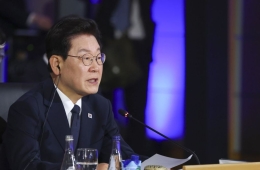
President Lee Jae-myung speaks about revitalizing the capital market at a policy meeting in Yeouido, Seoul, on Nov. 13, 2026. Yonhap News Agency
View original imageAt a capital market policy meeting held that day at the Korea Exchange in Yeouido, Seoul, President Lee was asked to activate the stock market stabilization fund. He said, “I think we need to examine whether there are ways to make it work effectively, what an appropriate size might be, for example, and whether there are newer approaches.”
The discussion began with a proposal from Kim Jin-wook, a chief economist at Citibank. Kim identified high volatility as a major reason foreign long-term investors were unable to buy actively, despite the Korean stock market’s low valuations. He said, “The most practical policy to ease volatility is to activate a stock market stabilization fund,” arguing that even without actual purchases, a signal that the government was prepared to respond to stabilize the market could curb excessive selling sentiment.
President Lee agreed with the fund’s purpose but expressed concern about the side effects of market intervention. “Would this really fundamentally help stabilize the market?” he asked. “Isn’t it, so to speak, market intervention? Isn’t that why we have held back, out of concern that it could instead further undermine confidence in the market?”
He also took a cautious stance on short-selling regulations. President Lee noted that although short selling is viewed negatively as driving prices down, it can also help cool an overheated market. Kim also said that restrictions on short selling could hinder the Korean market’s inclusion in the Morgan Stanley Capital International (MSCI) Developed Markets Index, adding that stabilizing investor sentiment through a stock market stabilization fund would be preferable to direct regulation.
A stock market stabilization fund is a mechanism intended to ease market jitters by using capital contributed by financial institutions and others to buy stocks when the market plunges. In December 2024, amid market turmoil following the emergency martial law crisis, financial authorities said they would be ready to activate a 10 trillion won fund at any time.
Participants also discussed the need for the fund to make actual investments and ways to expand its size. Park Se-ik, CEO of Chesley Investment Advisory, pointed out that the fund established during previous market downturns had not actually made any purchases. He proposed raising 100 trillion won for a stabilization fund through contributions from financial holding companies and others.
Park also argued that large-scale futures and options trading by foreign investors could heighten volatility in the Korean stock market, making long-term capital capable of responding to such activity necessary. He said that if the stabilization fund stepped in as a buyer when the market was deemed abnormally undervalued, it could achieve two goals: stabilizing the market and generating investment returns.
President Lee also voiced reservations about this proposal, saying, “I am cautious about speaking too readily, as this could trigger a debate over how far the public sector can intervene.” He also noted that private financial institutions should make their own investment decisions.
Hot Picks Today
 "Two Spend 500,000 Won in a Flash, Yet Wait Two Hours?" ... 'Dreamland' Shunned by Kids and Foreign Tourists
- The Era of Getting 200 Million Won After 30 Years Is Over... A Japanese Bank's "Perpetual Department Head" Who Just Clocked In Cries Out
- Spain Hit by Its Worst Tragedy... Lee Kangin, Moreno and Real Madrid Join Soccer World in Mourning
- They Said, “Make It Your Home for Life” - Then Suddenly Kicked 200 Passengers Off... What Happened to the Around-the-World Cruise?
- "130 Rice Bowls Sold Out in a Day"... 'Unfiltered Face' Adds 8 Million Won to Night Market Sales: China's Bungeunwoo
However, he acknowledged the need to consider new tools to address the stock market’s recent sharp swings. “A plunge after a rapid rise is generally how the market works,” President Lee said, while adding that concerns about excessive volatility were valid.
© The Asia Business Daily. All rights reserved. Unauthorized AI training and use prohibited.