Lee Calls for "Swift Delisting of Insolvent Firms"; Industry Counters: "Market Cap Alone Has Its Limits"
President Lee Chairs Capital Market Policy Meeting
Court Injunction Halts Delisting Under KRW 20 Billion Market Cap Threshold
Delisting of 39 Companies Delayed... End of Month Seen as Turning Point
Venture Industry: "Even Sound Companies Could Be Hurt"
President Lee Jae-myung called for the swift delisting of insolvent KOSDAQ companies, but court injunctions have halted delisting procedures for companies that fall short of the market capitalization requirement. As tighter delisting standards emerge as a key task in restoring market confidence, legal disputes over protecting the rights of companies facing delisting have become a new variable. Meanwhile, the venture industry has also raised concerns that screening out insolvent companies based solely on market capitalization could harm small and medium-sized businesses with strong growth potential.

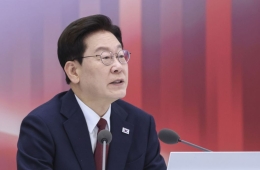
President Lee Jae-myung speaks about revitalizing the capital market at a policy meeting on capital markets in Yeouido, Seoul, on November 13. 2026.11.13 Yonhap News Agency
View original imageAt a capital market policy meeting held at the Korea Exchange in Yeouido, Seoul, on November 13, President Lee said, "Insolvent companies and underperforming companies should be delisted swiftly by properly applying the delisting requirements," calling for a review of the entire listing, delisting and evaluation system.
However, the discussion highlighted as a major issue the fact that the government's tougher delisting policy has been held up by court rulings. Kim Woo-chan, a professor at Korea University, said, "Delistings are essential to restoring confidence in the KOSDAQ market, but they are now being blocked," and pointed out that procedures for delisting under the market capitalization requirement had been suspended for 39 companies.
In fact, on October 2, the Seoul Southern District Court granted injunctions suspending the effect of delisting decisions, as sought by KOSPI-listed JooyonTech and KOSDAQ-listed KM Pharmaceutical. In response, on October 7, the Korea Exchange decided to maintain the designation of the companies as management issues for falling below the market capitalization requirement, while postponing subsequent delisting procedures.
Under delisting reforms announced by the government in February, the KOSDAQ market capitalization requirement was raised from KRW 15 billion to KRW 20 billion in July this year. It is scheduled to rise further to KRW 30 billion in January next year. The requirements were also tightened to allow companies to be delisted if they fail to meet the market capitalization requirement for a specified period after being designated as management issues.
The legal dispute is ongoing. On November 12, the 51st Civil Division of the Seoul Southern District Court held its first hearing on the Korea Exchange's objection to the injunction and agreed to accept additional materials through November 27. The court plans to decide whether to uphold the injunction as early as the end of November, and no later than the first week of December. Key issues include the grounds for applying the stricter standards early and whether companies facing delisting had an opportunity to present their case.
Market experts also broadly agree that stricter delisting standards are necessary. According to the Financial Services Commission, 1,353 companies newly listed on the KOSDAQ over the past 20 years, while only 415 companies were delisted. Although 38 delisting decisions were made in 2025, up from eight in 2023, this is considered insufficient to resolve the accumulation of insolvent companies.
By contrast, Song Byeong-jun, chairman of the Korea Venture Business Association, said that tightening the market capitalization requirement could instead create a vicious cycle for small and midsize listed companies facing financial difficulties. If share prices fall, investors may avoid buying the shares out of concern about delisting, which could lead to further price declines, he said.
Hot Picks Today
 "Two Spend 500,000 Won in a Flash, Yet Wait Two Hours?" ... 'Dreamland' Shunned by Kids and Foreign Tourists
- The Era of Getting 200 Million Won After 30 Years Is Over... A Japanese Bank's "Perpetual Department Head" Who Just Clocked In Cries Out
- Spain Hit by Its Worst Tragedy... Lee Kangin, Moreno and Real Madrid Join Soccer World in Mourning
- They Said, “Make It Your Home for Life” - Then Suddenly Kicked 200 Passengers Off... What Happened to the Around-the-World Cruise?
- "130 Rice Bowls Sold Out in a Day"... 'Unfiltered Face' Adds 8 Million Won to Night Market Sales: China's Bungeunwoo
Song said, "An insolvent company and a company with a low share price are not necessarily the same," explaining that even companies with sound business performance are being overlooked by the market. He also claimed that some companies have received acquisition offers demanding that they sell their shares at a bargain price, using the possibility of delisting as leverage. Bora Jeong, CEO of Stick Ventures, also proposed that assessments of listed companies' growth prospects should take into account not only simple quantitative indicators but also their technological capabilities and business potential.
© The Asia Business Daily. All rights reserved. Unauthorized AI training and use prohibited.