President Lee: "Promote M&A Despite Criticism... Mandatory Tender Offers Come Down to Resolve"
President Lee Holds Capital Market Policy Roundtable
“It Is Difficult to Go Against the General Consensus of the People”
Holds In-Depth Talks with Experts on a 100% Mandatory Tender Offer Ratio
Orders Comprehensive Review of Barriers to Hostile M&A
At a capital market policy discussion on the 13th, President Lee Jae-myung said of the mandatory tender offer system, “Even if we draw criticism from the public and investors, we should move in the direction of growing the pie,” adding, “All shareholders will benefit only when the entire market is normalized by promoting mergers and acquisitions (M&A).” His remarks suggested that raising the mandatory offer ratio to 100% could shrink the market, effectively backing the government’s proposal over the demands of minority shareholders.
President Lee also stressed, “We need to promote hostile M&A to break down abnormal structures. This abnormality is the biggest challenge we must overcome.” To that end, he called for a comprehensive review of institutional barriers to hostile M&A and a reassessment of the requirements for maintaining a stock market listing for companies in which major shareholders effectively monopolize management control.

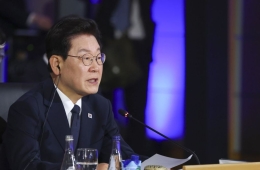
President Lee Jaemyung speaks about revitalizing the capital market at a policy roundtable in Yeouido, Seoul, on Nov. 13, 2026. Yonhap News, Nov. 13, 2026.
View original imageWearing a red tie, which signifies a “bull market” in the stock market, President Lee made these remarks at a capital market policy roundtable in Yeouido, Seoul, on Nov. 13, after experts expressed differing views on the mandatory tender offer ratio. “There are conflicting interests,” he said.
The mandatory tender offer system is designed to give ordinary shareholders the opportunity to sell their shares when a company’s management control is acquired. The government is weighing two policy objectives: protecting minority shareholders and promoting M&A. President Lee emphasized, “In politics, it is difficult to casually go against the general consensus of the people.” However, he indicated that it would ultimately be difficult to raise the mandatory tender offer ratio to 100%, as minority shareholders are demanding.
The debate began when Kim Woo-chan, a professor at Korea University, argued for a 100% mandatory tender offer requiring the buyer to purchase all shares held by shareholders who wish to sell when control of a company is acquired. His point was that the “50%+1 share” proposal currently under discussion would not adequately protect ordinary shareholders. President Lee said, “I have a lot to consider, as I will also be involved in making the final decision,” and described the proposal as “ideal, good, and fair.” He nonetheless asked, “If the cost of financing an acquisition becomes so high that the M&A itself does not happen, wouldn’t minority shareholders lose the opportunity altogether?”
When Professor Kim countered that the development of the acquisition financing market had reduced the burden of raising funds compared with the past, President Lee asked another question. “We need to consider whether it is better to have many M&A deals in which only half the shareholders benefit, or to have the total number of deals fall sharply, reducing the overall benefits even further,” he said.
The discussion also focused on how to allocate the opportunity to sell shares to minority shareholders, in addition to the offer ratio. “Let’s make it fair for both major and minority shareholders,” President Lee said, raising the possibility of retaining the obligation to purchase 50%+1 share while allocating the opportunity to sell among shareholders. The private equity fund (PEF) industry, however, countered that M&A could be stifled if major shareholders were unable to sell all their holdings, as this would reduce the incentive to make deals.
Even after being told that the relevant bill had passed the National Assembly’s Legislation and Judiciary Committee with bipartisan agreement, President Lee asked, “Isn’t it currently stalled because of opposition?” His remarks reflected the view that any decision should take into account not only the need for the system but also public acceptance and its potential impact on the market.

President Lee Jae-myung speaks about revitalizing the capital market at a policy meeting in Yeouido, Seoul, on the 13th. 2026.11.13 Yonhap News
View original imageEarlier in the discussion, participants also focused on ways to promote hostile M&A. When it was pointed out that there were as many as 570 companies where major shareholders and their related parties held more than 50% of shares and the price-to-book ratio (PBR) was below 1, President Lee stressed, “Hostile M&A is the most powerful mechanism for actually normalizing the market.”
He continued, “Doesn’t our country have a hostile attitude toward hostile M&A? Don’t policymakers’ policies also implicitly work to defend against hostile M&A?” He called for a comprehensive review, saying, “Look into whether there are various mechanisms that are blocking hostile M&A,” and asked officials to find concrete ways to promote it.
He also questioned the rationale for keeping companies listed when major shareholders own 70–80% of their shares. “They enjoy all the benefits of being listed while effectively monopolizing management,” President Lee said, asking, “Shouldn’t they be delisted?” He added, “Shouldn’t we consider ways to remove companies that are effectively run like private businesses from the market?” and called for a review of the criteria for maintaining a listing.
Hot Picks Today
 "Two Spend 500,000 Won in a Flash, Yet Wait Two Hours?" ... 'Dreamland' Shunned by Kids and Foreign Tourists
- The Era of Getting 200 Million Won After 30 Years Is Over... A Japanese Bank's "Perpetual Department Head" Who Just Clocked In Cries Out
- Spain Hit by Its Worst Tragedy... Lee Kangin, Moreno and Real Madrid Join Soccer World in Mourning
- They Said, “Make It Your Home for Life” - Then Suddenly Kicked 200 Passengers Off... What Happened to the Around-the-World Cruise?
- "130 Rice Bowls Sold Out in a Day"... 'Unfiltered Face' Adds 8 Million Won to Night Market Sales: China's Bungeunwoo
He also pointed out that voluntary shareholder-friendly management by companies has its limits. When Lee Seung-woo, an assistant governor at the Financial Supervisory Service, proposed promoting “earnings calls” to encourage companies whose share prices fall despite improved results to strengthen their earnings announcements and communication with shareholders, President Lee said, “We can’t just rely on people’s goodwill,” stressing that “we need to encourage or require this through institutions.”
© The Asia Business Daily. All rights reserved. Unauthorized AI training and use prohibited.