President Lee: "Capital Market Reform Put to the Test... Quickly Delist Insolvent, Low-Growth Companies"
President Lee Presides Over Capital Market Policy Meeting
“Separately Instructed Serious Crimes Investigation Agency to Crack Down on Unfair Practices”
Also Points to Stock Price Suppression and Abuse of Control by Controlling Shareholders
“Capital Market Must Be Normalized as Soon as Possible”
“Mandatory Tender Offer System Must Balance Shareholder Protection with Potential M&A Market Slowdown”
President Lee Jae-myung cited the recent weakness in stock prices on the 13th, saying, "Our government's commitment and policies on capital market reform are being put to the test." He said the government would press ahead steadily with policies to normalize the capital market and restore investor confidence. Focusing in particular on the KOSDAQ market, he called it "quite problematic" and stressed the need to review the overall system for market entry, delisting and evaluation. He also ordered the government to draw up measures to promote hostile mergers and acquisitions (M&A) of companies with a price-to-book ratio (PBR) of 1 or less.

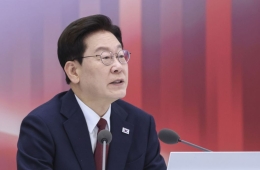
President Lee Jaemyung listens to an expert's presentation on revitalizing the capital market and takes part in a discussion at a capital market policy meeting held at the Korea Exchange's exhibition hall in Yeouido, Seoul, on Nov. 13, 2026. Yonhap News Agency
View original imageLee made the remarks at a capital market policy meeting held that day at the Korea Exchange in Yeongdeungpo-gu, Seoul, saying, "Normalizing the capital market is a firm priority for our government." This was Lee's second visit to the exchange, following his first on June 11 last year. His first visit came during an upswing, when the KOSPI surpassed the 2,900 level for the first time in three years and five months. This meeting, by contrast, was held amid weak stock prices. Seemingly mindful of the situation, Lee remarked, "Everyone looks so solemn. Is it because stock prices are on a downward trend?"
Lee pointed to the fact that Korean companies' technological capabilities and industrial competitiveness are world-class, yet are not properly valued on the domestic stock market. "It is sad, but also highly unreasonable and abnormal, that the same stocks are undervalued simply because they are shares in Korean companies and are listed on the Korean stock market," he said, stressing that correcting this was a key government priority. He added, "The most important value in the capital market is trust," saying the government must address investors' distrust over stock price manipulation, multiple listings, the improper outflow of corporate profits, and policy consistency.
Lee reiterated his commitment to boosting stock prices by restoring confidence in the capital market. Focusing in particular on the KOSDAQ market, he said, "I see reforming the KOSDAQ market and expanding the foundation for stable investment as priorities," and called for "properly applying delisting criteria to insolvent and low-growth companies and expediting their removal from the market." He added, "We need to comprehensively assess the systems for market entry and exit and transform the KOSDAQ into a market where innovative companies can grow and investors can invest with confidence."
Lee also said, "We have corrected flawed systems and adopted good ones, but I believe there is still more to do," adding that "the government is taking a strict, whole-of-government approach to unfair practices such as stock price manipulation." He continued, "I also gave separate instructions to the Serious Crimes Investigation Agency to take a firm stance against unfair practices in the capital market," and said, "I believe a lot will change and things will improve."

President Lee Jae-myung casts an impromptu vote on measures to promote mandatory tender offers at a capital market policy meeting held at the Korea Exchange's exhibition hall in Yeouido, Seoul, on the 13th. 2026.11.13 Yonhap News Agency
View original imageLee identified the mandatory tender offer system as a key topic for discussion on protecting minority shareholders during changes in corporate control. "Isn't there an ongoing debate about how to improve the mandatory tender offer system?" he said, stressing that the need to protect minority shareholders' rights and interests must be weighed alongside the possibility of a slowdown in the M&A market. The mandatory tender offer system is designed to give ordinary shareholders the opportunity to sell their shares when a company is acquired. Key issues include whether the purchase obligation in an acquisition of control should cover 50% plus one share or be extended to all shares.
Hot Picks Today
 "Two Spend 500,000 Won in a Flash, Yet Wait Two Hours?" ... 'Dreamland' Shunned by Kids and Foreign Tourists
- The Era of Getting 200 Million Won After 30 Years Is Over... A Japanese Bank's "Perpetual Department Head" Who Just Clocked In Cries Out
- Spain Hit by Its Worst Tragedy... Lee Kangin, Moreno and Real Madrid Join Soccer World in Mourning
- They Said, “Make It Your Home for Life” - Then Suddenly Kicked 200 Passengers Off... What Happened to the Around-the-World Cruise?
- "130 Rice Bowls Sold Out in a Day"... 'Unfiltered Face' Adds 8 Million Won to Night Market Sales: China's Bungeunwoo
During a discussion on expanding shareholder-focused management and enhancing corporate value, participants said hostile M&A was not possible for companies with a low PBR of 1 or less. "The biggest mechanism for normalizing the market is hostile M&A," Lee said. "Don't people have negative feelings about hostile M&A? I wonder whether policymakers' actions are implicitly geared toward defending against hostile M&A." He added, "Conduct a comprehensive review to see whether anything is preventing the system from working," and called for officials to "discuss concrete ways to promote hostile M&A and identify them."
© The Asia Business Daily. All rights reserved. Unauthorized AI training and use prohibited.