KOSPI Rises More Than 2% as Jensen Huang Resignation Eases 'Uncertainty'
KOSPI up 2%, KOSDAQ up more than 4%
"Jensen Huang issue likely to cause only short-term volatility"
Next week's NVIDIA earnings report to shape investor sentiment
U.S. stocks fell across the board overnight following news of NVIDIA CEO Jensen Huang's abrupt resignation, but South Korean stocks opened more than 2% higher, shrugging off external headwinds. Buying appears to have been supported by the view that Huang's resignation would not lead to a broader contraction in demand across the artificial intelligence (AI) industry.

According to the Korea Exchange, as of 9:50 a.m. on the 13th, the KOSPI was up 124.75 points, or 2.33%, from the previous trading day at 5,467.48. After opening at 5,452.41, up 109.68 points, or 2.05%, from the previous session, the index continued to gain ground in early trading. The KOSDAQ was also up 4.16% at 725.50.
By investor category on the main board, foreign investors and institutions were net buyers of KRW 221.9 billion and KRW 42.1 billion, respectively, driving the index higher. Individuals, meanwhile, were net sellers of KRW 351.4 billion, appearing to take profits.
Most of the top stocks by market capitalization were also in positive territory. Samsung Electronics (2.64%) and SK hynix (2.87%), the market's leading stocks, opened higher together, lifting the index. Other major large-cap stocks, including LG Energy Solution (2.12%), Samsung Electro-Mechanics (2.93%) and Hyundai Motor (3.38%), also posted gains.
Gains spread across sectors as well. Almost all sectors advanced, including construction (3.57%), medical and precision equipment (3.49%), securities (3.18%), entertainment and culture (2.87%), and electrical and electronic equipment (2.65%). Only the electricity and gas sector fell sharply, down 7.55%.
Despite Wall Street's overnight decline, driven by news of Huang's resignation as well as concerns over interest rates and oil prices, South Korean stocks rose more than 2% in early trading. The gains appear to reflect bargain buying focused on large-cap domestic stocks, amid a view that the change in NVIDIA's leadership would not undermine structural demand in the global AI semiconductor industry. "Since the South Korean stock market had already priced in some of the related negative news, bargain buying is likely to support the index's downside," said Han Ji-young, an analyst at Kiwoom Securities.
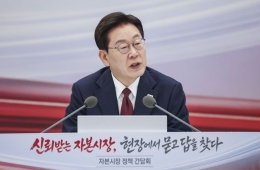
A capital market policy meeting held earlier that morning also appears to have provided momentum for the rally. From 9:30 a.m. to 11:10 a.m., the government held a capital market policy meeting chaired by President Lee under the theme "A Capital Market That Earns Trust: Asking Questions and Finding Answers on the Ground." Participants discussed key capital market policies and issues, including a mandatory public tender offer system, stricter delisting rules and the separation of KOSDAQ segments.
Some analysts expect the Jensen Huang issue to result only in increased short-term volatility. "The mass-production schedule for NVIDIA's next-generation product, Vera Rubin, and supply contracts with major customers have been largely finalized, making a major disruption to business operations over the next one to two years unlikely," Han said. "Therefore, even if uncertainty stemming from Huang's resignation temporarily puts selling pressure on NVIDIA's suppliers, there is no need to interpret it as a broader deterioration in the outlook for the domestic semiconductor industry."
Hot Picks Today
 "Two Spend 500,000 Won in a Flash, Yet Wait Two Hours?" ... 'Dreamland' Shunned by Kids and Foreign Tourists
- The Era of Getting 200 Million Won After 30 Years Is Over... A Japanese Bank's "Perpetual Department Head" Who Just Clocked In Cries Out
- Spain Hit by Its Worst Tragedy... Lee Kangin, Moreno and Real Madrid Join Soccer World in Mourning
- They Said, “Make It Your Home for Life” - Then Suddenly Kicked 200 Passengers Off... What Happened to the Around-the-World Cruise?
- "130 Rice Bowls Sold Out in a Day"... 'Unfiltered Face' Adds 8 Million Won to Night Market Sales: China's Bungeunwoo
"The KOSPI is likely to continue its valuation normalization, supported by easing concerns about AI investment and solid fundamentals," said Lee Kyung-min, an analyst at Daishin Securities. "With CoreWeave's results and strong domestic semiconductor exports supporting AI demand, investor sentiment could improve further if NVIDIA's earnings next week confirm a positive outlook."
© The Asia Business Daily. All rights reserved. Unauthorized AI training and use prohibited.