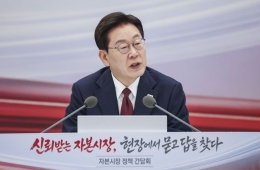
President Lee: "Government's Commitment to Capital Market Reform Put to the Test"
President Lee Presides Over “Capital Market Policy Meeting”
“Swift Delisting of Insolvent KOSDAQ Companies Also Needed”
Separately Orders Serious Crimes Investigation Agency to Crack Down on Unfair Practices
Flags Stock Price Suppression and Abuse of Management Rights by Controlling Shareholders
“Need to Balance Shareholder Protection With Concerns That Mandatory Tender Offers Could Hinder M&A”
President Lee Jae Myung said on Nov. 13 that the government’s commitment to capital market reform was being put to the test, and called for the swift delisting of insolvent and underperforming companies to restore confidence in the KOSDAQ market. He said he had separately instructed the Serious Crimes Investigation Agency to crack down strictly on unfair practices in the capital market, including stock price manipulation. He also raised the possibility of companies deliberately suppressing their share prices and controlling shareholders abusing their management rights, reaffirming his commitment to structural reform across the capital market.

Presiding over a “Capital Market Policy Meeting” in Yeouido, Seoul, while wearing a red tie—the color associated with a bull market in stocks—President Lee said in his opening remarks, “Normalizing the capital market is a firm policy direction and commitment of our government,” and made the remarks.
President Lee singled out reform of the KOSDAQ market as an urgent priority. “Insolvent and underperforming companies should be swiftly delisted by properly applying the delisting criteria,” he said, stressing that “the systems for market entry, exit and evaluation need to be reviewed comprehensively.”
He also cautioned that stronger delisting criteria should not end up harming innovative companies with strong growth potential. “It is also important to ensure that companies with technological capabilities and growth potential are properly evaluated and not harmed,” he said, adding that KOSDAQ should be transformed into a market where innovative companies can grow and investors can invest with confidence.
This is seen as a move to shift away from the previous approach to market management, which focused on increasing the number of listed companies, and to overhaul the listing and delisting system with a focus on corporate growth potential and market soundness. Over the past 20 years, 1,353 companies have newly listed on KOSDAQ, while only 415 have been delisted. The share of marginal companies also rose from 13.1% in 2017 to 32.6% in 2025.
"Separately instructed the Serious Crimes Investigation Agency to crack down strictly on unfair practices in financial markets"
President Lee also expressed a strong commitment to eradicating unfair trading, including stock price manipulation. “We are responding at the pan-government level to stock price manipulation and other such unfair practices,” he said. “We are also increasing the number of enforcement personnel, and I have separately instructed the Serious Crimes Investigation Agency to pay particular attention to unfair practices in the financial and capital markets and crack down on them strictly.”
He also raised concerns about practices aimed at keeping companies’ share prices artificially low. Pointing out that many companies are still valued below their book value, President Lee said, “I don’t think it’s simply a matter of performance or growth potential.”
“There are suspicions emerging that some companies are deliberately managing their share prices downward to shift taxes when they pass on inheritances,” he continued. “The core issue is the lack of trust that companies may not respect shareholders as their owners, but instead treat them as people to be exploited, or that controlling shareholders may be abusing their management rights.” His remarks reflected the view that the causes of corporate undervaluation should be examined not only in terms of poor performance or a lack of growth potential, but also in relation to corporate governance and violations of shareholder rights.
Focuses on debate over mandatory tender offer system... "Need to consider concerns it could hinder M&A"
President Lee also identified the “mandatory tender offer system,” which is intended to protect minority shareholders during management control transactions, as a key topic for discussion. “There is currently a debate over how to improve the mandatory tender offer system,” he said, stressing that the need to protect minority shareholders’ rights and interests must be weighed alongside the possibility of stifling the mergers and acquisitions (M&A) market.
The mandatory tender offer system is designed to give ordinary shareholders the opportunity to sell their shares when a company is acquired. Key issues include whether the scope of the purchase obligation in an acquisition of management control should be set at 50%+1 share or expanded to cover all shares. There are also concerns that stronger shareholder protections could increase the financial burden on acquirers and dampen corporate restructuring and M&A activity.
As President Lee has emphasized the need to balance the two goals of protecting minority shareholders and promoting M&A activity, this issue is expected to remain a major point of debate in the design of the system.
"Capital market reform commitment put to the test... Trust is key"
Regarding the recent stock market correction, President Lee acknowledged the pressures caused by the market’s rapid rise, while expressing his resolve to press ahead with policies to normalize the capital market without wavering. “Our stock market has undergone a major correction recently,” he said. “It had risen so rapidly and far beyond expectations that I was a little concerned.” He added, “The higher the mountain, the deeper the valley,” before asking, “If the valley is deep, might the mountain not rise high again?” He described the current situation as one in which “our government’s commitment and policies on capital market reform have once again been put to the test.”
He pointed out that Korean companies’ technological capabilities and industrial competitiveness are at a world-class level, yet they are not properly valued in the domestic stock market. “It is sad, but also highly irrational and abnormal, that the same stocks are undervalued simply because they belong to Korean companies and are listed on the Korean stock market,” he said, stressing that correcting this is a key task for the government.
“The most important value in the capital market is trust,” he said, adding that investor distrust over stock price manipulation, dual listings, improper diversion of corporate profits and the consistency of government policy must be addressed.
Hot Picks Today
 "Two Spend 500,000 Won in a Flash, Yet Wait Two Hours?" ... 'Dreamland' Shunned by Kids and Foreign Tourists
- The Era of Getting 200 Million Won After 30 Years Is Over... A Japanese Bank's "Perpetual Department Head" Who Just Clocked In Cries Out
- Spain Hit by Its Worst Tragedy... Lee Kangin, Moreno and Real Madrid Join Soccer World in Mourning
- They Said, “Make It Your Home for Life” - Then Suddenly Kicked 200 Passengers Off... What Happened to the Around-the-World Cruise?
- "130 Rice Bowls Sold Out in a Day"... 'Unfiltered Face' Adds 8 Million Won to Night Market Sales: China's Bungeunwoo
“The government’s role is to establish fair and transparent market rules and ensure that they are properly applied to everyone without exception,” President Lee said, stressing that “once market confidence is restored, companies in our market will once again receive proper valuations that reflect their actual worth.”
© The Asia Business Daily. All rights reserved. Unauthorized AI training and use prohibited.