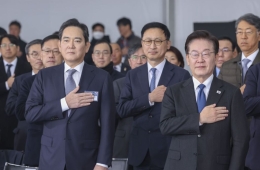
Yangju Mayor Jeong Deokyeong: "Prioritize Pedestrian Rights for Vulnerable Road Users in the Physical AI Era"
Emphasizes incorporating pedestrian safety from the urban planning stage at National Assembly policy seminar
Discusses institutionalizing pedestrian environment assessments and separating movement spaces for people and robots
Yangju Mayor Jeong Deokyeong said at the policy seminar “The Advent of the Physical AI Era and the Right to Walk,” held at the National Assembly Members’ Office Building on November 12, “From the earliest stages of urban development and planning, we must prioritize people’s safety and right to mobility, especially the right to walk for vulnerable road users, including children, older adults and people with disabilities.”

Yangju Mayor Jeong Deok-young poses for a commemorative photo with participants at a policy seminar titled “The Advent of the Physical AI Era and Pedestrian Rights” held at the National Assembly Members' Office Building on the 12th. Provided by Yangju City.
View original imageMore than 30 people attended the seminar, hosted by Sejong University’s Korea Space Syntax Research Institute, including National Assembly Member Lee Sanghwi, Sejong University Professor Kim Younguk, and academic and policy experts. Participants discussed how to ensure citizens’ safety and right to mobility as autonomous mobile robots and humanoids become more common in daily life and people and robots share pedestrian spaces.
Sejong University Professor Son Donguk proposed institutionalizing pedestrian environment assessments to complement existing vehicle-centered traffic impact assessments. Sejong University Professor Oh Sangjin presented urban design approaches to protecting pedestrian rights in the era of Physical AI. Participants also discussed ways to separate the movement areas of people and robots and use artificial intelligence to manage pedestrian safety.
In his congratulatory remarks, Yangju Mayor Jeong Deokyeong said, “The spread of Physical AI technology presents a new challenge: how people and robots can use pedestrian spaces safely and harmoniously. Because pedestrian spaces are places where citizens go about their daily lives and communicate, we must prioritize people’s safety and right to mobility from the earliest stages of urban development and planning, especially the right to walk for vulnerable road users, including children, older adults and people with disabilities.”
Hot Picks Today
 "Two Spend 500,000 Won in a Flash, Yet Wait Two Hours?" ... 'Dreamland' Shunned by Kids and Foreign Tourists
- The Era of Getting 200 Million Won After 30 Years Is Over... A Japanese Bank's "Perpetual Department Head" Who Just Clocked In Cries Out
- Spain Hit by Its Worst Tragedy... Lee Kangin, Moreno and Real Madrid Join Soccer World in Mourning
- They Said, “Make It Your Home for Life” - Then Suddenly Kicked 200 Passengers Off... What Happened to the Around-the-World Cruise?
- "130 Rice Bowls Sold Out in a Day"... 'Unfiltered Face' Adds 8 Million Won to Night Market Sales: China's Bungeunwoo

Yangju Mayor Jung Deok-young speaks at the policy seminar "The Advent of the Physical AI Era and Pedestrian Rights," held at the National Assembly Members' Office Building on the 12th. Provided by Yangju City.
View original imageHe added, “Yangju will also prepare for its transition into a future-ready city by building a smart transportation system and laying the foundation for the mobility industry. We will work to ensure that urban development leads to greater safety and a better quality of life for our citizens.”
© The Asia Business Daily. All rights reserved. Unauthorized AI training and use prohibited.