'Nvidia in Crisis'... Intel Launches AI Alliance With Korean Companies
Domestic AI Chips and Models to Be Combined on Korean-Made Servers... Ha Jungwoo Encourages Partner Companies
KAIST-Dime Unmanned Factory Demonstration Introduced; "South Korea's Physical AI Market Is in Focus"
Inference GPU With Up to 480GB of Memory Unveiled
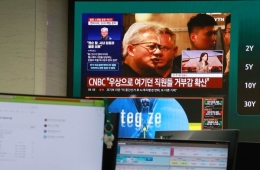
With the future of Nvidia CEO Jensen Huang uncertain, Intel is striking back by expanding its AI partnerships in South Korea.
Intel unveiled an AI inference GPU that can support up to 480GB of memory and agreed to build AI infrastructure based on domestic servers with South Korean semiconductor, server, and software companies.
With the Ministry of SMEs and Startups, it will support the commercialization and overseas expansion of South Korean AI startups. It also plans to expand cooperation with domestic companies in physical AI fields, including unmanned factories.
At the "2026 Intel AI Summit Seoul," held on November 12 at COEX in Samseong-dong, Gangnam-gu, Seoul, Intel Korea launched the "K-AI Full-Stack Alliance," with 23 participating companies.
Initial participants include KTNF, a domestic server company; AI semiconductor companies FuriosaAI and DeepX; AI model developer Upstage; and cloud company MegazoneCloud.
The goal is to connect each company's semiconductors, AI models, and software using domestic servers, helping South Korean companies build AI systems tailored to the needs of different industries.

Ha Jungwoo (first from left), vice chairman of the National AI Strategy Committee, listens to an explanation of a KTNF server using chips from domestic NPU company Furiosa and Intel CPUs, guided by Intel Korea CEO Bae Taewon, on the 12th. Photo by Paek Jongmin, Tech Specialist.
View original imageIntel Korea CEO Bae Taewon cited "Ignite," a startup incubation program run with the Ministry of SMEs and Startups, as an example of their cooperation. The program combines government support for commercialization with Intel's technology and global network to help South Korean startups enter overseas markets.
Mok Seunghwan, head of the Startup and Venture Innovation Office at the Ministry of SMEs and Startups, emphasized helping startups secure initial sales channels and expand overseas. In a video congratulatory message, Lee Dogyu, head of the Information and Communications Policy Office at the Ministry of Science and ICT, said he hoped cooperation between Intel and South Korean companies would lead to applications in industrial settings and overseas expansion.
Ha Jungwoo, vice chair of the National AI Strategy Committee, also visited the event to encourage the South Korean companies working with Intel. Ha showed interest in a server equipped with a neural processing unit (NPU) from domestic AI semiconductor company FuriosaAI.
Intel Korea also signed a business agreement with Seoul AI Hub to support startups in developing and validating AI solutions.
In the physical AI field, Dime Technology, which built an unmanned factory demonstration lab at KAIST, was introduced as a key collaboration example. The system combines Intel edge computing equipment with Dime's robot integration and control software to operate robots and equipment together inside a factory. Intel said it is also collaborating with major South Korean companies on physical AI.

Anil Nanduri, head of AI product and market strategy at Intel's Data Center Group, holds up a chip and a unit of the D-series graphics processing unit (GPU) designed for inference. Developed under the codename "Crescent Island," the product is equipped with up to 480 GB of low-power DRAM (LPDDR5X), which is used in smartphones and other devices. Photo by Paek Jongmin, tech specialist.
View original image◆"Far Faster Than Nvidia": GPU With 480GB of Memory Unveiled
Anil Nanduri, head of AI product and market strategy at Intel's Data Center Group, showcased the D270 GPU for inference.
Developed under the code name "Crescent Island," the product can support up to 480GB of low-power DRAM (LPDDR5X) on a single card. That is up to five times the 96GB offered by Nvidia's RTX PRO 6000 Blackwell Server Edition. Intel said the GPU was designed to lower inference costs when processing long documents or responding to multiple requests at once. A large GPU memory capacity makes it possible to use high-performance AI models with large memory requirements.
Nanduri emphasized that in Intel's own pre-production tests using the D270, throughput for four financial simulations using 64-bit floating-point (FP64) operations was 1.92 to 5.9 times that of Nvidia's product. Intel also proposed using central processing units (CPUs) to allocate and execute tasks for AI agents, while combining GPUs and dedicated accelerators for inference.
Meanwhile, 52 domestic and international companies, including Samsung Electronics, SK hynix, and LG Electronics, participated in the summit. Intel said approximately 1,000 industry representatives and others attended the event.
Hot Picks Today
 "Two Spend 500,000 Won in a Flash, Yet Wait Two Hours?" ... 'Dreamland' Shunned by Kids and Foreign Tourists
- The Era of Getting 200 Million Won After 30 Years Is Over... A Japanese Bank's "Perpetual Department Head" Who Just Clocked In Cries Out
- Spain Hit by Its Worst Tragedy... Lee Kangin, Moreno and Real Madrid Join Soccer World in Mourning
- They Said, “Make It Your Home for Life” - Then Suddenly Kicked 200 Passengers Off... What Happened to the Around-the-World Cruise?
- "130 Rice Bowls Sold Out in a Day"... 'Unfiltered Face' Adds 8 Million Won to Night Market Sales: China's Bungeunwoo
The event, featuring exhibitions and technology demonstrations by domestic and international companies, brought to mind the Intel Developer Forum (IDF), held in San Francisco during Intel's heyday two decades ago.

Anil Nanduri, head of AI product and market strategy at Intel's Data Center Group, announces that the "D Series" inference graphics processing units (GPUs) are far faster than competing products from Nvidia. Photo by Paek Jongmin, Tech Specialist
View original imageSantosh Viswanathan, Intel's head of the Asia-Pacific region, said, "South Korea has strong semiconductor and R&D capabilities, as well as significant innovation potential in sovereign AI, physical AI, and the intelligent edge. With its open heterogeneous computing and broad AI portfolio, Intel will work with South Korean innovators and partners to create new AI use cases and expand them into larger markets."
© The Asia Business Daily. All rights reserved. Unauthorized AI training and use prohibited.