Issued Promissory Notes and IMAs Grow in Scale... FSS: "Prepare Proactively for Losses on High-Risk Products"
Urges Securities Firms to Strengthen Risk Management for Issued Promissory Notes and IMAs
The Financial Supervisory Service (FSS) has again urged securities firms expanding their short-term note issuance and Integrated Investment Account (IMA) businesses to strengthen their management of financial soundness and liquidity, as well as their internal controls. It stressed that, as the amount of funding raised through short-term notes and IMAs grows, firms must proactively prepare for potential losses on high-risk investment products and establish risk management systems to protect investors.
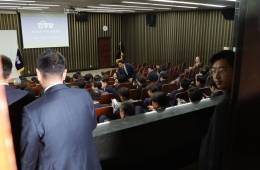
The FSS said it held a meeting on the afternoon of November 12 at the Korea Financial Investment Association in Yeouido with the chief risk officers (CROs) and heads of asset management at nine comprehensive financial investment business entities to discuss ways to strengthen risk management and internal controls for short-term notes and IMAs.
In his opening remarks, FSS Deputy Governor Seo Jaewan said the businesses are expected to continue expanding in scale following the recent approval of new short-term note issuance businesses for Samsung Securities and Meritz Securities, as well as the expansion of products eligible for inclusion in retirement pension portfolios. He emphasized, "Protecting investors and providing high-quality, stable risk capital are possible only when supported by high-level risk management and a robust internal control system."

The FSS first called on firms to proactively prepare for potential losses on high-risk investment products, including overseas investments, amid significant domestic and international uncertainty surrounding interest rates and stock prices. It also said that even when firms launch high-interest short-term note products amid recent increases in market interest rates, they must manage them at levels that are sustainable from a financial soundness perspective.
The FSS also called for stronger liquidity and solvency management, including scenario analysis for crisis situations and the preparation of emergency funding plans. It said firms should carefully review plans to recover long-term assets and, in light of the newly introduced adjusted liquidity ratio, diversify the maturities of their funding and investments and improve their liquidity response systems.
The FSS also emphasized that the supply of risk capital should focus not only on quantitative expansion but also on qualitative improvement. The amount of risk capital supplied by comprehensive financial investment business entities rose from KRW 9.6 trillion at the end of the first quarter of this year to KRW 11.6 trillion at the end of the second quarter. The ratio of risk capital supplied to funds raised through short-term notes and IMAs also increased from 16.8% to 19.5% over the same period.
Deputy Governor Seo urged firms to "actively identify companies with technological capabilities and growth potential that have been overlooked by investors, and take the lead in expanding the reach of productive finance as partners that grow alongside them." He also called on firms to use the recent emergence of the first investment through a risk capital investment platform as a reference and identify venture and innovative companies through diverse channels. KB Securities has received proposals for venture investment partnerships through the platform and is reviewing potential investments. It plans to invest in innovative venture companies based in regional areas, including artificial intelligence (AI) companies, in the future.
The FSS is also working with the financial investment industry to establish a more detailed risk management framework for corporate credit extensions. It plans to set out detailed procedures and standards for key stages, including organizational structures, screening, and post-investment management, through the "Best Practices for Corporate Credit Extension Risk Management." Key provisions will include standards to ensure the expertise and independence of credit officers; criteria for assessing a company's business, industry, and financial risks, as well as the purpose of financing and repayment plans; and ongoing monitoring of changes in credit status and repayment capacity.
The FSS also asked firms to establish effective measures to prevent conflicts of interest and barriers to information sharing in the management of short-term notes and IMAs. In addition, regarding the temporary exemption from the requirement to maintain collateral ratios for credit extensions, which has been in effect since November 9, the FSS called on firms to clearly explain their detailed implementation criteria and faithfully implement the "Voluntary Management Plan for Margin Loans" to prevent the measure from leading to an expansion of so-called "debt-financed investing."
Hot Picks Today
 "Two Spend 500,000 Won in a Flash, Yet Wait Two Hours?" ... 'Dreamland' Shunned by Kids and Foreign Tourists
- The Era of Getting 200 Million Won After 30 Years Is Over... A Japanese Bank's "Perpetual Department Head" Who Just Clocked In Cries Out
- Spain Hit by Its Worst Tragedy... Lee Kangin, Moreno and Real Madrid Join Soccer World in Mourning
- They Said, “Make It Your Home for Life” - Then Suddenly Kicked 200 Passengers Off... What Happened to the Around-the-World Cruise?
- "130 Rice Bowls Sold Out in a Day"... 'Unfiltered Face' Adds 8 Million Won to Night Market Sales: China's Bungeunwoo
Meeting participants agreed that investor protection standards must be raised in line with the expansion of funding and investment. They said they would review their investor protection frameworks in full and incorporate the supervisory authorities' guidelines into their internal rules and procedures. Newly approved business operators, in particular, said they would focus on managing financial soundness and liquidity for the time being and earn investors' trust through stable operations.

An FSS official said, "We will continue to pursue improvements to regulations and develop best practices for risk management and internal controls so that short-term notes and IMAs can fulfill their intended roles of helping the public grow their assets and promoting productive finance." The official added, "We will also continue to monitor the supply of risk capital and listen to the industry's concerns."
© The Asia Business Daily. All rights reserved. Unauthorized AI training and use prohibited.