[Exclusive] ETF Average Daily Trading Value Surpasses KOSPI for First Time Ever
Last month, ETFs recorded average daily trading value of 20.3813 trillion won
Trading value reached 100.1% of the KOSPI's
Investors prefer index investing over individual stocks
Concerns over ETFs influencing stocks in a "Wag the Dog" phenomenon
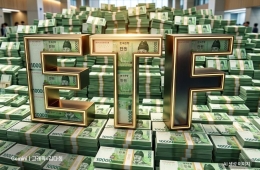
For the first time ever, the domestic exchange-traded fund (ETF) market's average daily trading value surpassed that of the KOSPI. As investor confidence in individual listed companies' stocks has wavered, funds have shifted toward ETFs tracking indexes and themes. At the same time, demand for leveraged and inverse products, including single-stock leveraged ETFs, has surged.

According to the Korea Exchange on the 12th, ETFs recorded an average daily trading value of 20.3813 trillion won last month. This slightly exceeded the KOSPI's average daily trading value of 20.3651 trillion won over the same period, bringing ETF trading value to 100.1% of the KOSPI's. On a monthly average daily basis, this is the first time ETF trading value has surpassed that of listed stocks alone since Korea's ETF market launched in 2002.
ETFs are classified as funds (beneficiary certificates), so their trading value is tallied separately from that of KOSPI-listed stocks alone (common and preferred shares). In other words, investors traded more money in ETF fund securities tracking indexes or themes than they did directly in individual listed companies' stocks.
From just 1.1% of the KOSPI's average daily trading value when the market launched in 2002, the ETF share rose gradually to 31.5% in 2020 and 44.3% in 2025, before climbing sharply to about 70% on a cumulative basis from January through October this year.
The fundamental reasons behind this reversal in trading value are a loss of confidence in investing in individual stocks and a structural shift in investment preferences toward passive funds. Analysts say that "basket investing," which avoids the risk of sharp share-price declines caused by earnings volatility or company-specific bad news and instead invests in a market index or an entire promising industry, has become the norm among individual investors.
"Investors are concentrating their funds in passive products that invest in baskets rather than individual stocks," said Lee Junseo, a professor of business administration at Dongguk University. "As confidence in individual stocks has weakened, tracking market indexes has become the norm. With the perception that 'ETFs are the answer' spreading, investment preferences are becoming more broadly oriented toward passive investing."
Steady inflows of regular investment purchases through retirement pensions and Individual Savings Accounts (ISAs), along with demand for overseas ETFs listed in Korea that allow domestic investors to trade global assets in won, have also broadened the ETF market.
With investors' preferences shifting toward passive investing, a surge in trading of leveraged and inverse products aimed at short-term gains became the decisive catalyst that accelerated the reversal.
In particular, after 2x single-stock leveraged and inverse products based on Samsung Electronics and SK hynix were listed at the end of May, trading demand seeking short-term volatility poured into the derivatives-based ETF market. The month after single-stock leveraged products were introduced, in June, ETFs' average daily trading value soared to an all-time high of 38.0797 trillion won. In July, ETF trading value reached 90.3% of the KOSPI's.

At the end of July, financial authorities introduced market-stabilization measures, including raising the minimum cash deposit requirement to 30 million won. While trading in single-stock leveraged products itself cooled, the already surging demand for leveraged trading shifted to existing index-based leveraged products, such as those tracking the KOSPI 200 and KOSDAQ 150, creating a balloon effect.
"With passive investing already established as a basic investment preference, additional demand for leveraged and inverse investments - including the controversial single-stock leveraged products amid increased market volatility - substantially boosted overall trading value," Lee said.
Experts are concerned about the potential side effects of ETF trading overwhelming the underlying stock market. These include the "Wag the Dog" phenomenon, in which derivative fund products (the tail) shake the individual stocks underlying them (the dog), and a weakening of the stock market's core price-discovery function.
"If the ETF market grows too large, the market's inherent price-discovery function, based on the valuation of individual stocks, could be undermined," Lee said. The concern is that instead of companies' appropriate share prices being determined by their earnings and fundamentals, with ETF supply and demand then formed around those prices, mechanical buying and selling at the index level could end up determining individual share prices in reverse.
Hot Picks Today
 "Two Spend 500,000 Won in a Flash, Yet Wait Two Hours?" ... 'Dreamland' Shunned by Kids and Foreign Tourists
- The Era of Getting 200 Million Won After 30 Years Is Over... A Japanese Bank's "Perpetual Department Head" Who Just Clocked In Cries Out
- Spain Hit by Its Worst Tragedy... Lee Kangin, Moreno and Real Madrid Join Soccer World in Mourning
- They Said, “Make It Your Home for Life” - Then Suddenly Kicked 200 Passengers Off... What Happened to the Around-the-World Cruise?
- "130 Rice Bowls Sold Out in a Day"... 'Unfiltered Face' Adds 8 Million Won to Night Market Sales: China's Bungeunwoo
A financial investment industry official also said, "As the concentration of funds in passive products intensifies, supply-and-demand and liquidity polarization among individual stocks could be exacerbated depending on whether they are included in major ETFs' portfolios. We need to be alert to the risk that the mechanical buying and selling associated with ETF trading could distort individual companies' share prices."
© The Asia Business Daily. All rights reserved. Unauthorized AI training and use prohibited.