[Editorial] U.S.-China-Russia Dialogue in Focus at APEC; Proactive Response Needed

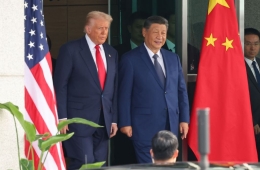
U.S. President Donald Trump and Chinese President Xi Jinping. Yonhap News Agency.
View original imageThe world’s attention is focused on the Asia-Pacific Economic Cooperation (APEC) Summit, which will be held in Shenzhen, Guangdong Province, China, on November 18-19. If U.S. President Donald Trump, Chinese President Xi Jinping, and Russian President Vladimir Putin hold their first-ever trilateral summit, it would be a historic meeting. The possibility of North Korea-U.S. and North Korea-China summits has also been raised. With the event potentially marking a turning point in an uncertain global landscape, more proactive responses are needed than ever on trade and security.
Xi, who is seeking a fourth consecutive term next year, hopes to use this APEC summit as a stage to consolidate his leadership. He is also making no secret of his ambition to become the world’s leader, filling the void left by Russia, which is at war, and the United States, which is mired in leadership turmoil. Whether a trilateral summit will take place, however, remains uncertain. According to The Wall Street Journal (WSJ), China wants to read a prepared statement, while the United States wants free discussion. China has also rejected the arms-control agenda proposed by the United States. Even so, many observers believe the summit is likely to go ahead, as the interests of the United States, which wants a trilateral meeting, and China, which aspires to global leadership, align.
Ukraine and Iran are expected to be among the key issues on the APEC agenda. The Russia-Ukraine war, now in its fifth year, and the U.S.-Iran war, with no end in sight, are major drivers of the worsening global situation. How to address trade issues such as tariffs and China’s massive trade surplus will also have a significant impact on the global economy. The Korean Peninsula could also be discussed. A recent visit to China by Kim Song-nam, the Workers’ Party of Korea’s international secretary overseeing external relations, is noteworthy. During the visit, he met with Chinese Foreign Minister Wang Yi and Cai Qi, a member of the Political Bureau Standing Committee and secretary of the Central Secretariat.
Hot Picks Today
 "Two Spend 500,000 Won in a Flash, Yet Wait Two Hours?" ... 'Dreamland' Shunned by Kids and Foreign Tourists
- The Era of Getting 200 Million Won After 30 Years Is Over... A Japanese Bank's "Perpetual Department Head" Who Just Clocked In Cries Out
- Spain Hit by Its Worst Tragedy... Lee Kangin, Moreno and Real Madrid Join Soccer World in Mourning
- They Said, “Make It Your Home for Life” - Then Suddenly Kicked 200 Passengers Off... What Happened to the Around-the-World Cruise?
- "130 Rice Bowls Sold Out in a Day"... 'Unfiltered Face' Adds 8 Million Won to Night Market Sales: China's Bungeunwoo
Before APEC, the government needs to make its shared position with the United States on the “denuclearization of the Korean Peninsula” clear. The issue must not be subsumed into or overshadowed by discussions on nuclear arms control. The government should repeatedly urge China to play a “constructive role” in deterring North Korean provocations, easing tensions, and bringing North Korea back to dialogue. We must ensure that our voice is not erased in negotiations among major powers. Diplomacy is our lifeline. We must strengthen the South Korea-U.S. alliance, build our own defense capabilities, and actively create opportunities for dialogue with North Korea.
© The Asia Business Daily. All rights reserved. Unauthorized AI training and use prohibited.