K-MICE Evolves... "Beyond Exhibition Centers to Integrated Infrastructure Combining Hotels and Performances"
Samjong KPMG Publishes Report
Global MICE Market to Reach $3 Trillion by 2034
Competition for Visitor Stays and Spending... "Combine Exhibitions, Hotels and Performances"
New Business Opportunities for Construction Firms, Developers and Financial Institutions

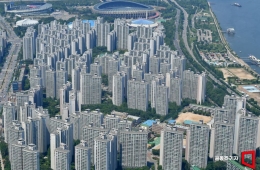
The Olympic Main Stadium at Jamsil Sports Complex in Seoul's Songpa District is undergoing renovations. Under the private investment project to build a large-scale MICE complex and a 30,000-seat domed baseball stadium in the area, the Olympic Main Stadium will be renovated and serve as a temporary replacement for Jamsil Baseball Stadium from 2027 to 2031. Photo by Kang Jinhyung.
View original imageThe MICE (meetings, incentives, conventions and exhibitions) industry is evolving beyond single-function, exhibition-centered venues into a multifaceted infrastructure industry combining performances, sports, hotels, tourism and retail. Analysts say MICE infrastructure development should therefore move beyond simply expanding facility capacity and focus on encouraging visitors to stay longer and spend more.
On Nov. 11, Samjong KPMG published a report titled "The Rise of Korea's MICE Industry: Opportunities in Integrated Infrastructure," which outlines these trends.

According to the report, the global MICE market is projected to grow from $1.2261 trillion (approximately KRW 1,642.4835 trillion) last year to $3.0625 trillion in 2034. This would represent average annual growth of 11% over about nine years, expanding the market to roughly 2.5 times its current size. The market is also expected to reach $1.3422 trillion this year, up 9.5% from the previous year.
The domestic market is also growing. In 2025, South Korea hosted 491 international meetings, a 43.1% increase from the previous year, returning to second place globally after the United States. In particular, the number of international meetings held outside the capital region rose by 93 from the previous year, while their share of all meetings increased by 8.6 percentage points. This signals a shift away from large exhibition centers concentrated in the capital region toward venues integrated with regional industrial and tourism assets.

The report finds that MICE participants' needs are shifting from "attending events" to "networking and experiences." When asked which elements they value more than they did five years ago, convention participants cited interaction (42%) and opportunities to connect with others (40%). The report says this reflects a change in MICE events into spaces where participants can take part directly and enjoy a range of experiences.
Accordingly, the report says MICE infrastructure should evolve by combining hotels and accommodations, retail and F&B (food and beverage) with performances and arenas, sports venues, tourism and leisure, and technology and media.
In South Korea, plans are underway to build or expand at least eight large exhibition centers by 2032, adding more than 270,000 square meters of exhibition space. However, many of these projects are still focused on expanding exhibition facilities. The report recommended expanding the model of combining diverse functions in a single space, as seen in the Jamsil Sports and MICE Complex, a leading example of integrated MICE development.

Samjong KPMG defines integrated MICE infrastructure using the formula "(core factors + expansion factors) x location." Core factors are exhibition and convention facilities, hotels and accommodations, and retail and F&B. Expansion factors are performances and arenas, sports venues, tourism and leisure, and technology and media. Location and accessibility, combined with these elements, determine actual demand and project viability.
Depending on which anchor facilities are combined with these components, integrated MICE infrastructure business models fall into four categories: extended-stay, sports-anchored, urban entertainment and transit-hub models.
Samjong KPMG said this integration could be a key strategy for increasing year-round utilization and profitability at MICE facilities. Combining year-round programming, such as performances, sports, tourism and retail, can attract visitors and generate spending even when no events are taking place.

For construction companies and developers, opportunities may lie not only in new integrated developments but also in repositioning aging or underused assets, such as existing convention centers, stadiums and resorts, as integrated MICE facilities. Operating models that diversify revenue beyond facility rental fees to include hotel, F&B and retail sales, as well as naming rights, sponsorships and advertising, will also be needed.
Investment and financial institutions can expect opportunities in development finance for phased projects, refinancing and equity investment. Investors need to assess the cash flow and operational capabilities of the entire complex, rather than individual facilities, including whether stable revenue sources such as hotels, offices and rentals can offset fluctuations in income from performances and events.
The report also emphasized that governments, local authorities and public institutions should go beyond directly building facilities and create an environment that enables private-sector participation. This means securing land, urban planning and infrastructure such as transportation, while providing appropriate incentives. Outside the capital region, strategies that combine local industries and tourism offerings with MICE to stimulate regional economies are also important, the report said.
Hot Picks Today
 "Two Spend 500,000 Won in a Flash, Yet Wait Two Hours?" ... 'Dreamland' Shunned by Kids and Foreign Tourists
- The Era of Getting 200 Million Won After 30 Years Is Over... A Japanese Bank's "Perpetual Department Head" Who Just Clocked In Cries Out
- Spain Hit by Its Worst Tragedy... Lee Kangin, Moreno and Real Madrid Join Soccer World in Mourning
- They Said, “Make It Your Home for Life” - Then Suddenly Kicked 200 Passengers Off... What Happened to the Around-the-World Cruise?
- "130 Rice Bowls Sold Out in a Day"... 'Unfiltered Face' Adds 8 Million Won to Night Market Sales: China's Bungeunwoo
"The MICE industry's competitiveness is shifting from 'how large an exhibition center you have' to 'how long you can get visitors to stay, connect and spend,'" said Jin Hyeongseok, vice president at Samjong KPMG. "Going forward, integrated infrastructure that brings together hotels, performances and sports, tourism and leisure, and retail in a coordinated way will become the new benchmark for competitiveness."
© The Asia Business Daily. All rights reserved. Unauthorized AI training and use prohibited.