U.S. Core CPI Rises 0.3% for Third Straight Month; Fed Officials Stress Further Tightening (Comprehensive)
Waller: "Consider a 0.5-Percentage-Point Hike in December"
Logan: "At Least Two Rate Hikes Needed"
U.S. 2-Year Treasury Yield Rises to 4.73%
U.S. consumer prices rose more than expected in October, renewing concerns about inflation. Although the rate of price increases slowed from the previous month, underlying price pressures remained strong. Meanwhile, officials with a say in the Federal Reserve's (Fed) interest rate decisions have successively stressed the need for further rate hikes. As a result, markets appear to be pricing in the possibility of a rate hike in December, with the yield on two-year U.S. Treasury notes surging.

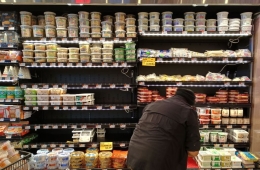
A worker stocks shelves at a supermarket in New York. New York (U.S.) = Correspondent Hwang Yunju.
View original imageThe U.S. Department of Labor said on November 10 local time that the Consumer Price Index (CPI) rose 0.4% from the previous month in October. That was above the 0.3% forecast by economists surveyed by Dow Jones. However, the increase was slower than September's 0.6% rise.
Core CPI, which excludes volatile food and energy prices, rose 0.3% from the previous month, topping the market forecast of 0.2%. Core CPI has risen 0.3% for three consecutive months since August. Analysts say that while price increases have eased somewhat, inflationary pressures are proving difficult to contain.

Processed foods are displayed at a grocery store in Manhattan, New York. New York, U.S. = Hwang Yunju, correspondent.
View original imageAmong the detailed categories, housing costs rose 0.3% from the previous month, accounting for more than 30% of the overall CPI increase. Food prices rose 0.5%, with food at home and dining out up 0.4% and 0.5%, respectively. Energy prices rose 0.7%, a sharp slowdown from the previous month's 5.2% increase.
Among items excluding food and energy, prices for recreation rose 0.8%, motor vehicle insurance premiums rose 0.7%, and education costs rose 0.3%. By contrast, prices for used cars and trucks fell 1.2%.
This CPI report was the last consumer price reading before the year's final regular meeting of the Federal Open Market Committee (FOMC), scheduled for December 8-9. Because the federal government shutdown in October last year prevented the collection of price survey data, year-over-year increases were not provided for most categories in this report.
Waller and Logan Call for Further Tightening; Waller Signals a 50-Basis-Point Hike

Senior Fed officials have also stressed the need for further rate hikes. Shortly before the CPI report was released, Fed Governor Christopher Waller said in a speech at a Bank of England (BOE)-related conference in London that the Fed should raise its benchmark interest rate by at least 0.25 percentage points at the FOMC's regular meeting on December 8-9.
"If core CPI rises 0.3% or more in October, a stronger monetary policy response may be needed," Waller said. "In that case, we should consider a 0.5-percentage-point rate hike at the December meeting."
He added, "Raising the benchmark rate by only 0.25 percentage points could put our credibility at risk, and I do not want to take that risk."
Waller identified rising energy prices and cost pressures stemming from increased investment in artificial intelligence (AI) as causes of inflation. He said it was necessary to examine whether the recent rise in energy prices was being passed on to the prices of goods and services. In particular, he noted that insurance premiums for oil tankers transiting the Strait of Hormuz and the cost of transshipping crude oil were pushing oil prices up by $20 to $30 per barrel.

Lorie Logan, president of the Federal Reserve Bank of Dallas, also cited the need for further tightening. In a speech at Davidson College in North Carolina late last month, Logan had said that the benchmark interest rate should be raised at least twice.
Speaking at a joint energy conference hosted by the Dallas and Kansas City Federal Reserve Banks in Houston, Texas, that day, she said, "Given the current economic outlook, it remains clear that the FOMC should raise interest rates by 0.25 percentage points at least twice."
"The exact pace of rate increases may depend on short-term economic and financial conditions," she said. "This winter, the FOMC may move faster than it did this fall."
She also noted that current monetary policy was not restrictive enough to curb inflation. Logan estimated that the current federal funds rate target range was at least 0.5 percentage points below the level that would moderately restrain economic activity and return inflation to its target.

"Tighter monetary policy is needed to strike the right balance between the inflation and employment outlooks and the risks surrounding them," she said, stressing that "it is important to reach that balance quickly." She warned in particular that "the longer inflation remains above target, the greater the risk that it will become entrenched in the behavior of economic actors."
Logan said inflationary pressures persisted across a broad range of sectors, including services prices, in addition to the rise in energy prices caused by the war in the Middle East.
She noted that in September, the core Personal Consumption Expenditures (PCE) price index, which excludes food and energy, rose 3.1% year over year, while core services prices excluding housing and transportation rose 3.2%. She said underlying price pressures may not ease easily even if temporary shocks, such as rising energy prices, subside.
Hot Picks Today
 "Two Spend 500,000 Won in a Flash, Yet Wait Two Hours?" ... 'Dreamland' Shunned by Kids and Foreign Tourists
- The Era of Getting 200 Million Won After 30 Years Is Over... A Japanese Bank's "Perpetual Department Head" Who Just Clocked In Cries Out
- Spain Hit by Its Worst Tragedy... Lee Kangin, Moreno and Real Madrid Join Soccer World in Mourning
- They Said, “Make It Your Home for Life” - Then Suddenly Kicked 200 Passengers Off... What Happened to the Around-the-World Cruise?
- "130 Rice Bowls Sold Out in a Day"... 'Unfiltered Face' Adds 8 Million Won to Night Market Sales: China's Bungeunwoo
Meanwhile, markets reacted immediately to the higher-than-expected CPI reading and hawkish comments from Fed officials. The two-year Treasury yield, which is sensitive to monetary policy, rose by more than 0.1% that day to 4.731%.
© The Asia Business Daily. All rights reserved. Unauthorized AI training and use prohibited.