"Wait for 'This Moment' to Buy KOSPI"... Brokerage Sees Rebound Potential to 7,100
KOSPI plunges 44.5% in 93 trading days
Corporate net income forecasts revised up 9.7% in a month
Forward PER at 3.54, its lowest since 2001
Semiconductor undervaluation comes into focus... Potential rebound to 7,100
Following the U.S. midterm elections, concerns over regulations on artificial intelligence (AI) data centers coincided with foreign selling, sending the KOSPI tumbling below the 5,000 mark. However, as corporate earnings forecasts were revised upward, analysts described the current market as a classic “undershooting” phase, in which stock prices have fallen excessively relative to fundamentals. They viewed levels below 5,300 as excessively undervalued and presented them as an opportunity to buy in stages. They also said the index could recover to 7,100 if corporate earnings forecasts hold.

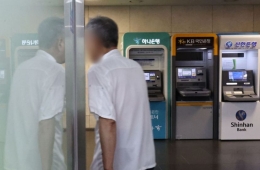
The domestic stock market was shown on an electronic board in the dealing room at Hana Bank's headquarters in Jung-gu, Seoul, on the 6th, after the KOSPI plunged more than 8% shortly after opening, triggering a circuit breaker.
View original imageFaster plunge than during the Asian financial crisis... Down 44.5% in 93 trading days
On November 6, the KOSPI closed at 5,059.69, down 11.7% from the previous week. It fell as low as 4,911.28 intraday, triggering a circuit breaker. Compared with its June 22 peak, the index had fallen 44.5% in 93 trading days.
Daishin Securities analyzed 10 instances since 1980 in which the KOSPI fell more than 30% from its peak and found that the median decline was 44.5%. However, it took 109 trading days to reach the same level of decline during the 1997 Asian financial crisis and 240 trading days during the 2008 global financial crisis. This indicates that the current decline has been faster than those during major past crises.
Earnings outlook improves... PER at 3.54, its lowest since 2001
In a report on November 9, Lee Kyung-min, a researcher at Daishin Securities, described levels below 5,300 on the KOSPI as a range in which stock prices had fallen excessively relative to corporate earnings. “Below 5,300, earnings are rising while prices alone have collapsed,” he said, calling it an opportunity to increase portfolio exposure.
Indeed, forecasts for the next 12 months' net income at KOSPI-listed companies were revised upward by 9.7% over the past month. Fourth-quarter operating profit forecasts also rose from KRW 264 trillion to KRW 290 trillion. Meanwhile, the KOSPI fell 44.5% from its peak, while 12-month forward earnings per share (EPS) increased 32.9% over the same period, from 1,075 points to 1,429 points.
The gap between stock prices and earnings forecasts was also reflected in valuations. The KOSPI's 12-month forward price-to-earnings ratio (PER) fell from 8.5 to 3.54, its lowest level since 2001. The price-to-book ratio (PBR) also fell below 1, to 0.95. Daishin Securities calculated that the index level corresponding to a forward PBR of 1 is around 5,330. Since the current index is below that level, it is undervalued even compared with book value, the firm said.
Prioritize semiconductor investments... KOSPI could reach 7,100 if valuations recover
Daishin Securities also cited past rebounds following sharp declines as a basis for investment decisions. In cases where the KOSPI fell more than 30% from its peak before forming a bottom, median returns afterward were 31.2% over three months, 40.7% over six months, and 60.3% over 12 months. Among cases in which investors bought when the index was down 40% from its peak, the KOSPI was higher 12 months later in 80% of them.
The firm also forecast that the KOSPI could rise to around 7,146 if its forward PER recovered from the current 3.54 to around 5. However, this estimate assumes that corporate earnings forecasts remain unchanged.
Semiconductors topped the list of promising sectors. The forward PERs of Samsung Electronics and SK hynix had fallen to 2.67 and 2.2, respectively. In the first week of November, foreign investors were net sellers of KRW 7.7 trillion worth of shares in the semiconductor sector alone. Daishin Securities said that if selling pressure eases, large-cap semiconductor stocks could lead a rebound. Other sectors it highlighted included IT hardware, machinery, shipbuilding, energy, trading companies, capital goods, and IT appliances, as well as transportation, insurance, and retail, where earnings forecasts have improved.
Foreign investor flows and AI credit concerns pose risks... Wait and see if the index falls below 4,600
The factors that will determine whether the market rebounds are an easing of foreign selling and a reduction in credit concerns surrounding AI-related companies. Major U.S. economic indicators and corporate earnings are also expected to influence the market's direction. The U.S. Consumer Price Index (CPI) is due on November 10, followed by earnings reports from CoreWeave on November 11, Applied Materials on November 13, and NVIDIA on November 18.
Daishin Securities presented 4,800–5,065 as its base-case range for the KOSPI's mid-November low. It said the index could fall to 4,580–4,670 if foreign investors continue selling, or to 4,050–4,250 if AI investment itself is scaled back.
Hot Picks Today
 "Two Spend 500,000 Won in a Flash, Yet Wait Two Hours?" ... 'Dreamland' Shunned by Kids and Foreign Tourists
- The Era of Getting 200 Million Won After 30 Years Is Over... A Japanese Bank's "Perpetual Department Head" Who Just Clocked In Cries Out
- Spain Hit by Its Worst Tragedy... Lee Kangin, Moreno and Real Madrid Join Soccer World in Mourning
- They Said, “Make It Your Home for Life” - Then Suddenly Kicked 200 Passengers Off... What Happened to the Around-the-World Cruise?
- "130 Rice Bowls Sold Out in a Day"... 'Unfiltered Face' Adds 8 Million Won to Night Market Sales: China's Bungeunwoo
Researcher Lee advised investors to increase their exposure through staged purchases below 5,300 on the KOSPI, but to stop buying and reassess market conditions if the index closes below 4,600. He expected a breakout above and consolidation around 6,000 to mark a turning point into the next upward phase.
© The Asia Business Daily. All rights reserved. Unauthorized AI training and use prohibited.