Lee: "External Environment to Change After U.S. Midterms... South Korea and U.S. Must Broaden Communication"
Calls for diversified diplomacy after U.S. midterm elections
Urges expanded outreach to state governments and the business community
Criticizes resistance to eviction orders and redevelopment holdouts: "Why allow illegal holdouts?"
Appears aimed at Pastor Jeon Gwang-hoon and Sarang Jeil Church
Orders all ministries to investigate; tells prime minister to report within one to two weeks
Calls for fast-tracked public institution reform; warns livelihood-related offenders: "Get caught and face ruin"
On Nov. 10, President Lee Jaemyung instructed officials to expand diplomatic and economic cooperation networks to include the U.S. Congress, state governments and the business community, in response to changes in the external environment following the U.S. midterm elections. He also ordered a nationwide investigation into cases involving interference by force with the lawful enforcement of the law or continued illegal activity, including the “holdout” tactics used by Pastor Jeon Gwang-hoon’s Sarang Jeil Church at a redevelopment site, and told officials to report their findings within one to two weeks.

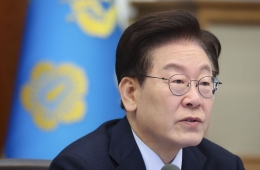
President Lee Jaemyung speaks during a Cabinet meeting at Cheong Wa Dae on Nov. 10, 2026. Yonhap News.
At the 48th Cabinet meeting, which he chaired that day at the Sejong Hall of Cheong Wa Dae, President Lee said, “Various changes in the external environment are expected following the U.S. midterm elections.” He added, “Relevant ministries should analyze the various anticipated variables from multiple angles and carefully prepare response plans for each scenario.”
In particular, he called for broadening the foundation for South Korea-U.S. cooperation beyond the executive branch to include Congress, state governments and the business community. “What matters most is concentrating our diplomatic efforts on building and broadening the foundation of trust and cooperation between the two countries from a mutually beneficial perspective,” President Lee said. “While continuing close coordination with the U.S. administration, we should also establish a bipartisan basis for cooperation in the U.S. Congress and broaden communication with state governments and the business community.”
The remarks are seen as a response to the shift in the balance of power between the Trump Administration and Congress after the Democratic Party secured majorities in both the House and Senate in the U.S. midterm elections on Nov. 3. The government plans to maintain its policy of cooperation with the U.S. administration while securing bipartisan support in Congress to strengthen its ability to address trade, investment, diplomatic and security issues. President Lee said, “We must pool our wisdom to robustly protect our national interests and corporate investments while ensuring that agreements reached by the two countries in diplomacy and security are properly implemented.”
He also called for close monitoring of the United States and the global economic situation, stronger financial market monitoring and rapid response systems, and enhanced competitiveness in key strategic industries such as semiconductors and artificial intelligence (AI). “The greater the uncertainty in international affairs, the more important it is to balance consistent principles with flexible responses,” President Lee said. “Without being swayed by every change, I will devote all our capabilities to practical diplomacy that serves the national interest and governance that prioritizes people’s livelihoods.”
He also ordered a rigorous investigation into illegal activities that undermine law enforcement. Citing cases in which people physically obstructed the execution of eviction orders issued through legal procedures during redevelopment, or delayed projects for years through so-called “holdout” tactics, he criticized the reality that illegally resisting enforcement can lead to economic gains. As President Lee had personally raised the issue of Sarang Jeil Church’s “holdout” tactics at a redevelopment site in Jangwi-dong, Seoul, on Nov. 4, his remarks that day appear to have targeted cases in which Pastor Jeon Gwang-hoon’s side obstructed eviction enforcement.
“There are groups that profit by breaking the law. In redevelopment projects, they use force to resist eviction enforcement for years, causing enormous damage, or engage in so-called holdout tactics. In the end, it seems to work,” President Lee said. “When people see this, wouldn’t they think, ‘If you’re strong, you can just hold out; what does the law matter? The law is on the side of the strong’?”
“Why do we leave things like that unchecked?” he asked, then instructed officials to “check all cases nationwide of people persistently engaging in illegal activities or denying the lawful order, and report on them.”
He specifically named the police, the Ministry of the Interior and Safety, the Ministry of Justice and other relevant agencies, and called for a comprehensive picture of illegal activities currently being handled separately by different ministries. After citing a past case involving the removal of illegal structures in valleys, he said that allowing illegal activities to go unchecked leads to distrust in the government. He instructed Prime Minister Han Seongsook to compile relevant cases and investigation results from across the country and “report back within one to two weeks.”

President Lee Jaemyung speaks during a Cabinet meeting at the Blue House on Nov. 10, 2026. Yonhap News Agency
View original imageHe also issued a strong call for the restructuring of public institutions. Citing the sweeping transformation of industrial structures and balanced regional development, President Lee said, “Reforming the public sector is a key national and generational task that can no longer be postponed.” He stressed that “under no circumstances should the interests of individual organizations obstruct reforms for the benefit of the people and the community as a whole.” He added that “speed is the key to the success or failure of reform” and called for groundbreaking incentives to drive swift restructuring.
Since the government announced plans to merge and consolidate public institutions on Sept. 3, opposition has emerged from several organizations. The heads of three institutions under the Ministry of Education—the Northeast Asian History Foundation, the Academy of Korean Studies and the Institute for the Translation of Korean Classics—publicly expressed concern that a merger would undermine their expertise and independence. The plan to transfer the Korea Disabled Entrepreneurs Association Support Center to the Korea Employment Agency for Persons with Disabilities under the Ministry of Employment and Labor has also faced opposition from disability groups. In addition, opposition has been voiced both inside and outside the organizations over the proposed consolidation of the four port authorities, the Korea National Oil Corporation and the Korea Gas Corporation, and the Korea Employment and Labor Educational Institute and the Korea Labor Foundation.
He also called for a government-wide response to crimes that harm people’s livelihoods. President Lee stressed the need for a strong response to crimes targeting vulnerable groups, including relationship-based crimes and random-motive crimes, as well as online scams, drugs, illegal private lending and fake news. “We must respond firmly to structural unfairness and corruption rooted in unfair advantages and privilege, such as illegal real estate activities and local corruption, so that people understand that breaking the law will lead to ruin,” he said.
Hot Picks Today
 "Two Spend 500,000 Won in a Flash, Yet Wait Two Hours?" ... 'Dreamland' Shunned by Kids and Foreign Tourists
- The Era of Getting 200 Million Won After 30 Years Is Over... A Japanese Bank's "Perpetual Department Head" Who Just Clocked In Cries Out
- Spain Hit by Its Worst Tragedy... Lee Kangin, Moreno and Real Madrid Join Soccer World in Mourning
- They Said, “Make It Your Home for Life” - Then Suddenly Kicked 200 Passengers Off... What Happened to the Around-the-World Cruise?
- "130 Rice Bowls Sold Out in a Day"... 'Unfiltered Face' Adds 8 Million Won to Night Market Sales: China's Bungeunwoo
President Lee also addressed how Cabinet members should approach the regular session of the National Assembly. They should actively accept legitimate criticism of government policies while confidently rebutting claims that lack evidence. “Looking from a critical perspective or from the opposing side can reveal problems that were not previously apparent,” President Lee said. “We should accept such feedback with gratitude and make corrections where needed.” However, he said, “Confidently rebut baseless claims,” warning that an invariably defensive response could lead people to believe the government was at fault.
© The Asia Business Daily. All rights reserved. Unauthorized AI training and use prohibited.